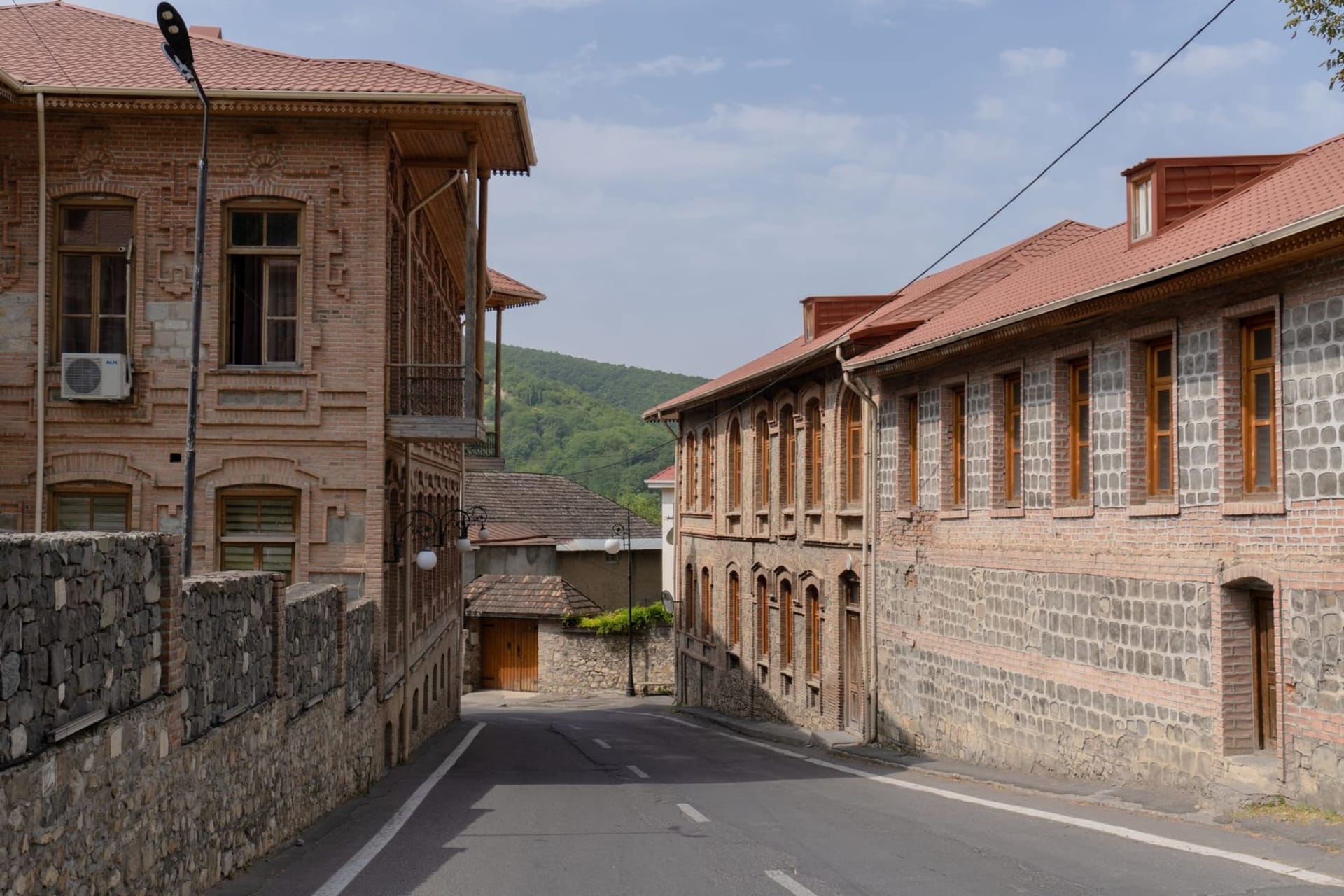
A Silk Road gem in the Caucasus foothills, famous for its Khan's Palace of intricate shebeke stained glass.
The road into Sheki drops through walnut forests so dense the light goes green and cool, and by the time the city materializes in the valley below — terracotta rooftops pressed against the Caucasus foothills, minarets needling the sky — I had already forgotten that Azerbaijan existed on a map. We arrived in late afternoon, when the air smelled of dried herbs and something sweet from a halva stall near the bus station on Heydar Aliyev Street, and I knew we weren’t moving on quickly.
The Palace and Its Windows
The Khan’s Palace — Sheki Xan Sarayı — is what everyone comes for, and it earns every kilometer of the journey to reach it. Built in 1762 without a single nail, it is a single two-storey pavilion that seems too small for its reputation until you step inside and the light hits. The windows are shebeke: thousands of hand-cut fragments of colored glass fitted into intricate geometric frames without glue or metal, the entire structure held by the physics of tension and precision alone. On a clear morning, the interior wall becomes a projection of amber, blue, and rose that moves as the sun moves. I stood there for longer than I could account for. Lia had to come find me.
The frescoes covering every surface — hunting scenes, battle tableaux, vases of flowers in impossible colors — were restored in the Soviet era and look almost too vivid, but up close you can see the original brushwork beneath, the older, quieter layer.
The Old Town and What I Didn’t Expect
The Yukhari Caravanserai, a sixteenth-century merchants’ inn just outside the palace gates, now houses a hotel and a handful of carpet workshops where old men work looms in near silence. I had read about it but expected it to be decorative, a thing to photograph. What I didn’t expect was being invited in for tea by a weaver named Tural, who spread out three kilims on the stone floor and spent forty minutes explaining the regional patterns — the pomegranate motifs specific to Sheki, the border styles that place a carpet within a single village’s tradition. We bought nothing but left knowing more than we had any right to.
The bazaar streets near Karvansara Square sell the local specialties: piti, a lamb and chickpea soup cooked in individual clay pots that arrive at the table sealed, the fat pooled on top; and Sheki halva, not the sesame paste of the Middle East but a dense, layered pastry of rice flour, butter, saffron, and nuts that dissolves into something between shortbread and a dream.
Up Into the Foothills
A marshrutka runs from the city center toward Kish, six kilometers north, where a twelfth-century Albanian church sits on a hillside in astonishing quiet. The church predates Islam in the Caucasus and is small enough to feel human-scaled. The drive there passes through orchards of apple and pear, and the road smells of woodsmoke even in summer.
When to go: May through June, or September into October — the foothills are green in spring and gold in autumn, temperatures are mild, and the walnut harvest in October fills the markets with something almost ceremonial.