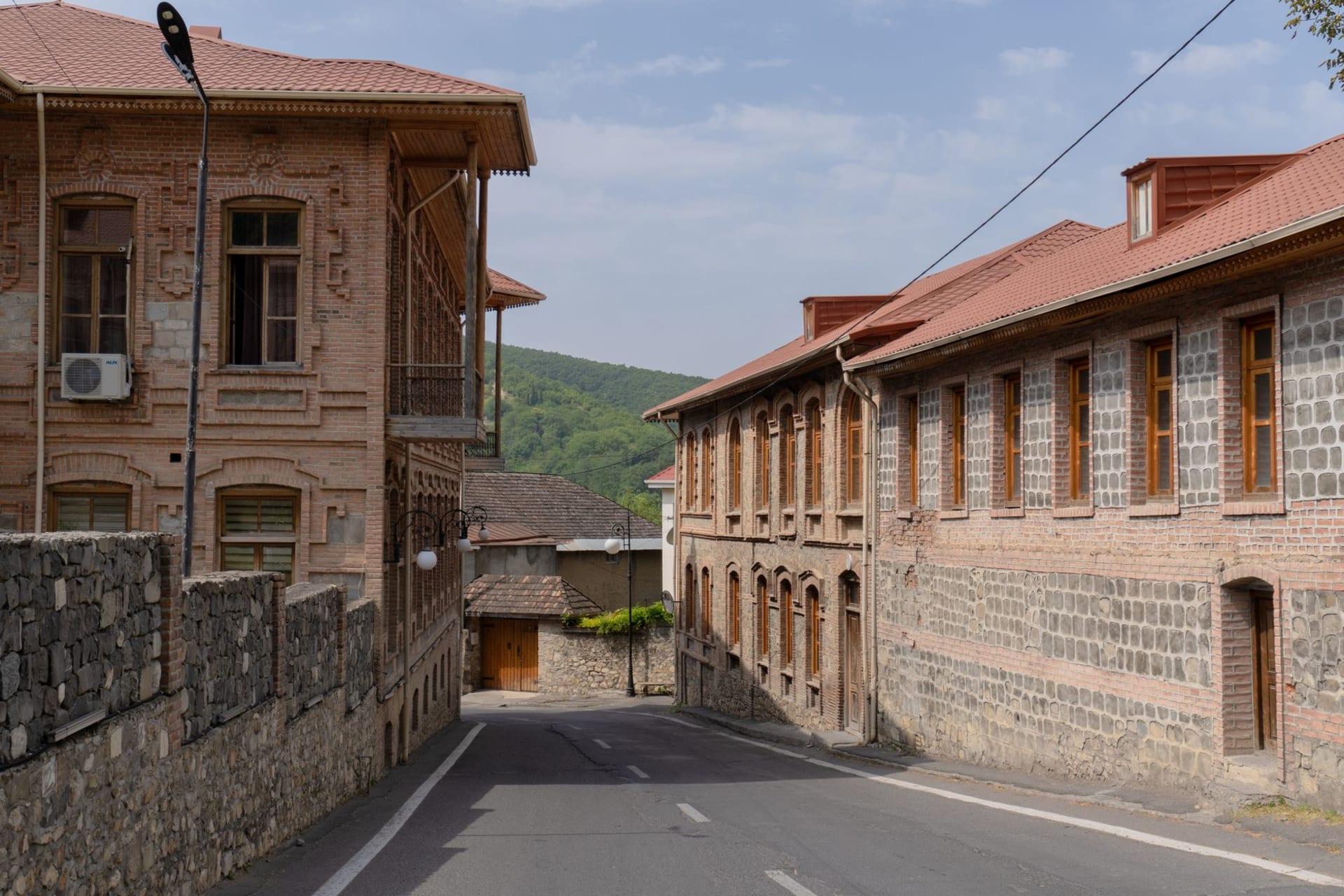
Shamakhi
"Every building in Shamakhi has been rebuilt at least twice. The wine, though, is continuous."
Shamakhi has been the capital of the Shirvan khanate, a major stop on the Silk Road, and the victim of earthquakes catastrophic enough to reroute history. The 1902 quake leveled much of what had survived everything else. What stands now is a layered reconstruction: old stones, Soviet additions, recent renovation, and underneath all of it the memory of a city that was once one of the great trading posts between the Caspian and the Mediterranean. I arrived knowing roughly this much and spent two days feeling the weight of it.
The Madrasa Grape
Azerbaijan’s wine story is being told mostly in Shamakhi and the Shirvan plateau now, which is interesting given that the country spent several dry Soviet decades without a functioning winemaking culture to speak of. What’s being recovered — slowly, in small quantities — is something more specific than generic Caucasian red. The Madrasa grape is indigenous, grown here for at least a millennium, and it produces wines that are genuinely unlike anything I’d had before: deeply colored, tannic, with a dried-fruit quality that’s almost like a very old-world Rhône but not quite that either.
A small family-run winery a few kilometers south of town let me taste through three vintages of the same wine on a wooden table in the shade of a vine pergola. The winemaker, a young man who had studied in France before coming back, talked about the grape with the focused attention of someone still figuring something out. I bought two bottles that I had to carry very carefully on the bus back to Baku, which I considered the appropriate price.
The Juma Mosque and What Earthquakes Leave
The Juma Mosque of Shamakhi dates its founding to the eighth century, though almost nothing from the original structure survives. What stands now is mostly nineteenth-century stone, rebuilt after the 1859 earthquake, restored again after 1902, and again after Soviet neglect. The courtyard is quieter than you’d expect from a site of this age and significance. I sat on a bench in the shade and watched the afternoon light move across the stone, which had been worn smooth in some places by hands and feet over centuries.
Across town, a hilltop cemetery holds carved stone grave markers — some Islamic, some older in their iconography — that predate the mosque’s current form. The carvings include hunting scenes, botanical patterns, inscriptions in several scripts. It’s the kind of place that rewards slow attention rather than the quick photograph.
The Plateau Above Town
The road east from Shamakhi climbs onto a plateau of dry grassland and limestone with views that extend, on clear days, to the shimmer of the Caspian fifty kilometers away. Shepherds move flocks across this terrain in autumn, and the highway — such as it is — passes through a sequence of villages where the pace of life appears to have stabilized somewhere around 1975 and found no particular reason to update.
I rented a car for half a day, which I recommend. The public transport options are limited and the best things — a ruined caravanserai just off the plateau road, a village bakery I found by smell — are not on any map I had.
The town itself is compact enough to walk in an afternoon. The combination of landscape, wine, and an honestly complicated history makes Shamakhi one of the most interesting half-day drives from Baku, and one of the more undervisited stops in a country that is, in general, undervisited.
When to go: September and October for the grape harvest and cooler plateau temperatures. May and June for green hillsides and mild weather. The plateau road can be driven year-round but becomes treacherous in ice; winter visits are for the hardy.