Nakhchivan
"To reach Nakhchivan from Baku you fly over Armenia, a detail the flight map prefers not to illustrate."
Getting to Nakhchivan requires a flight — from Baku, overflying the country that has blocked the land route since 1991. The flight takes forty-five minutes. On the descent you see a landscape that is immediately legible as different: drier, more austere, the mountains to the south carrying the particular bareness of the Iranian plateau. I landed feeling I had arrived somewhere that had been testing its own self-sufficiency for a long time, and had come to understand that quality as identity.
The Momine Khatun Mausoleum
The reason most people come, if they come at all, is a tomb built in 1186. The Momine Khatun mausoleum rises from the edge of the city in ten-sided brick, twenty-six meters of Seljuk geometry that architects have been studying for eight hundred years. The brickwork is extraordinary — not inert but almost kinetic, the diamond-patterned surface creating a rotation effect as you walk around it, the form narrowing toward a conical crown that catches the light differently by the hour. The architect was Ajami Nakhchivani, the same man responsible for the slightly older Yusuf ibn Kuseyir mausoleum nearby, and together they constitute one of the most significant surviving bodies of Seljuk architectural work in the world.
I arrived at the mausoleum at around four in the afternoon, when the low sun hit the brick at an angle that made the diamond pattern seem to vibrate. A small group of schoolchildren was there with a teacher. I circled the building three times. The schoolchildren left. I kept circling.
The Alinja Fortress and Salt Mountains
The medieval fortress at Alinja sits at 1,800 meters, carved into a rock formation above a river gorge, and held out against Timur’s forces for fourteen years in the late fourteenth century. The approach involves a steep climb — chains installed in the vertical sections, which I used without shame — and at the top you get battlements, sheer drops, and views into Iran. The air at that altitude had a cold clarity even in late June.
West of the city, the Duzdağ salt mountain is surreal: pink and orange salt strata exposed in a cliff face, with a salt mine inside that has been used as a therapeutic facility since the Soviet period. There are hotel rooms carved into the salt itself, for people with respiratory conditions. I walked the tunnels for an hour. The air tasted metallic and clean.
A City That Knows How to Wait
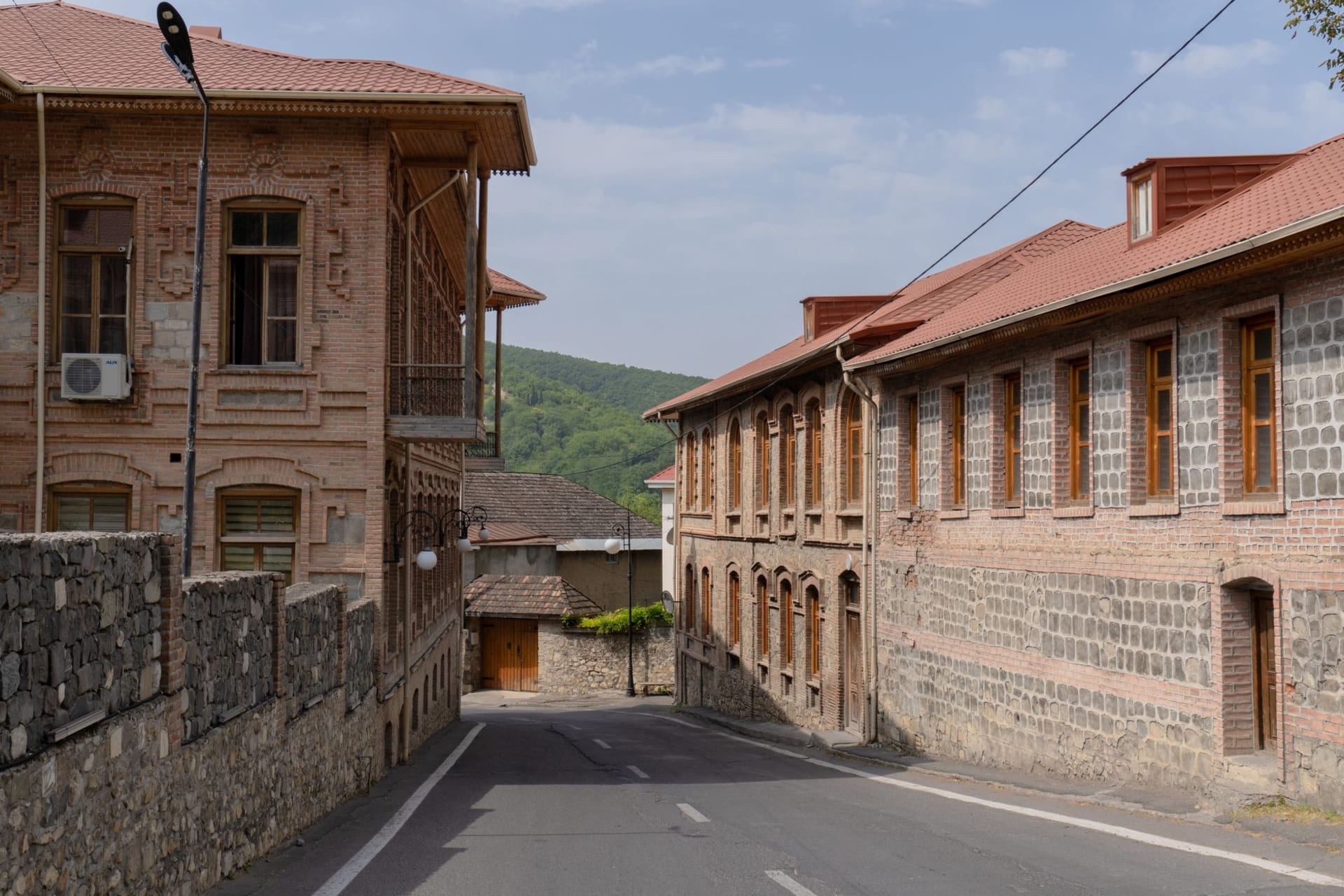
Nakhchivan city itself has the quality of somewhere that has learned to exist on reduced terms and has stopped resenting it. The markets are well-stocked through Iran, whose border is open and active. The bread — lavash pulled from tandir ovens, eaten immediately — is as good as any I had in Azerbaijan. The old part of the city has a quietness that feels cultivated rather than neglected.
I had tea in a chaikhana where the television was showing Iranian news, which reminded me that the border with Iran is a five-minute drive from where I was sitting, and that orientation here is south and west, not east toward Baku. Nakhchivan operates on its own internal logic. The blockade is an inconvenience it has converted into a personality. I found that more interesting than anything I was prepared for.
When to go: April through June for mild temperatures and green hillsides before the summer drought. September and October are also excellent — harvest season, cooler air, light that flatters the brick on the old monuments. July and August are hot and dry. Winter can be cold but the monuments are striking in snow.