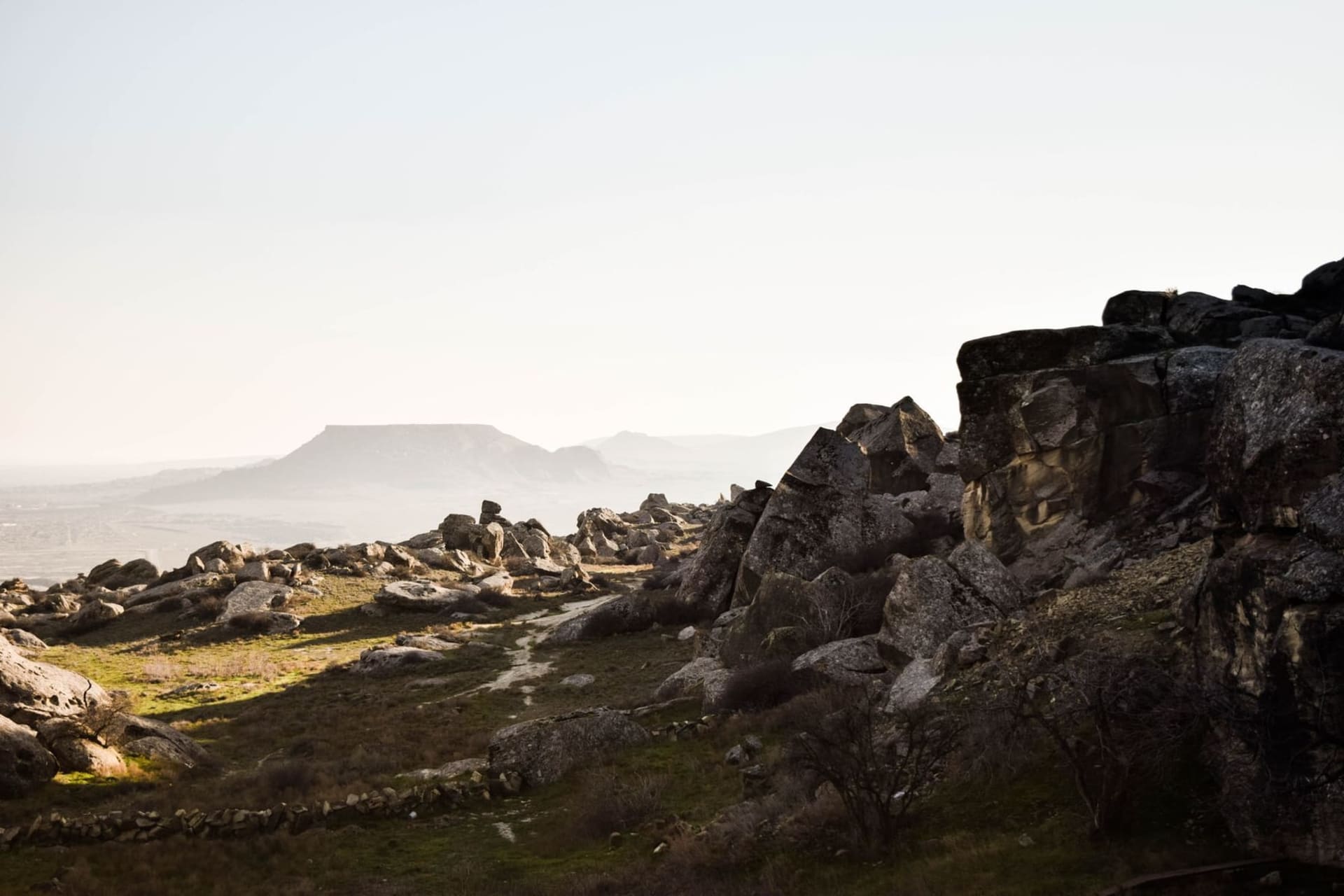
20,000-year-old rock carvings and bubbling mud volcanoes in a lunar landscape south of Baku.
The taxi driver kept glancing in the rearview mirror as he explained, in a mix of Russian and gestures, that the mud volcanoes ahead were nothing — just little ones. He had seen bigger ones swallow goats. I was not sure if he was joking. The road south of Baku narrowed into a two-lane strip cutting through bleached semi-desert, the Caspian already behind us, the land turning pale and lunar as if the planet had given up on color.
Carvings at the Edge of Memory
The Gobustan State Historical-Artistic Reserve sits about 65 kilometers south of Baku, and the entrance feels deceptively modest — a small museum, a parking lot, a few tour groups photographing each other. But then you walk into the rock field itself and the scale of what you are looking at begins to press down on you. More than 6,000 petroglyphs carved across these boulders by people who lived here between 5,000 and 20,000 years ago. Bulls. Deer. Boats. Human figures mid-dance, arms raised, caught forever in a gesture no one living can fully interpret.
Lia crouched in front of a panel of boat carvings and said nothing for a long time. The boats are the ones that stop you — this is arid scrubland now, the Caspian kilometers away, but when these were carved the shoreline came this far inland. Someone stood here and drew what they saw: water, vessels, the logic of a world that no longer exists.
A Roman inscription on one boulder — left by a centurion from Legio XII Fulminata, dated 95 AD — felt almost too convenient, like a footnote the landscape had planted to remind you that every era of humans passes through and leaves its mark.
Mud Volcanoes and Wrong Expectations
I had expected the mud volcanoes to be dramatic. They are not, and that is what makes them strange. The ones near Gobustan — particularly the cluster on the road toward Alat — are low, grey, barely knee-high cones that burp cold mud with the rhythm of something breathing. No heat. No sulfur. The mud is thick and silvery and arrives at the surface with a sound that is genuinely difficult to describe: a soft pop, a wet exhale, a small implosion.
The surprise was stepping too close to one and feeling the ground shift slightly underfoot — the crust thin, the whole field subtly alive. The driver, who had followed us out of the car, laughed and pulled me back by the sleeve.
We ate back in Baku that evening: lamb piti in a clay pot at a restaurant near Fountain Square, the broth poured separately, the meat falling apart. The flatness of the landscape was still sitting somewhere behind my eyes.
When to go: Spring (April to May) and autumn (September to October) offer the most bearable temperatures — summer heat in this exposed terrain is punishing, and the mud volcanoes are more active and photogenic after rain.