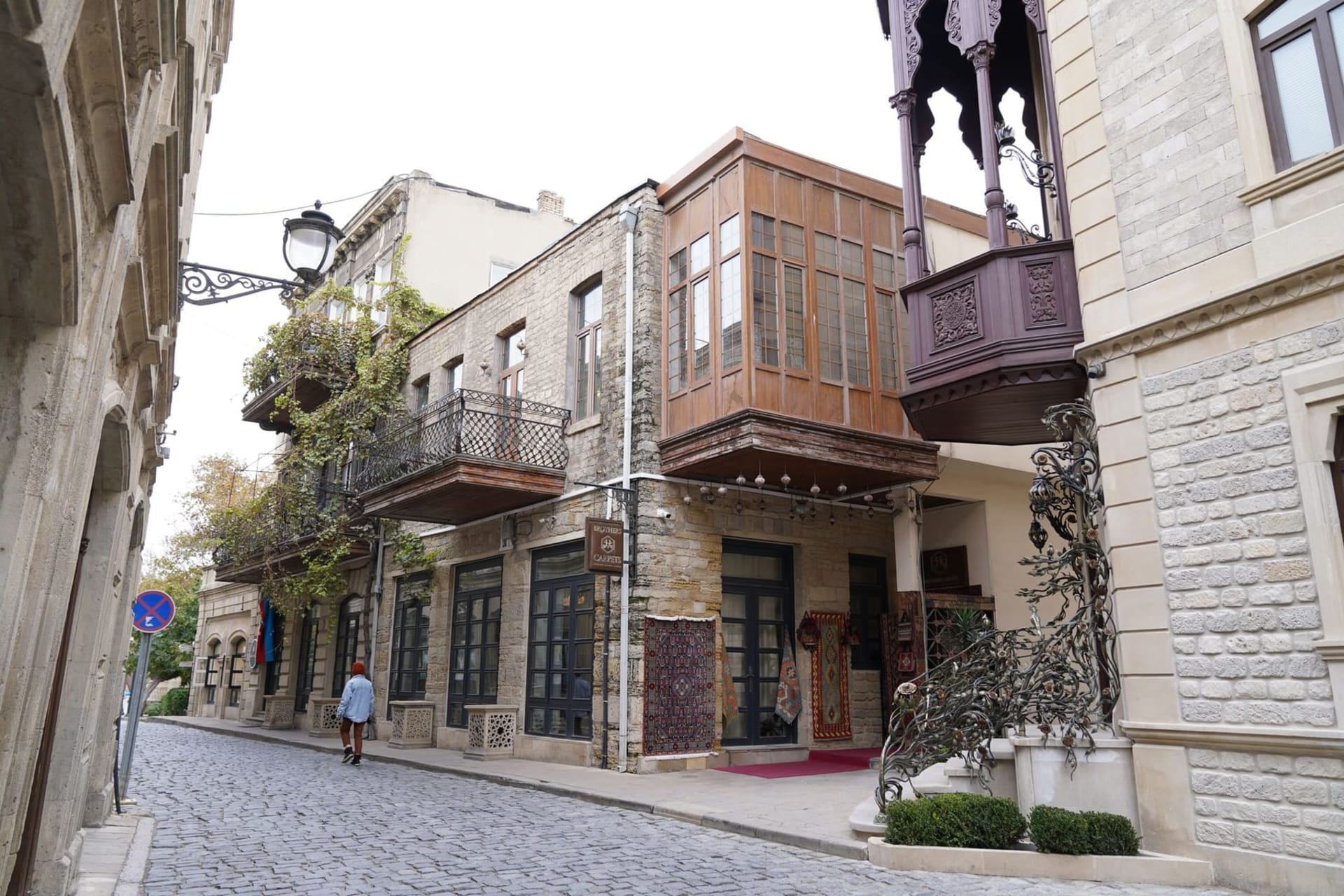
Icheri Sheher — Baku's walled medieval inner city, a UNESCO labyrinth of caravanserais and narrow stone alleys.
The gate on Gosha Gala Darvaza opens without ceremony — just a worn stone arch you pass through and suddenly the noise of central Baku drops away behind you. The walls of Icheri Sheher don’t announce themselves. They simply absorb you.
Stone and Saffron
The alleyways inside are not picturesque in the curated sense. They are lived-in, slightly complicated, full of contradictions — a satellite dish mounted on a twelfth-century parapet, a woman hanging laundry from the same window frame that once watched Silk Road merchants negotiate below. I followed the main artery past the Palace of the Shirvanshahs and its hexagonal mausoleum, where the carved stone filigree above the portal is fine enough to look like lace. The light at noon falls hard and direct, bleaching the limestone to the color of old bone.
We stopped for piti at a tiny place near Kichik Qala Street — the lamb and chickpea soup arrives sealed under a disc of dough that you tear open yourself. The steam that escapes smells of saffron and dried fruit and something darker underneath, like the stone walls themselves had been simmered into the broth. Lia ordered seconds without looking at the menu.
The Unexpected Underground
The surprise came late on our second afternoon. Wandering off the tourist circuit near the caravanserai on Asaf Zeynalli Street, I noticed a low wooden door held open by a brick. Below street level, lit by a single bare bulb, an old man was restoring a kilim across the full width of what had once been a stable or warehouse — the ceiling still held the old stone vaulting. He didn’t stop working when I appeared. He nodded at the rug as if to say: look, not at me. The pattern was geometric, deep red and ivory, and his hands moved across it with the unhurried confidence of someone who had done this for forty years. I stood there longer than was reasonable.
Maiden Tower at Dusk
The Qiz Qalasi — the Maiden Tower — is best at the end of the day, when the tour groups thin out and the light on the Caspian goes flat and golden behind it. No one is entirely sure what it was built for. The theories are many. I find that more interesting than an answer would be.
When to go: April through early June offers mild temperatures and clear skies without the midsummer heat that radiates off Icheri Sheher’s stone. October is equally good — the city quiets after the tourist season and the evening light turns the old walls amber.