Achensee
"The lake appeared through the pines like a rumor that turned out to be true."
The Achenseebahn departs from Jenbach station on a track parallel to the main line and then immediately begins climbing. It is the oldest steam rack railway in Austria, opened in 1889, and it has not felt the need to update its fundamental character since. The carriages are wooden, the locomotive pushes from behind rather than pulling from ahead because rack railways work this way, and the gradient through the pine forest above Jenbach is steep enough that you grip the armrest not because you are worried but because the body insists. The journey takes thirty-five minutes. You smell the steam before you see the lake.
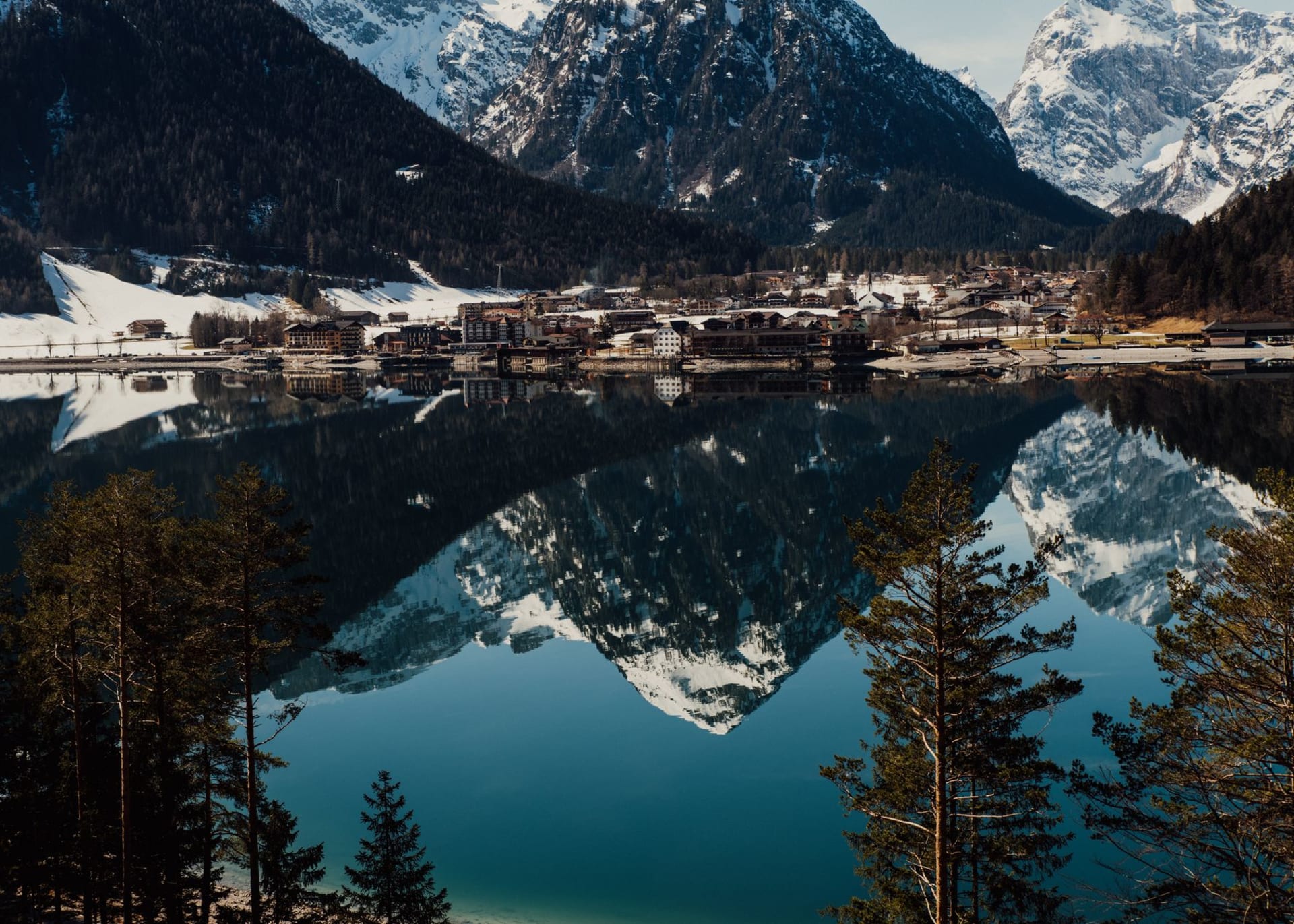
The Achensee appears between the trees with very little warning — a flash of blue, then a wider opening, then suddenly the full lake, four kilometers wide at its broadest and so intensely turquoise in certain lights that it looks like the kind of color a marketing department would choose and then be told was too unrealistic. It sits in a deep trough between the Karwendel mountains to the west and the Rofan massif to the east, sheltered enough to generate its own microclimate and large enough to have its own wind patterns that make sailing genuinely interesting. The Rofen, the prevailing southerly that runs up the lake in the afternoons, is what the sailing school at Pertisau has been teaching students to read since the 1950s.

Pertisau, on the western shore, is the village I keep returning to. It is not the largest settlement on the lake — that would be Maurach at the southern end — but it sits at the point where the Karwendel mountains come closest to the water, the cliffs dropping into the lake at gradients that make the reflection look almost vertical. The village has a handful of guesthouses, a brewery that produces a very decent Zwickelbier, and a morning rhythm organized around the ferry schedule. The lake ferries, operated since 1887, connect the villages along both shores on a timetable that suggests no particular hurry, which suits the lake perfectly. I took the ferry from Pertisau to Achenkirch at the northern end one afternoon and spent the crossing watching the Rofan cliffs slide by to the east, their limestone faces going pink in the late light.
The water temperature is cold by most standards — rarely above 22 degrees even in August — and clear in a way that you notice by looking down from the dock rather than through any signage about clarity. I swam at the Pertisau beach on an August morning before the day-trippers arrived from Innsbruck, and the cold was specific and bracing in the way that alpine lake cold is: not the shock of sea swimming but something more deliberate, the water having come off the snowfields above and taken time to settle but not to warm. I got out after twenty minutes because my hands had stopped cooperating. I would do it again immediately.

The Rofan cable car from Maurach rises to 1,838 meters above the lake and provides a view back down that takes a moment to process: the lake becomes a blue-green line in the valley below, the Inn valley visible to the south beyond the ridge, and on clear days the central Tyrolean Alps extending in every direction to a horizon that makes the planet feel very large. The Rofan hiking area above the cable car station has marked trails ranging from easy plateau walks to technical ridge routes, and the Gschöllkopf summit at 2,049 meters is reachable in a moderate two hours. I ate lunch at the Erfurter Hütte mountain hut above the cable car on a Tuesday when the only other guests were a group of Austrian school children on a field trip who were, on balance, more enthusiastic about the views than their teacher had expected.
When to go: June through September for swimming and lake activities, with July and August warmest. The Achenseebahn runs on steam traction on certain summer weekends — worth timing your visit around if you care about such things. October is quiet and the Rofan colors well.