Imilchil
"The road to Imilchil is one of the great arguments for having no particular destination."
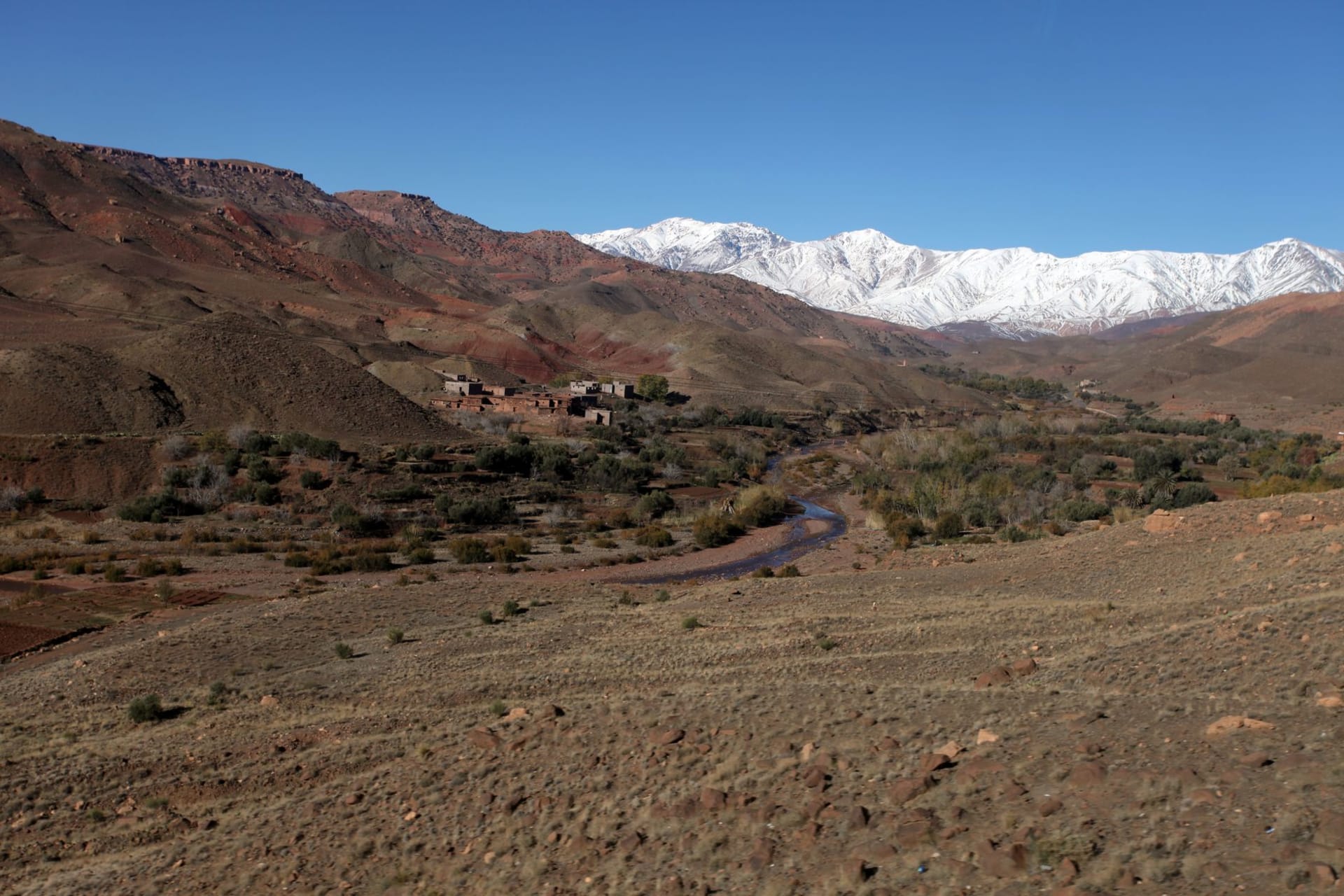
Getting to Imilchil is itself the first half of the experience. The road — calling it a road is generous for most of its length — climbs from the Todra Gorge into the Plateau des Lacs through a sequence of switchbacks that would constitute a significant mountain pass in most countries but that Moroccan maps render as a thin yellow line with no particular notation. I drove it in a rented Dacia Duster, which is both too small and exactly right for roads like this: narrow enough to thread between the rockfall debris that lines the outside edge of each hairpin, high enough to clear the ruts that appear where the gravel gives way to bare limestone. Above 2,000 metres, the landscape stripped down to what the Atlas looks like without its tourist infrastructure: treeless plateau, wind-flattened scrub, occasional flocks of sheep attended by a single figure in a heavy wool djellaba.
The village of Imilchil sits beside two small lakes — Islit and Tislit — whose names translate roughly as “the bride” and “the groom,” and whose origin story involves a Romeo-and-Juliet legend of two lovers from feuding tribes whose tears formed the lakes when their families forbade their union. This story is everywhere in Imilchil, embroidered onto cushions and printed on postcards and recited to visitors, and I mention this not to dismiss it but because the legend is genuinely older than my ability to verify, and it explains why the September moussem — the annual marriage festival of the Aït Hadiddou tribe — happens here rather than somewhere more accessible.

I came in October, a few weeks after the moussem, and the village was back to its ordinary self: a weekly souk, a few concrete-block houses, a gendarmerie, a school, the kind of mobile phone tower that appears on remote Moroccan hilltops before almost anything else. The women of the Aït Hadiddou are easy to identify — they wear a distinctive headdress, a white wool bonnet with a thick black pompom called a tizra, and striped wool cloaks over their shoulders — and they went about their affairs with the total indifference to visitor curiosity that comes from living in a place where visitors have been arriving with notebooks and cameras for decades without fundamentally changing anything.

What struck me most about Imilchil was the quality of the silence. At that altitude, with no trees to break the wind and no valley walls to focus or amplify it, the sound is simply movement — the plateau breathing. The nights are cold, the stars are ridiculous, and the bread at the single gîte where I stayed was baked fresh each morning in a clay oven whose smoke I could smell before I was fully awake. The woman who cooked made a breakfast of eggs scrambled soft with cumin, honey from her own hives, and a pot of tea that kept getting refilled without my asking. Outside, two dogs were arguing about something in the dark, and beyond them was nothing but the sound of several thousand metres of altitude doing what altitude does: insisting on its own presence.
When to go: September for the moussem, if you want to experience the festival — though it has become increasingly touristic and the experience of it depends heavily on when you arrive relative to the market-fair elements. October and November for the quiet plateau atmosphere and reliable road conditions. The road can close with snow from December onward; check locally before attempting the drive in winter.