The pink tuff city where every rooftop frames Mount Ararat, and the brandy is poured before the menu arrives.
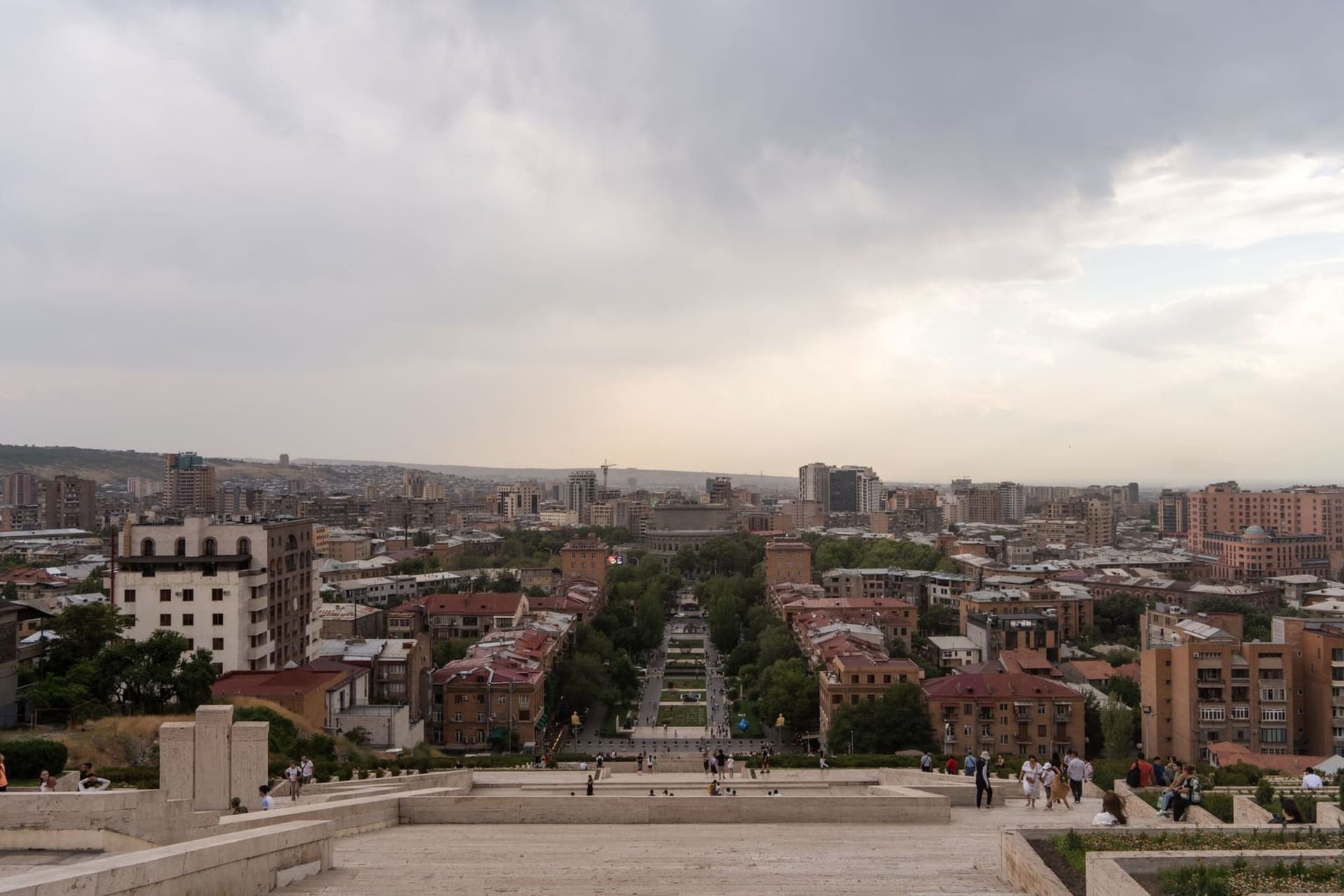
There is a particular quality of light in Yerevan at six in the evening — apricot-warm, tilted low — that makes the tuff stone facades glow as if lit from within. Every building in the city center is cut from the same volcanic rock, this soft pink-orange material that absorbs heat all day and releases it slowly into the dusk. Standing on the steps of the Cascade, looking south toward the Turkish border, I understood for the first time what it means to inhabit a landscape that is also a wound.
Republic Square and the Weight of History
We arrived in early October, when the plane trees along Mashtots Avenue had started dropping their leaves in wide gold circles on the pavement. Republic Square anchors the city like a stage — the Ministry of Foreign Affairs, the History Museum, the Hotel Armenia all arranged around the central fountain with the deliberateness of a civic dream. The dancing fountain shows run at night to Armenian folk music, and locals sit on the surrounding benches with the ease of people who have been coming here their whole lives.
The brandy, as promised, arrived before we had even looked at the menu at the small restaurant on Abovyan Street where the owner seated us at the back table without asking. Ararat brandy — not cognac, never cognac, they will correct you gently — is smooth in a way that surprises. It tastes of dried apricot and something older, something that resists naming.
The Covered Market and an Unexpected Discovery
The GUM Market on Mashtots surprised me completely. I had expected handicrafts and tourist honey. What I found instead was a working food market dense with dried herbs, walls of churchkhela hanging like dark jeweled ropes, old men playing backgammon at card tables between stalls selling pickled vegetables in enormous glass jars. Lia spent forty minutes negotiating over a bag of wild thyme with a woman who eventually threw in dried rose petals as a kind of punctuation mark to the transaction.
I ate lahmajoun at a plastic table near the entrance — thin, crackling flatbread topped with spiced minced meat and fresh tomato — rolled with parsley and a squeeze of lemon. It cost almost nothing. It was extraordinary.
Up the Cascade at Dusk
Jim Torossian’s Cascade complex climbs the hill above the city in wide marble steps lined with sculptures from the Cafesjian collection. By late afternoon the tourists thin out and Yerevan residents walk dogs and push strollers up the escalators inside. At the top, the city spreads below in its pink grid, and if the day is clear — genuinely clear, without the summer haze — Ararat appears to the southwest, enormous and snow-white and technically in Turkey. It does not feel like it belongs to Turkey. It feels like it belongs to the view.
When to go: Late September through October offers golden light, mild temperatures, and the tail end of the apricot and grape harvests. Avoid July and August, when the heat flattens everything and the city empties toward the lake at Sevan.