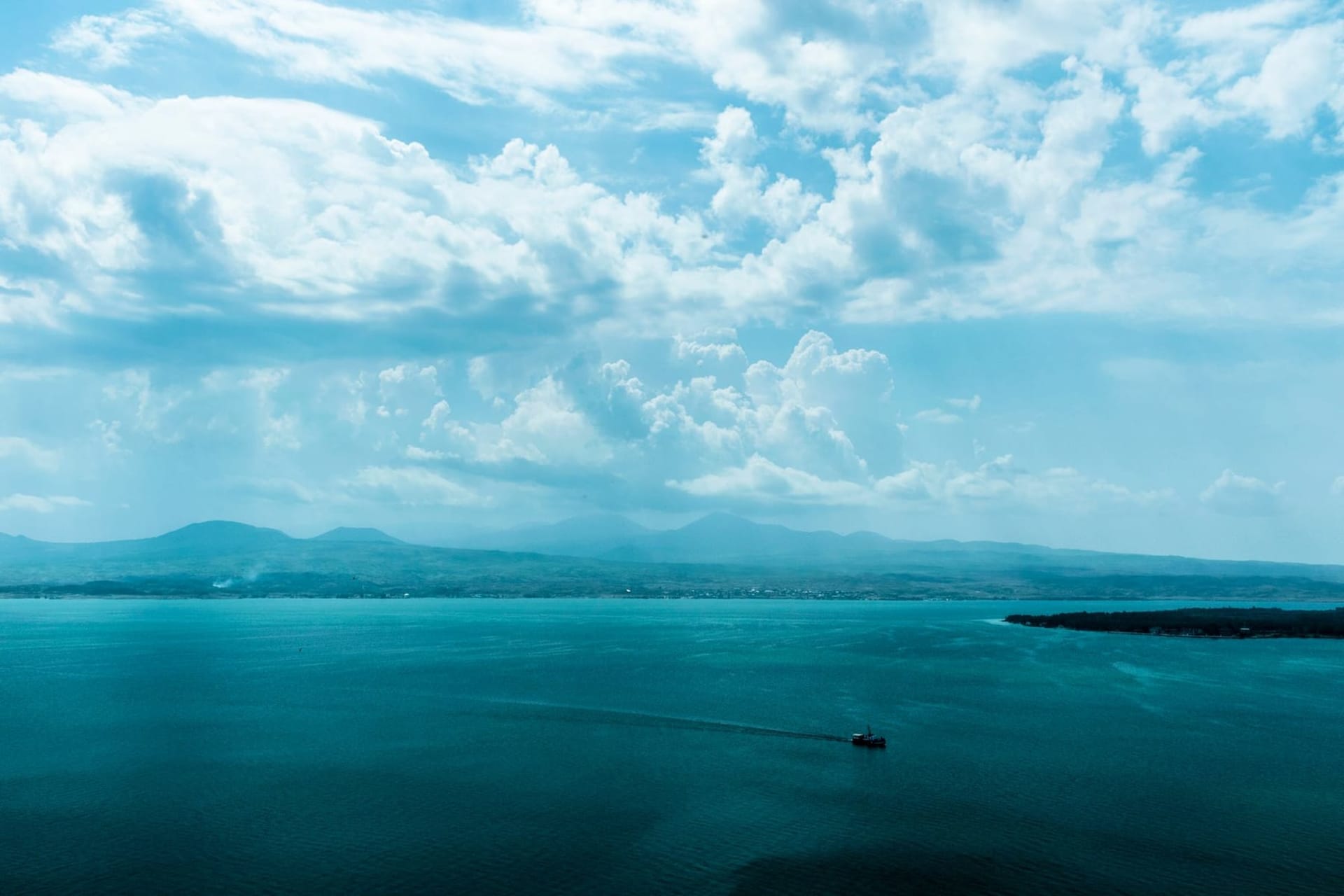
One of the world's largest high-altitude lakes, jewel-blue at 1,900 metres, with an ancient monastery on its shore.
We drove out of Yerevan on the M4 highway with the windows down, climbing steadily until the city dissolved into dry volcanic hillside and then — without any particular ceremony — Sevan appeared below us. Not a gradual reveal but a sudden one: one bend in the road and suddenly two thousand square kilometres of water the colour of glacial melt, impossibly saturated, sitting at 1,900 metres like something misplaced from another altitude entirely.
Lia said nothing for a moment. Then: “That’s not a real colour.”
She was right. It isn’t.
Sevanavank and the Feeling of Ancient Patience
The monastery sits on what used to be an island. Soviet-era irrigation projects lowered the lake enough to connect it to the shore, turning the peninsula into something you can walk to — which feels like cheating, somehow, like arriving backstage. The ninth-century church of Surb Arakelots is small and dark inside, the stone walls exhaling a cold that has nothing to do with the temperature outside. Khachkars — Armenian cross-stones — lean against the exterior in various states of weathered grace. I stood at the edge of the promontory looking north across the water and felt, in a way I rarely feel at landmarks, that I was genuinely somewhere old.
The smell up there is reed and altitude: clean in a way that has no smell at all, only absence.
Fish, Salt, and the Market at the Lakeside
Below the monastery, along the main lakeside road, vendors sell ishkhan — Sevan trout — from wooden stalls that look improvised and permanent at the same time. We ate it grilled, sitting at a plastic table with a direct view of the water, with lavash torn from a sheet still warm from the tonir and a bowl of matsun on the side. The fish was firm and clean-tasting, lake-cold even just off the grill.
What surprised me was the wind. I hadn’t expected it — a persistent, lateral push that came off the water without warning and sent our napkins into the lake. The vendors didn’t flinch. They weigh everything down with river stones pulled from the shore, a detail so practical and so right that I felt briefly embarrassed for not having anticipated it myself.
Light That Changes Its Mind
In the afternoon the lake turns several different blues in succession — cerulean, then slate, then a green that borders on impossible — depending on the cloud cover and your angle to the sun. We stayed until early evening and I photographed the same view four times, each time convinced I’d finally caught the colour accurately. I hadn’t. Some things resist being recorded.
When to go: June through September offers the best weather and calm water, with July and August warmest despite the altitude. May can be cold and windy; September is quieter and still beautiful, with fewer vendors and a sharper quality of light.