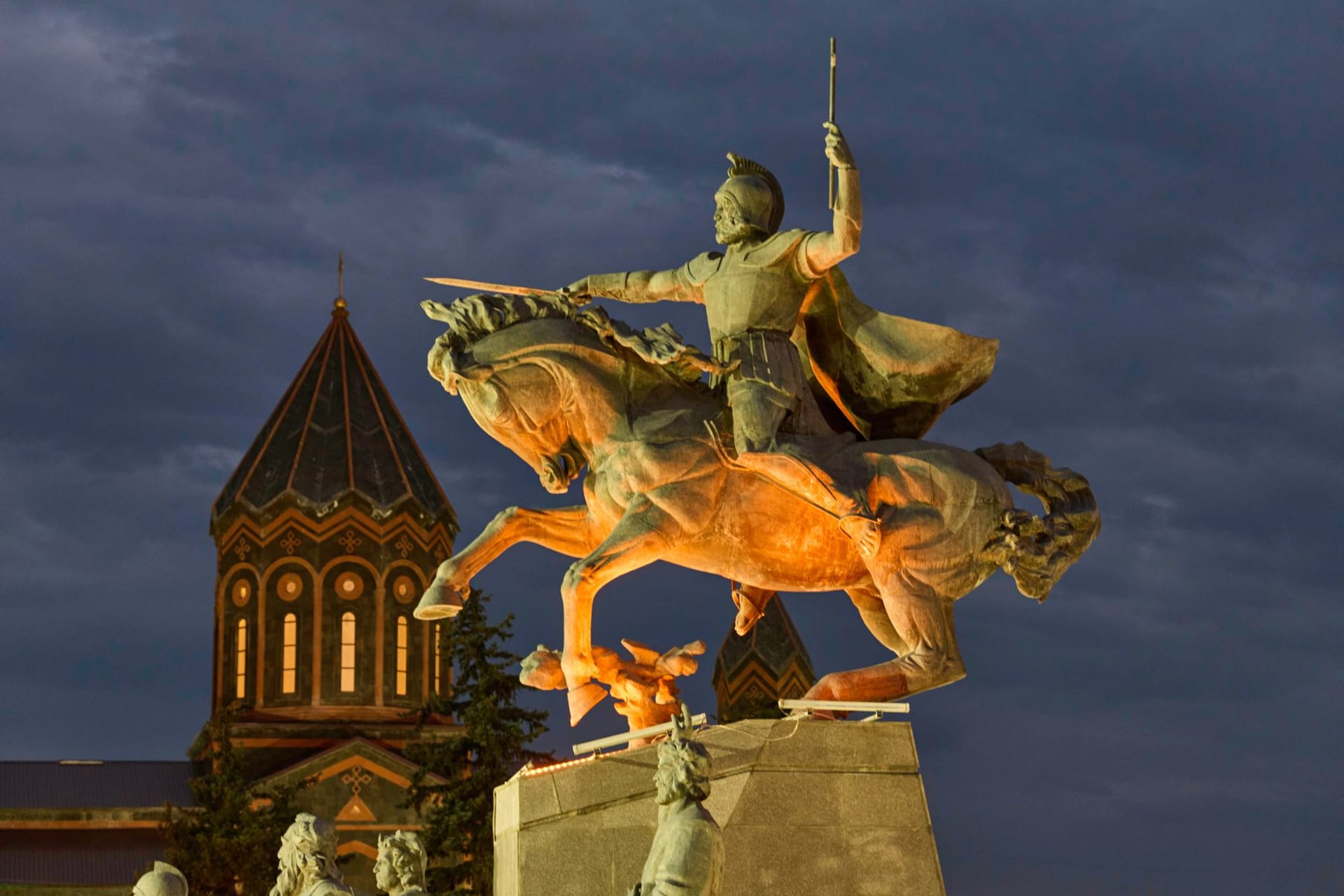
Gyumri
"Gyumri jokes about the earthquake. That's how you know they've lived with it long enough to make it theirs."
The City That Got Back Up
Gyumri was destroyed on December 7, 1988. An earthquake measuring 6.8 killed twenty-five thousand people in thirty seconds and leveled most of the city. Thirty-eight years later, the cranes are still visible on the skyline. Some residents live in the metal container homes that were installed as temporary shelter in 1989 and became permanent by necessity.
I’d heard this history before I arrived and expected something grim. What I found was considerably more complicated. The old Kumayri district — the pre-Soviet merchant quarter — was largely spared by the earthquake because it was built from the same black and rust-red volcanic tuff that distinguishes Armenian ecclesiastical architecture. Walking those streets is like moving through a nineteenth-century city preserved by accident: carved wooden balconies, ornate facades in dark stone, small shops selling coffee and pastries from premises that look unchanged since 1910.
Vardanants Square and the Art Scene
The main square is Soviet in scale — wide and formal and slightly melancholy in the way public spaces are when they were designed for parades. But the cafés around it have spilled onto the pavement and the energy in the evenings is genuinely warm. Gyumri has a reputation as the cultural capital of Armenia in a way that Yerevan, increasingly cosmopolitan and expensive, has partly ceded. The humor here is drier, the art more experimental, the pace slower in a way that feels chosen rather than imposed.
There are more galleries per square kilometer than anywhere else in the country. I wandered into three in one afternoon — two of them free, one asking a donation — and saw painting and textile work of a quality that would hold its own in a European capital. A woman at one gallery told me, without irony, that Gyumri artists are better than Yerevan artists because they have more to say. The earthquake, the Soviet collapse, the ongoing economic hardship. She was probably right.
Eating in Gyumri
The food here leans traditional in a way Yerevan’s hipper restaurants sometimes don’t. Khorovats — Armenian barbecue, pork or lamb over hardwood coals — arrives at tables in quantities designed for families, even when you’re eating alone. The bread is lavash and the meze arrives unrequested: pickled vegetables, fresh herbs, a wedge of cheese so salty it makes your eyes water.
I ate dinner at a place near the market with no English menu and ordered by pointing. I got soup, a plate of grilled meat, pilaf, a salad, bread, and mineral water for the equivalent of four dollars. The cook came out afterward to ask, in Russian, whether it had been good. I told her yes, using up about thirty percent of my Russian, and she laughed and went back into the kitchen.
The Earthquake Memorial
There’s a small memorial park at the edge of the old city. Simple, not overwrought. A few photographs, a list of names in stone, some flowers left by visitors. I sat there for a while thinking about cities that survive by insisting on their own life, and about how Gyumri has made something of that insistence.
When to go: May through September for pleasant temperatures and an active street scene. Gyumri sits at higher elevation than Yerevan and winters are serious — cold, snowy, and short on tourist infrastructure. The summer festival season (July–August) brings outdoor concerts and markets to the main square.