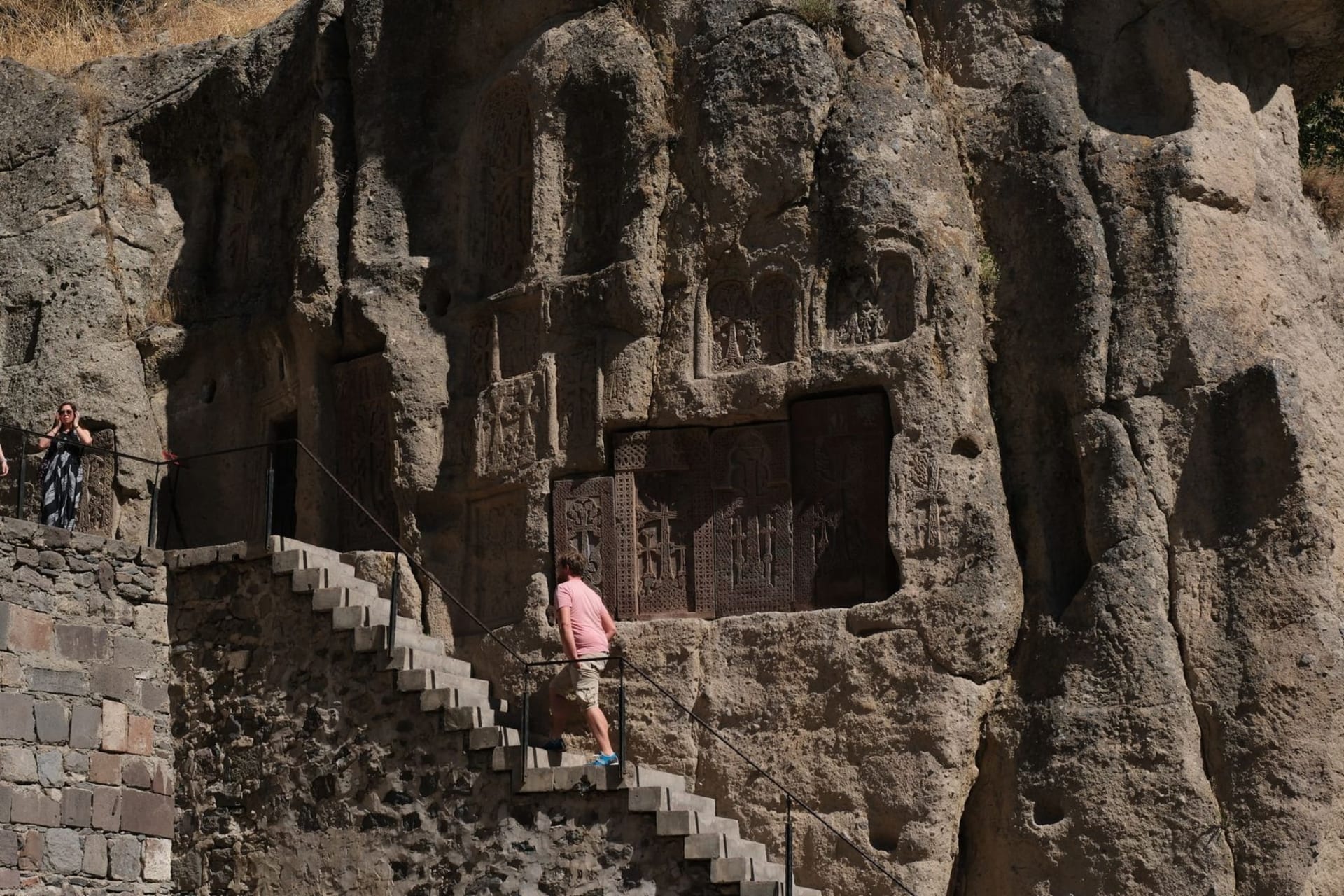
A medieval monastery partly carved from a cliff face in a gorge — UNESCO heritage, still active with prayer.
The driver from Yerevan turned off the main road and the gorge swallowed us whole. Walls of basalt rose on either side of the Azat River — dark, almost bruised rock — and then, at the end of the canyon, Geghard appeared. Not dramatically, not all at once. A tower first, then an arcade of carved stone, and finally the cliff itself, seamlessly becoming wall, becoming chapel. I stopped walking and stood there in the cold morning air, mouth open, embarrassed by my own reaction.
Cut Into the Mountain
The name Geghard means spear in Armenian — a reference to the lance said to have pierced Christ’s side at the Crucifixion, once housed here. But the monastery earns its name in a second sense too: the builders cut into the gorge cliff like a blade, hollowing out chambers that have no seam between architecture and geology. The gavit — the main antechamber — is an orthodox construction of the 13th century, built free-standing in pale tuff. But step through its far wall and you enter a second church that was not built at all. It was excavated. The ceiling is raw mountain, ribbed with carved rosettes. The columns exist because the builders left them in place when they carved everything else away.
The light inside comes from a single oculus in the ceiling. I watched it for a long time. The beam moves, the smoke from incense hangs in it, and the whole dark interior seems to breathe.
The Candle Room
Lia found it first — a side chamber entirely blackened by centuries of soot, low-ceilinged, barely lit. A priest was chanting softly to himself near the altar, seemingly indifferent to the slow file of visitors. Candles lined every ledge. The smell was beeswax and cold mineral stone and something older beneath both, something I couldn’t name. An elderly woman knelt in the corner and did not look up. I had expected a museum. This was not a museum.
What surprised me most was a carved niche at the back of this chamber, barely a meter wide, housing a spring. Real water, trickling from inside the cliff into a stone basin worn smooth by ten centuries of hands. Pilgrims still touch it. I touched it too, and felt the cold travel up my arm like a small correction.
Getting There
Geghard sits 40 kilometers east of Yerevan, just past the pagan temple of Garni. Most people visit both on the same morning, which is worth doing — the contrast between Garni’s open hilltop classicism and Geghard’s compressed, cliff-wrapped devotion makes each sharper by comparison. The canyon road is not served by regular marshrutka; shared taxis from Yerevan’s Gai market are the standard option, and negotiating one for the morning round trip is straightforward and inexpensive.
When to go: April through June and September through October offer the clearest light and the thinnest crowds. Winter visits are possible and genuinely atmospheric — snow against the black gorge walls, almost no other visitors — but dress in serious layers; the stone holds cold like a vault.