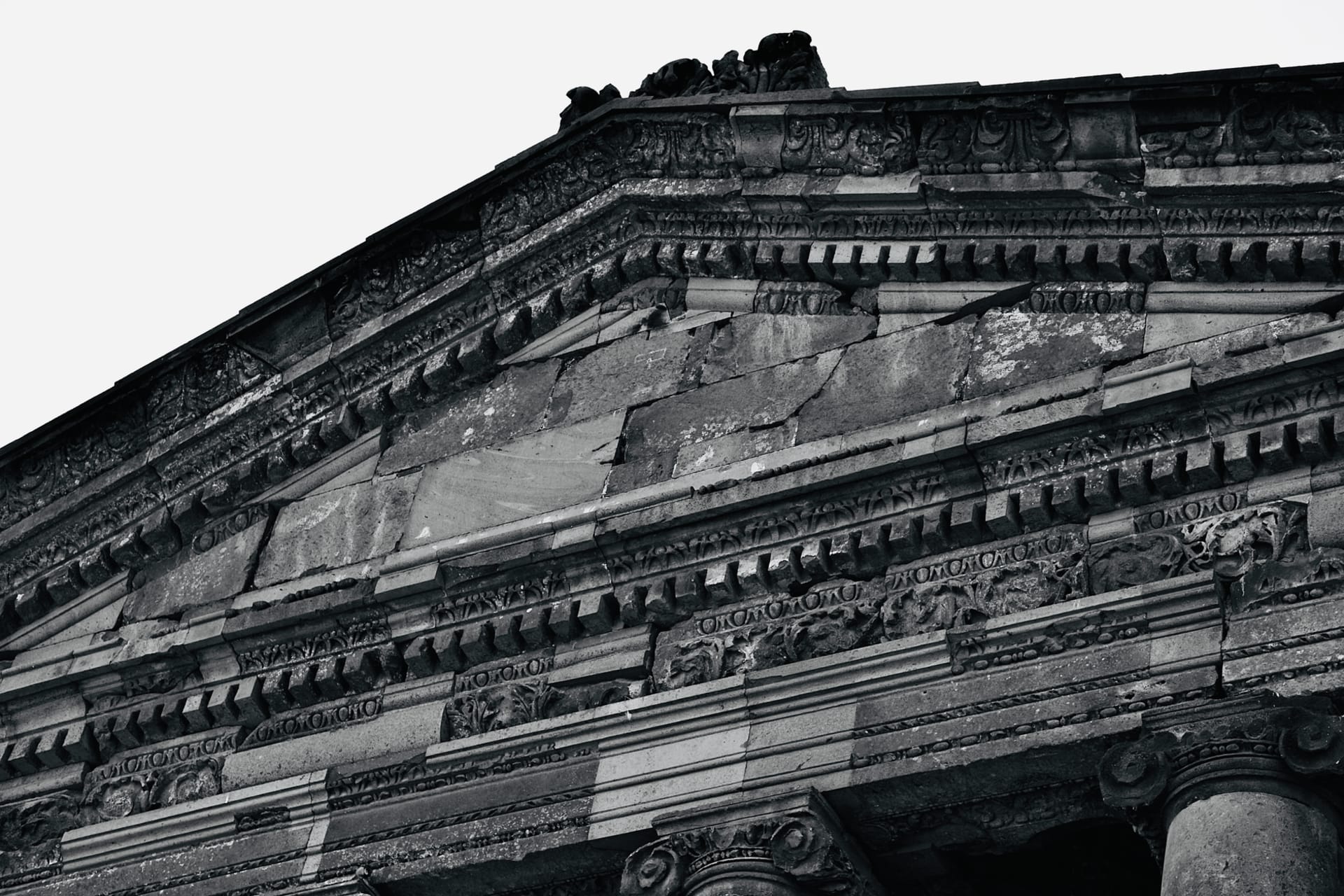
Garni
"A Greek temple in Armenia, above a canyon carved from black volcanic rock — this country keeps refusing to be simple."
Wrong Continent, Right Gorge
I expected to be underwhelmed. The Garni Temple is famous enough to appear on Armenian brandy bottles, which usually means the real thing has been loved to death. But standing at the edge of the plateau and looking down into the Azat River gorge — black basalt columns rising from the river like organ pipes, the canyon walls striated and severe — I felt the particular satisfaction of a place that fully delivers.
The temple itself is the only standing Greco-Roman structure in the former Soviet Union, built in the first century AD by a king who’d spent time in Rome and apparently came home with architectural opinions. It’s small by Mediterranean standards — a single chamber on a stepped podium — but the columns are original and the proportions are exactly right. What makes it strange is the context: this is not Italy or Greece. The valley below is unmistakably Caucasian, the mountains behind are Armenian, and the sound drifting up from the village is a woman calling something in a language that descends from Urartian.
The Symphony of Stones
Most people don’t walk down into the gorge. They photograph the temple, visit the adjacent church ruin (a seventh-century structure reduced to foundations after a 1679 earthquake), eat some lavash from the women cooking it in the courtyard, and leave. This is a mistake.
There’s a path that descends to the river, steep in places and requiring reasonable shoes, that leads to what locals call the Symphony of Stones — a stretch of gorge wall where basalt columns have fractured into near-perfect hexagonal forms, arranged in dense vertical bundles. It looks engineered and isn’t. I spent forty minutes down there and only saw three other people. The river is cold and fast and the canyon walls block the sun so that it feels like a different climate entirely from the plateau above.
Lavash and the Church Kitchen
Back up at the temple, Lia made us stop at the tonir — the underground clay oven — where two women were making lavash to order for a tour group. We joined the queue and watched them roll the dough into translucent sheets, slap it against the inside of the oven wall, and peel it off thirty seconds later, blistered and smelling of wood fire. You eat it immediately, before it crisps. It burns your fingers slightly and tastes like bread is supposed to taste before it became a product.
There’s a small café near the car park that serves Armenian coffee thick enough to stand a spoon in and cold mineral water from the same spring that supposedly supplied the royal citadel. I sat outside and looked at a view that hasn’t changed in two thousand years.
Getting There and Combining Trips
Garni is thirty kilometers from Yerevan and most people visit by taxi or on a tour that combines it with Geghard Monastery, nine kilometers further up the same valley. The combination makes sense — different centuries, the same gorge — and fills a reasonable half-day. Shared taxis from Yerevan’s Gai bus station are the cheapest option. Bargain for a return fare and agree on waiting time before you get in.
When to go: Year-round, but April through June and September through October are ideal — mild temperatures, clear air, and the gorge vegetation either green or golden. Midsummer is hot on the plateau and crowded. Winter brings snow and near-empty grounds, which has its own stark appeal.