
A northern river city on the Paraná where chamamé music and carnival define daily life more than any single monument does.
I heard chamamé before I saw much of Corrientes at all — a bandoneón and accordion duet drifting out of a bar near our hotel the first night, unhurried and a little melancholic in a way that didn’t match the heat still radiating off the pavement. That turned out to be the whole introduction I needed. Corrientes, tucked into the far north where the Paraná bends and the country starts feeling more Guaraní than Spanish, runs on this music the way Buenos Aires runs on tango, except with none of the self-consciousness.
The Costanera and the River
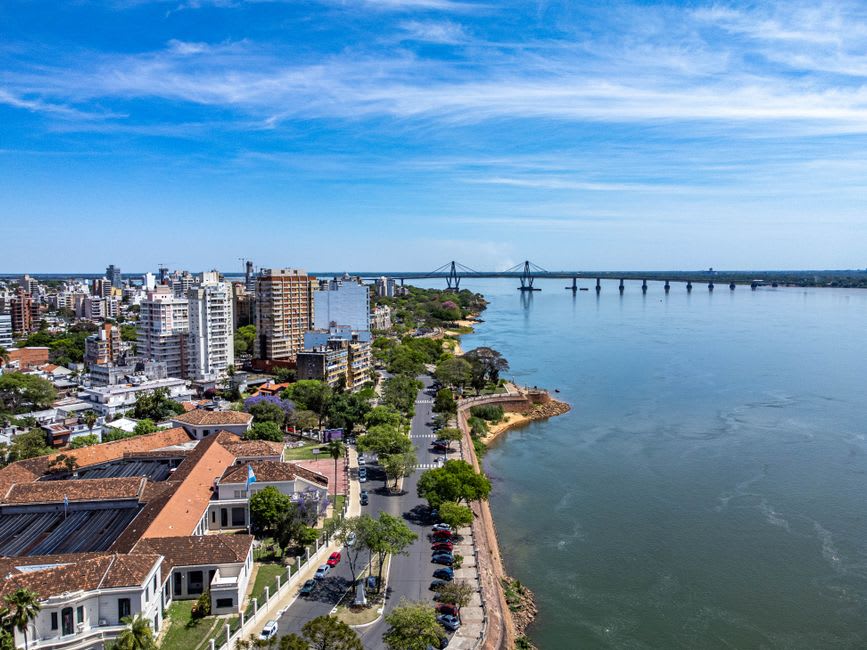
The Costanera General San Martín is where the city actually gathers — a long riverside promenade with the widest, most languid stretch of the Paraná I saw anywhere on the trip, brown-gold and slow-moving, with the Chaco province visible as a green line on the far bank. Lia and I walked it at sunset with what felt like half the city, past ice cream stands and groups of teenagers with guitars, and a fisherman working a hand line off the seawall who’d caught, by his own count, nothing all evening and didn’t seem bothered.
Carnival Country
Corrientes takes carnival more seriously than almost anywhere in Argentina outside Gualeguaychú, and even outside of carnival season the city has a dedicated Corsódromo, a purpose-built carnival stadium, sitting there as a permanent reminder of how central the celebration is to local identity. We weren’t there for carnival itself, but a man running a small museum of carnival costumes near downtown let us in after hours because Lia asked nicely, and the sequined, feathered constructions on display were more elaborate than anything I’d expect from a city this size.

Chamamé, for Real
The real education came at a peña on the edge of downtown, where a trio played chamamé into the early hours for a crowd that clearly knew every song — older couples dancing a close, formal two-step that looked nothing like the tango I’d seen in Buenos Aires, younger people singing along without irony. Someone explained to me that chamamé carries a specific feeling, sentimiento correntino, that doesn’t translate cleanly, and after two hours in that room I believed them.
When to go: Late January through Carnival (usually February) for the full festival intensity, though book accommodation well ahead. April through June and August through October offer milder river-city weather without the crowds.