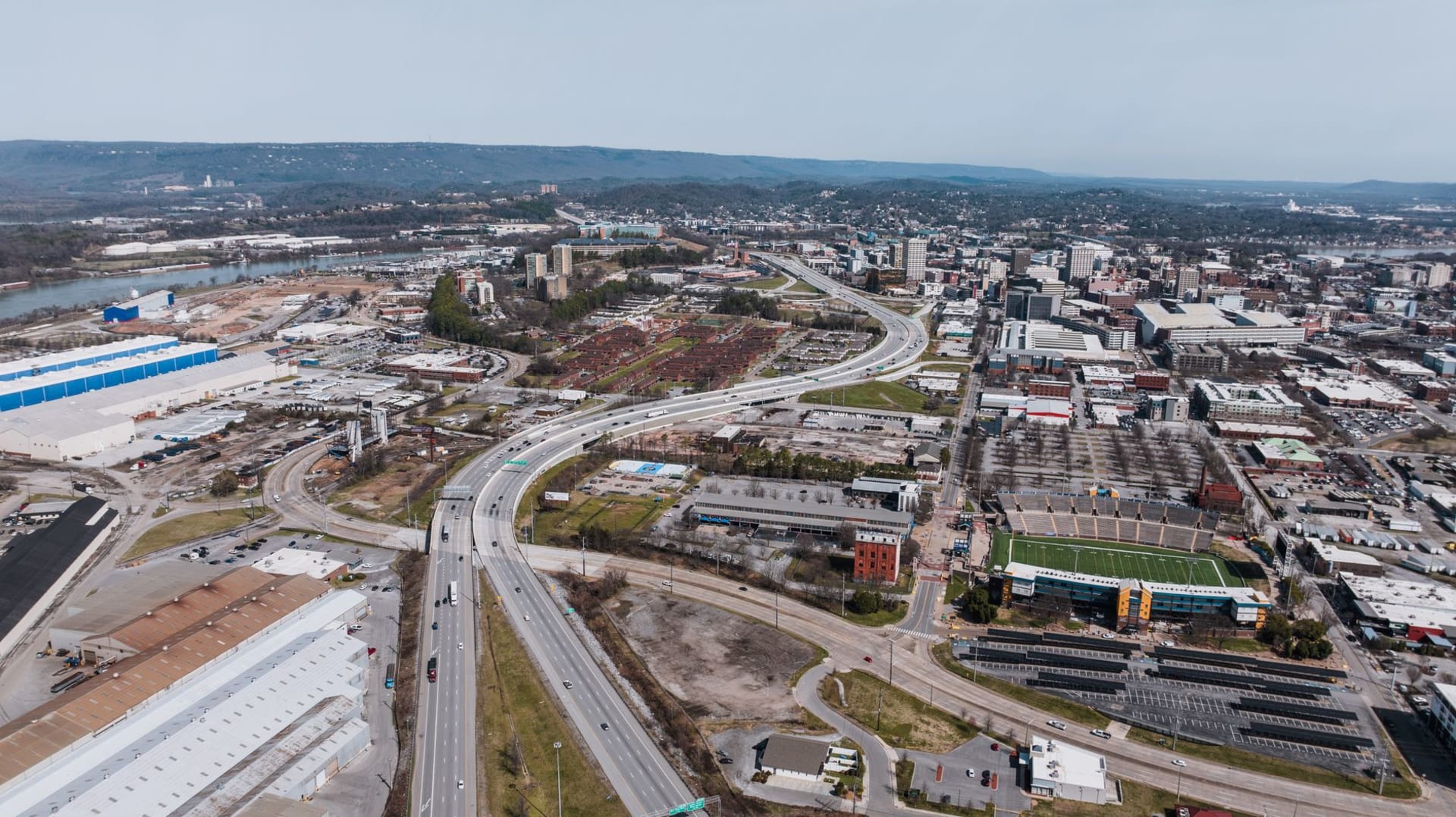
Chattanooga
"Chattanooga is proof that the right landscape, if you stop ignoring it long enough, will eventually build you a city worth living in."
Chattanooga is what happens when a mid-size American city with serious pollution problems and a declining industrial base looks at the Tennessee River gorge it has been sitting beside for two centuries and decides, finally, to act on what it has. The reversal happened in the early 1990s, when the city was ranked by the EPA as having the worst air quality in the United States and responded by doing something about it — converting its bus fleet to electric, cleaning up the riverfront, building the Tennessee Aquarium, creating a pedestrian bridge over the river that became the longest pedestrian bridge in America at the time. The downtown today, along the north shore of the Tennessee, is a functional, genuinely pleasant place, which is not a given for cities that have been through what Chattanooga went through.
I arrived from the north, coming down through the Sequatchie Valley from the Cumberland Plateau, and the approach prepares you. The valley narrows, the ridges close in on both sides, and then the Tennessee River appears in its gorge below Lookout Mountain and you understand that this was always going to be an important place — a natural passage through the southern Appalachians that both the Cherokee and the Confederacy understood before the city planners did. Chickamauga battlefield, just south of the city, was one of the bloodiest two-day battles of the Civil War; forty-five thousand casualties in a cornfield and a cedar forest over two September days in 1863. I walked the battlefield at dusk on a day when no other visitors were there, through the long grass and the silent artillery monuments, and came out the other side feeling the weight of the southern Appalachians differently than I had when I went in.

Lookout Mountain itself is worth the drive up. The Civil War battle fought here — the Battle Above the Clouds, November 1863, fought in such dense fog that units lost each other in the terrain — gives the mountain its historical identity, but Point Park at the summit gives it its daily one: a clifftop overlook that takes in seven states on a clear day (Tennessee, Georgia, Alabama, North Carolina, South Carolina, Virginia, Kentucky — I have confirmed five of the seven personally). Ruby Falls, a 145-foot underground waterfall inside a cave on the mountain’s western face, is the kind of geological improbability that feels like a fever dream when you are standing in front of it underground. The tourist infrastructure around it is heavy, but the waterfall itself has earned the attention.
In the city proper, the Southside neighborhood has become the center of the restaurant and bar scene that rebuilt itself after the river cleanup. St. John’s Restaurant, an anchor of the local dining scene for twenty years, does a seasonal menu with Tennessee sourcing that holds up against anything in Asheville or Nashville. The Public House, a smaller room with an emphasis on natural wine and small plates, is the kind of place you find in cities that have been paying attention. The rock climbing community has made Chattanooga a destination in its own right — the sandstone bouldering of Horse Pens 40 and the sport climbing on the crags above the Tennessee River Gorge draw climbers from across the Southeast and have built a culture of outdoor recreation that permeates the city’s self-image.

The Tennessee Aquarium, still the anchor of the riverfront after thirty years, is one of the better freshwater aquariums in the country — the freshwater section covering the Tennessee River system, with its paddlefish and hellbender salamanders and snapping turtles, is more scientifically interesting than most ocean aquariums, partly because the Tennessee River basin has more species of freshwater fish than any river system in North America, a fact that surprises most people and shouldn’t. I spent an hour watching the hellbender — a two-foot-long aquatic salamander that looks like something evolution left unfinished — and came out with a different understanding of what lives beneath the surface of these mountain rivers.
When to go: Spring, April through May, and fall, September through November, are the strongest seasons — the climbing is best, the riverfront walks are pleasant, and the surrounding countryside is in full color in October. Summer is hot and humid, typical of the deep South, but the aquarium and the underground cave at Ruby Falls offer air-conditioned alternatives. The city runs year-round with no real off-season.