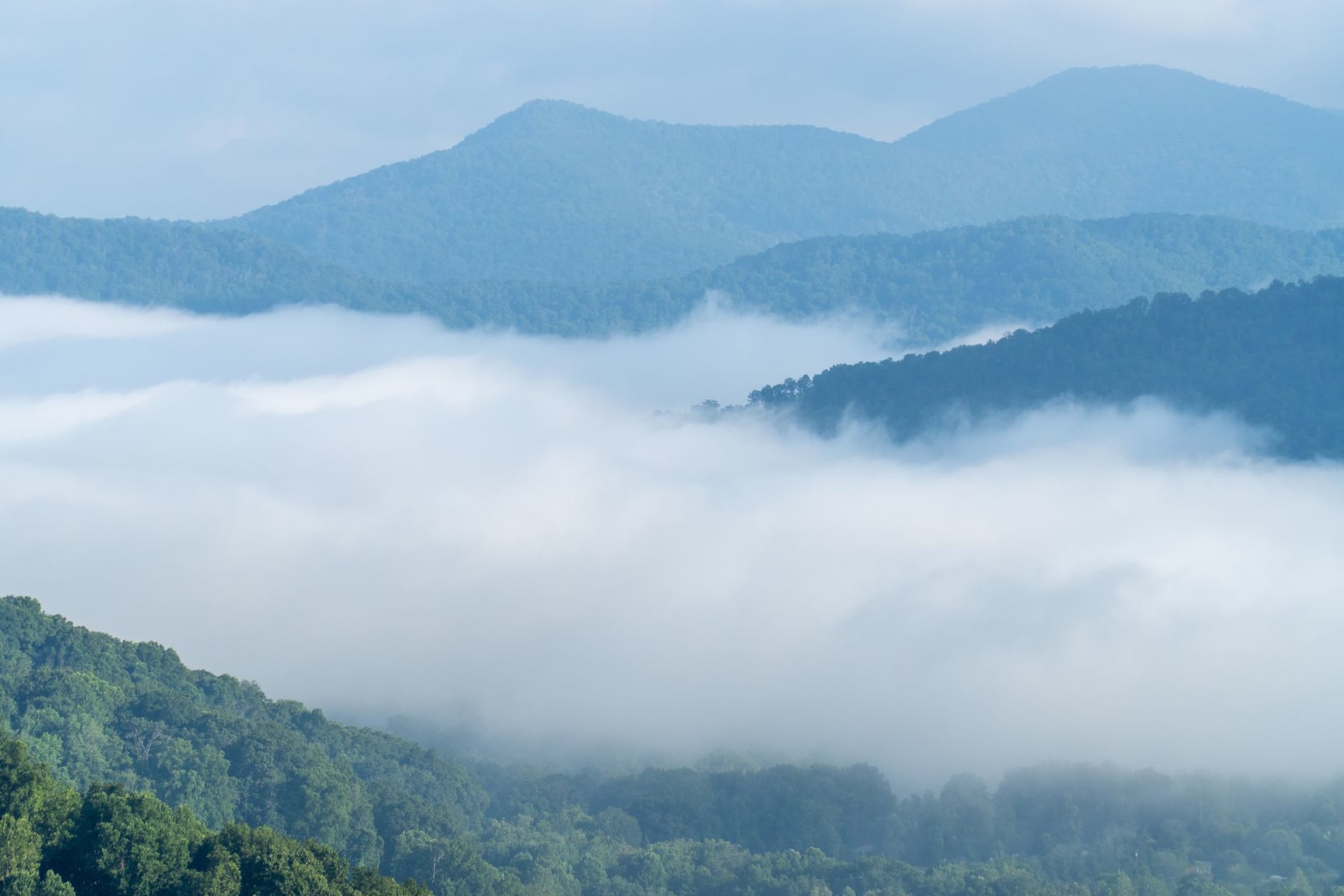
Americas
Appalachian Mountains
"I had not expected mountains this old to feel this alive."
I drove into the Blue Ridge Parkway from Asheville on a Tuesday morning in late October, and within ten minutes I had pulled over for the third time. Not because of traffic — the road was nearly empty — but because the forest on both sides had turned into something I could not drive past without stopping. Oaks going amber, maples going scarlet, sourwood trees at a shade of deep burgundy I had never seen in any other forest. Living in Mexico, I am used to green holding on all year. This idea of a forest consuming itself in color before letting go completely is still, every time, a surprise.
The Appalachians are the oldest mountains on earth. They were once as tall as the Alps, and three hundred million years of erosion have worn them down to their current form — rounded, forested, intimate in a way that sharp alpine peaks are not. They do not intimidate you; they absorb you. The Appalachian Trail runs for more than three thousand kilometers along the spine of the range, from Springer Mountain in Georgia to Katahdin in Maine. Most people hike sections. A few thousand each year attempt the full thru-hike, spending five to seven months walking through fourteen states. I have only ever done sections — a few days in the Smokies, a long weekend in Shenandoah — and each time I come out of the forest feeling like something in me has been reset.
The towns matter as much as the wilderness. Asheville, North Carolina, has somehow become one of the most interesting food cities in the American South, with a restaurant scene built around Appalachian ingredients — ramps, pawpaws, sorghum, country ham — treated with real seriousness. Hot Springs, a tiny trail town on the French Broad River, has a single main street and thermal soaking pools that hikers have been using since the nineteenth century. Abingdon, Virginia, has the Barter Theatre, founded during the Depression when people traded produce for tickets, and still one of the finest regional theaters in the country. These are not places that exist to service tourism. They exist because people actually live here, and the living has shaped them into something specific.
When to go: Mid-October for fall color — peak timing shifts year by year but tends to run from early October in the northern sections (Vermont, New Hampshire) down to late October in the southern Appalachians (North Carolina, Tennessee). Spring, from April through May, brings wildflower season in the Smokies and the Shenandoah, which is less famous but equally worth the trip. Avoid summer weekends in popular areas like the Blue Ridge Parkway — the road was not built for that kind of traffic.
What most guides get wrong: They frame the Appalachians as a leaf-peeping drive and nothing more. You point your car at the Blue Ridge Parkway, snap a few overlook photos, and consider the mountains seen. What they miss is that this is a working mountain culture with its own music, its own foodways, its own literary tradition — and that the best of it happens off the parkway, in the hollows and river valleys and small towns that the scenic road was deliberately routed to avoid. The Appalachians are not a backdrop. They are a place.