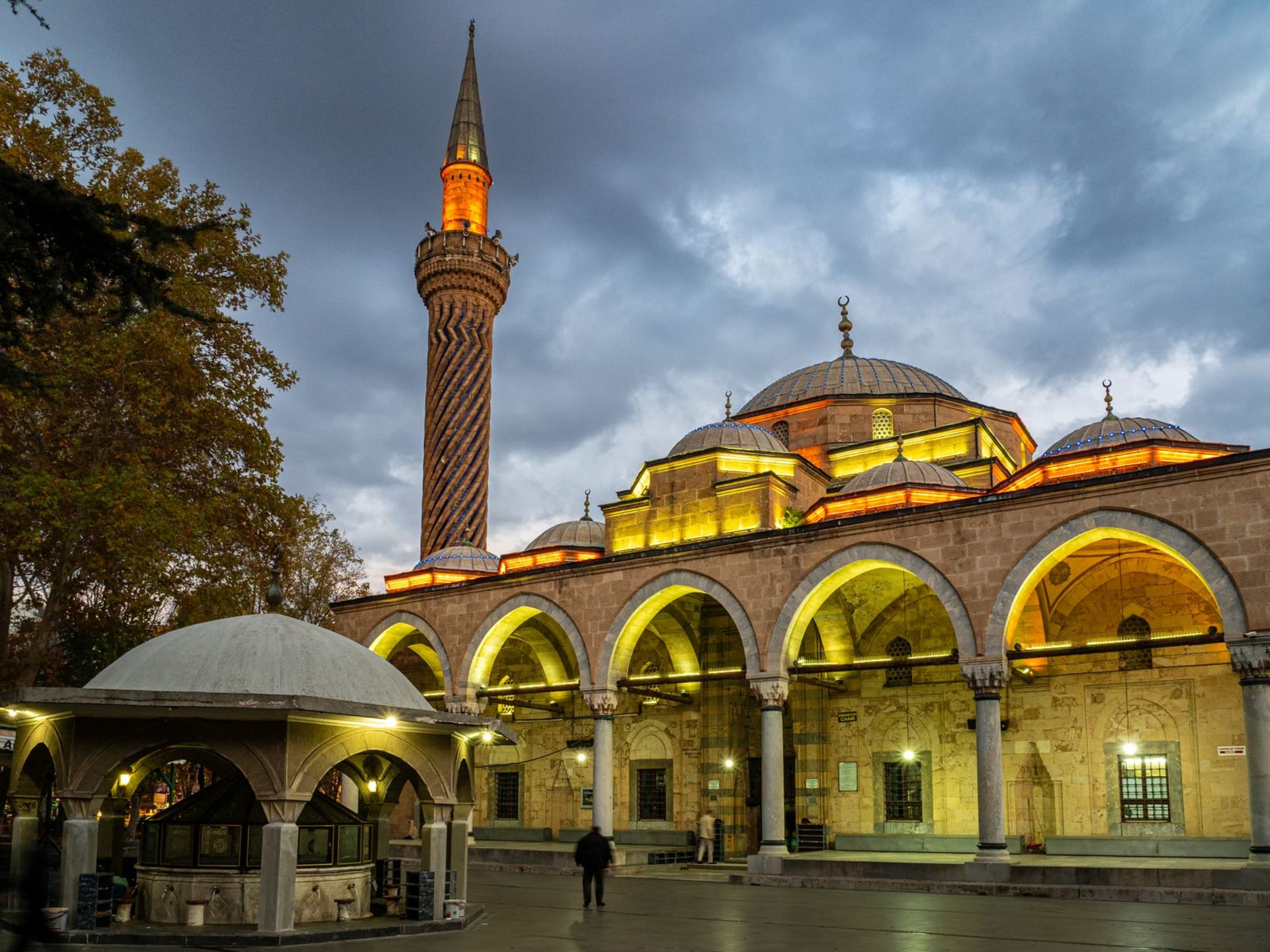
Konya
"In Konya, even the air inside a 13th-century mausoleum carries the smell of rose water and old wood."
I arrived in Konya on a Thursday evening, the bus pulling in just as the call to prayer spread across the rooftops in overlapping waves. The city is conservative in a way that immediately registers — more headscarves per street, fewer beer signs, a certain quietude that feels deliberate rather than imposed. I had come specifically for the Mevlâna Museum, which houses the tomb of Jalal ad-Din Rumi, the 13th-century Sufi mystic whose poetry has been translated into more languages than almost anyone alive today. Standing in the queue at the gate, I noticed that most of the visitors were not Europeans with guidebooks. They were Turkish, Iranian, Pakistani — pilgrims.

Inside, the atmosphere shifts completely. The main hall houses Rumi’s tomb beneath a sarcophagus wrapped in embroidered cloth, surrounded by other members of the Mevlevi order. Visitors move slowly, in near-silence, and I watched a man in his fifties weeping quietly with his hands pressed flat against the wooden railing. The museum around it is excellent — calligraphy, instruments, manuscripts, ceremonial robes — but the emotional weight of the room containing the tomb overrides all of it. I’ve been in churches and synagogues and Buddhist temples across three continents, and that room belongs in a different category: a place that holds a specific human longing so precisely it becomes almost unbearable.
The rest of Konya is a city getting on with things. The bazaar near the Selimiye Mosque moves at a clip, selling fabric, hardware, and piles of spices in sacks. I ate fırın kebabı — oven-roasted lamb shoulder that the restaurant had been cooking since early morning — and a plate of etli ekmek, the Konya flatbread topped with minced meat, long and thin and served on paper. The bread is something Konya is genuinely obsessive about. I asked a woman at a bakery which variety was best, and the conversation lasted twenty minutes.

The old city also contains the Alâeddin Mosque, built by the Seljuks in the 12th century on a low hill that may have been settled for four thousand years. The mosque itself is unpretentious and somewhat worn, which felt right. Konya has been accumulating layers since the Hittites, and the city does not perform its history — it simply lives inside it. The Sema ceremony, the whirling dervish ritual, takes place every Saturday at the cultural centre. I went with low expectations, prepared for something touristic. The reality was deeply strange and not touristic at all: the slow acceleration of the dervishes, their arms extended, one palm up and one down, the white robes blooming into discs of motion, the music a single flat string above a percussion line. After forty minutes I was not sure what had happened to the time.
When to go: October through April avoids the worst summer heat. The most significant occasion is Şeb-i Arûs — December 17th, the anniversary of Rumi’s death, when ceremonies and concerts fill the city and accommodation books out weeks in advance. Spring is gentle and the poplar-lined roads around the city glow pale green.