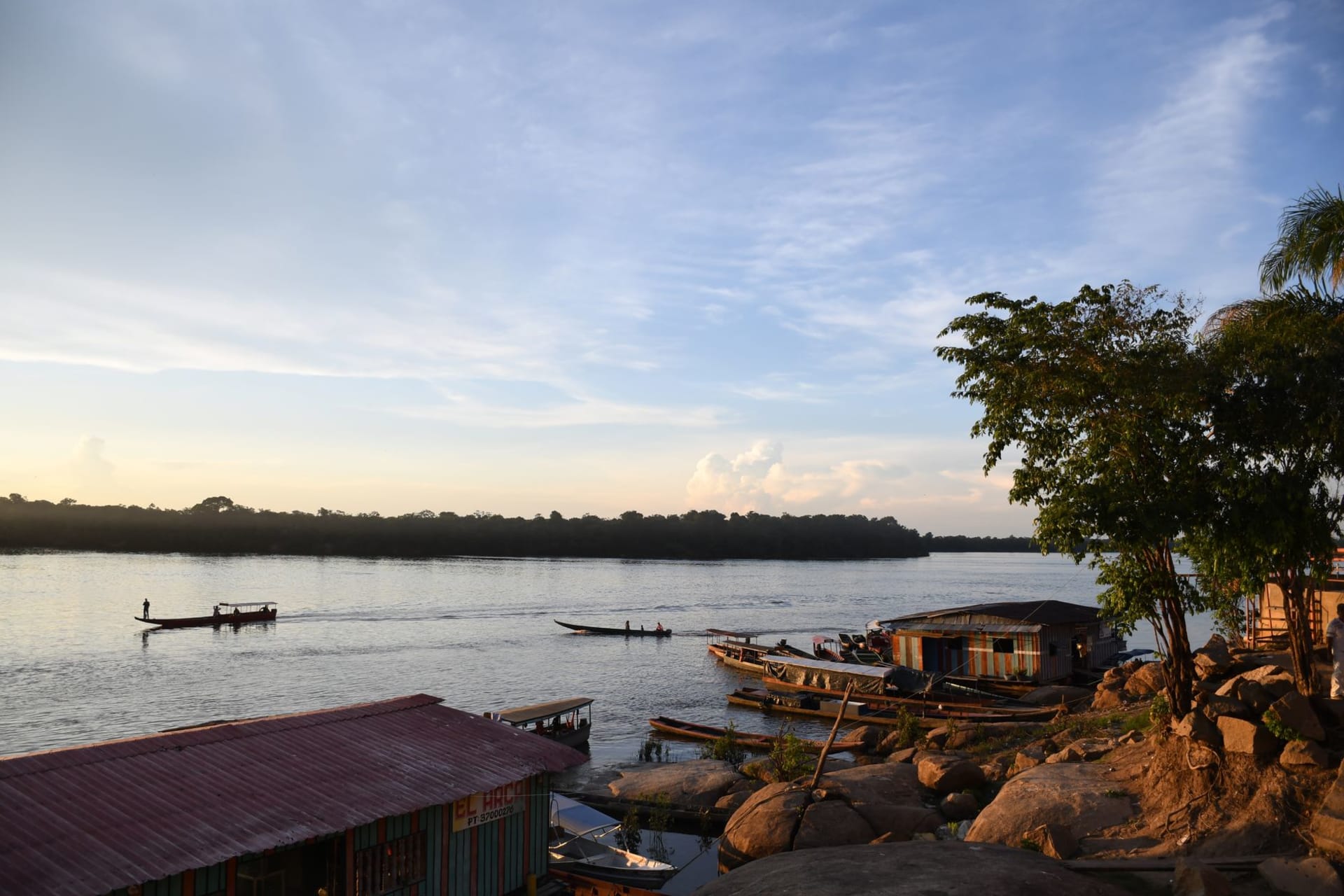
Tarapacá
"There are no roads to Tarapacá, which is the first thing anyone tells you and, after a few days, the thing you come to be grateful for."
Almost nobody goes to Tarapacá, and I understand why, because it is genuinely hard to reach and offers none of the comforts that justify hardship for most travellers. It’s a small village on the Putumayo River, in the far southeastern corner of Colombia’s Amazonas department, pressed up against the border with Brazil and Peru. There are no roads. You arrive either on the small, irregular state-subsidized flight from Leticia or on a cargo boat that takes days winding up the rivers. We took the plane, a twin-engine thing that held maybe a dozen people and our luggage weighed on a hanging scale, and watched an unbroken green carpet pass beneath us for an hour with not a single road or town in sight.
Life on the Putumayo
Tarapacá is a frontier in the oldest sense: a place where three countries and several Indigenous and riverside cultures meet without much ceremony. The houses stand on stilts along the muddy riverbank, the Putumayo itself is wide and brown and central to absolutely everything, and the rhythm of the village is set entirely by the water and the light. There’s a small airstrip, a handful of shops, a Colombian naval post, and the constant low presence of the surrounding forest, which is part of the vast and barely visited Río Puré National Park region. I spent the first afternoon simply sitting on a porch watching canoes come and go, and felt my sense of hurry quietly dismantle itself.

We had arranged, through a contact in Leticia, to stay with a family who took in the occasional visitor, and our days fell into the shape they set. A man named Eladio took us out on the river before dawn to fish, and the patience of it nearly undid me — long silences, the slap of the paddle, the slow extraction of a single large fish that we ate that same evening, grilled over wood. Lia, who fishes back home with her father, was completely at ease, and the two of them communicated in the universal sign language of people who like rivers, despite sharing perhaps fifteen words of Spanish between them.
The forest sets the rules
What stays with me about Tarapacá is the scale of its remoteness, and how that changes everything. There’s no real road network for hundreds of kilometres, no reliable signal, no shop that will have the thing you forgot. You adjust to what the place offers, which is mostly forest, river, and time. One afternoon a sudden, total downpour arrived with no warning and we sheltered under a tin roof with three generations of a family, nobody speaking much, watching the river dimple and the world dissolve into grey. It was one of the more peaceful hours of the whole trip.

I won’t pretend Tarapacá is for everyone. There’s no tourism infrastructure to speak of, getting in and out takes patience and flexibility, and you need to arrange contacts in advance through Leticia. But if you want to understand how vast and unbroken this corner of the Amazon still is — how completely the forest still governs human life here — there are very few easier places to find that than this hard-to-find one.
When to go
The drier months, roughly June to November, make river travel and fishing more reliable, while the high-water season from December to May floods the forest and changes the village’s whole relationship with the river. Either way, build in slack: flights from Leticia are small, infrequent and weather-dependent, and arrangements must be made locally well in advance.