
Mocagua
"The manatee looked up at me with an expression of absolute patience. It had been waiting longer than I'd been alive."
A small riverine community on the edge of Amacayacu park where a family-run manatee rescue centre quietly does the most important work in the Colombian Amazon.

Mocagua sits on the bank of a creek that feeds into the Amazon near the entrance to Amacayacu park, a community of perhaps three hundred people clustered around a school, a health post, and the wooden buildings of the Natütama Foundation — a local conservation organization that runs, among other things, a rehabilitation programme for Amazonian manatees orphaned when their mothers are killed by hunters or drowned in fishing nets. I arrived by motorized canoe from Puerto Nariño on a morning when the river was low enough to show the red laterite of the bank, and the first thing I heard before I reached the dock was splashing.
The manatee pool is behind the main Natütama building, a concrete tank fed by river water, and the three animals currently in residence ranged from a calf that had arrived three weeks prior — small enough to hold, though the staff emphasized they avoided this — to a subadult that had been at the centre for eight months and was approaching release weight. A young biologist named Clara had been working here for two years, and she explained the rehabilitation protocol with the careful precision of someone who had thought about these animals continuously for a long time: the calves need milk at two-hour intervals initially, the same interval as suckling in the wild; they need the right water temperature and quality; they need acoustic company because manatees use low-frequency vocalizations to maintain social contact.

What Natütama actually does in Mocagua extends well beyond the manatee programme. The organization trains community monitors — local people who patrol the river and its flooded forest margins noting wildlife sightings, fishing pressure, and illegal activity, contributing to a long-term dataset on Amazon river dolphin populations, manatee distribution, and freshwater turtle nesting. The monitors are from the community, paid by the community through proceeds from the foundation’s work, and their knowledge of the river is of the kind that field biologists from Bogotá and overseas institutions come to Mocagua specifically to access. The power dynamic this creates is one of the more quietly remarkable things I encountered in the Colombian Amazon.
I spent the afternoon walking the forest trail that leads from Mocagua into the edge of Amacayacu park, accompanied by a young monitor named Camilo whose attention to the forest floor produced, in forty-five minutes of walking, three tarantula sightings, a confusion of army ants crossing the trail in a column three meters wide, and the fresh mud-drag of a turtle nesting site on the creek bank. He documented each observation in a waterproofed field notebook with practiced economy — species, time, location, estimated size — and moved through the forest with a quality of embodied knowledge that made my own attention feel approximate.

Dinner was at the single family that hosts visitors, a meal of river fish and plantain and a dessert made from copoazú — a large tropical fruit related to cacao, with a creamy white pulp that tastes like something between guava and vanilla. We ate on a platform above the river and the night came in fast and full, and the dolphins surfaced twice in the channel below us, and Clara joined us and talked about manatees the way some people talk about children they are raising, with complete absorption and the occasional anxiety.
When to go: Mocagua is accessible by fast lancha from Leticia (around two hours) or Puerto Nariño (around thirty minutes). The Natütama Foundation welcomes visitors; a small donation supports their work. Stay overnight if possible to experience the river at night and join an early morning trail walk with a community monitor.
Keep exploring
More from Colombian Amazon
 amazon-colombia
Parque Nacional Natural Amacayacu
Five thousand square kilometres of primary Amazonian forest where the jungle sounds at night are so dense they become a kind of weather.
Explore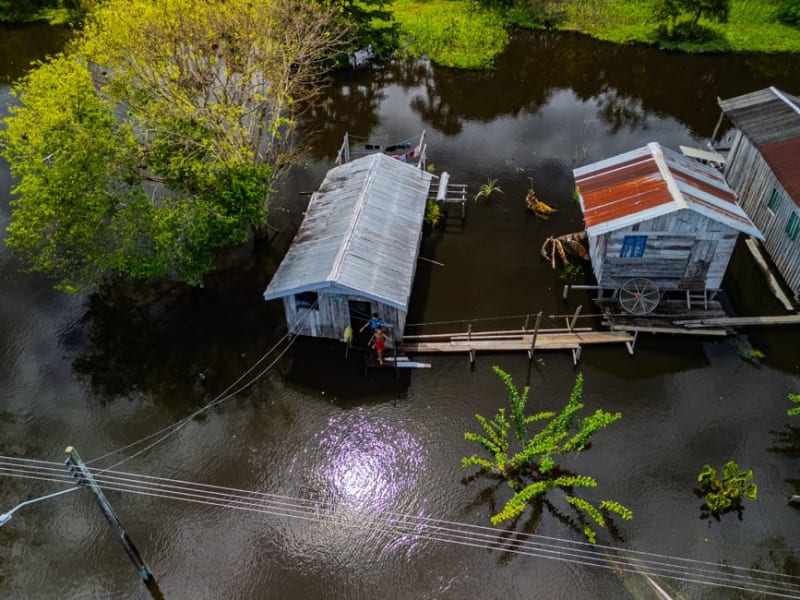 amazon-colombia
Puerto Alegria
A Peruvian fishing village on the far bank from Leticia, reachable only by boat and living on a completely different clock.
Explore amazon-colombia
Puerto Nariño
A car-free Amazonian community that manages its own jungle reserves and decided, deliberately, to become the most serene place in South America.
Explore amazon-colombia
Río Loretoyacu
A black-water tributary near Puerto Nariño where paddling through flooded forest at high water feels like moving through a drowned cathedral.
Explore amazon-colombia
Reserva Natural Tanimboca
A jungle canopy reserve fifteen minutes from Leticia where you sleep on platforms forty meters up and wake to a river of birds at eye level.
Explore amazon-colombia
Tarapacá
A remote frontier village on the Putumayo River deep in Colombia's far Amazon, reachable only by river or a tiny plane, where the forest still sets the rules.
Explore