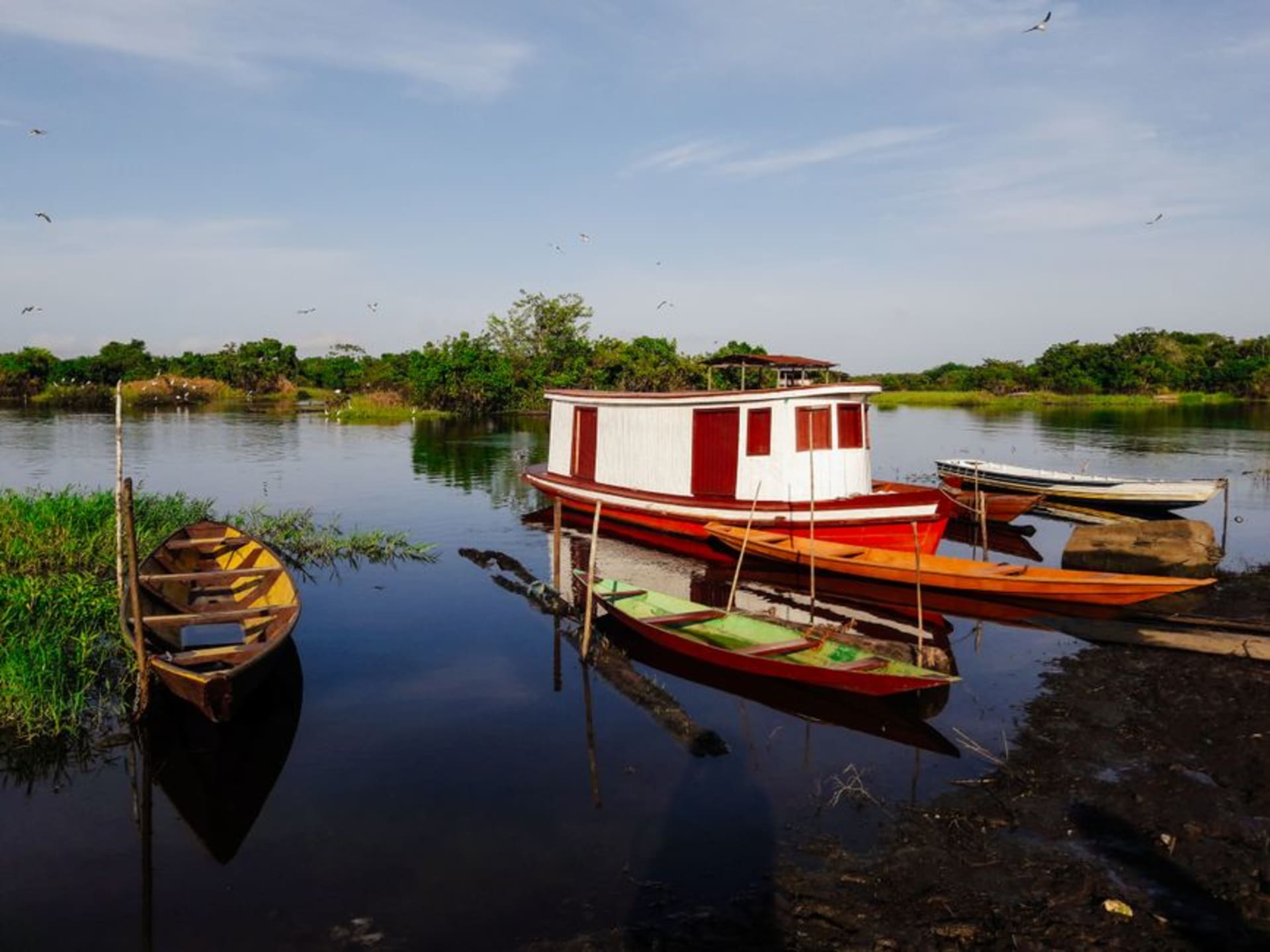
Obidos
"Here the whole Amazon squeezes through a doorway two kilometers wide, and you can watch it happen from a park bench."
A colonial river town where the Amazon narrows to a roaring throat, guarded by a crumbling fort and centuries of customs ledgers.
I’ll admit I hadn’t heard of Obidos before a boat captain in Santarem mentioned it, almost as an afterthought, while we were haggling over a slower riverboat north. “You should stop at the Garganta,” he said, “the throat.” Lia looked it up on her phone right there on the dock — the point where the entire Amazon, all that unfathomable width, gets squeezed down to about two kilometers. Ninety minutes later we were watching the water do exactly that, brown and fast and strangely loud, from a bench on the town’s riverside promenade. It didn’t look like a chokepoint. It looked like the river was in a hurry to be somewhere else.
We walked up from the docks into streets that felt lifted out of another century — low colonial houses in faded ochres and blues, wrought-iron balconies, a quiet that surprised me after the engine noise of the boat. Obidos was founded in 1697 as a fortified Portuguese outpost, and you can still feel why: whoever controlled this narrow stretch controlled everything moving upriver, cargo, canoes, eventually steamboats. The town’s old customs house did exactly that job for generations, taxing the Amazon’s traffic at its tightest, most defensible bend.
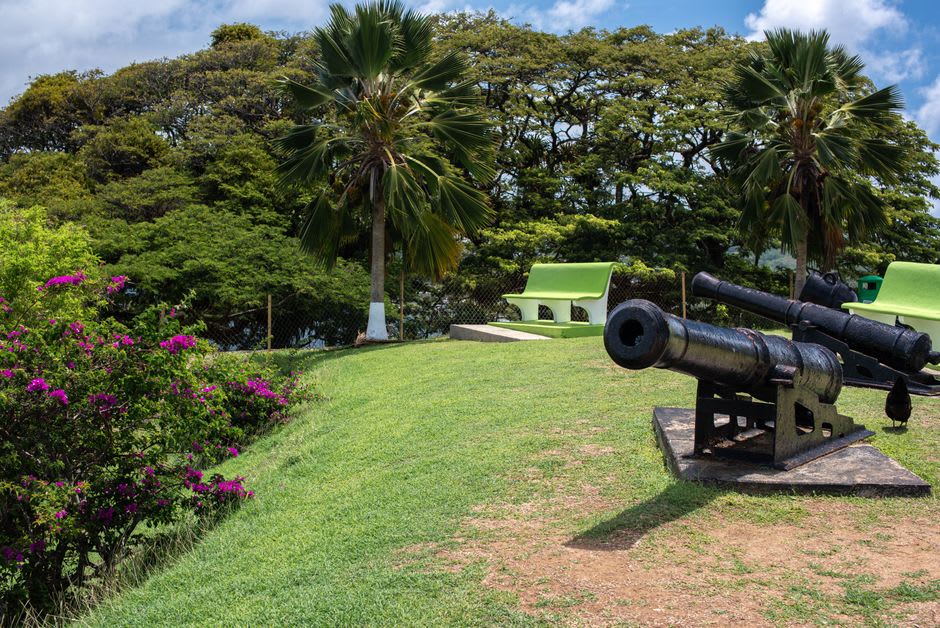
We spent a late afternoon at Fort Pauxis, right on the riverbank, its old cannons still aimed at the water as if a Dutch or English ship might round the bend any moment. Lia climbed up onto the ramparts and I stayed below photographing the light on the current — that river genuinely moves differently here, visibly faster than anywhere else we’d seen it. Later we hiked up to the hilltop ruins of Fort Gurjao, mostly foundations and imagination now, but the view from up there explained the whole town in one glance: a single vantage over the only door the Amazon has for hundreds of kilometers.
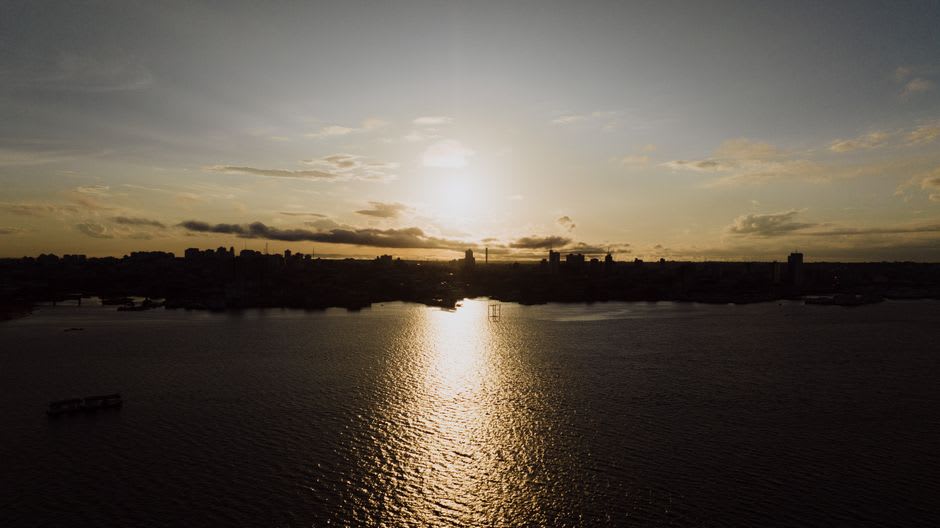
What stayed with me wasn’t the forts themselves, half-ruined as they are, but the strange intimacy of standing that close to the Amazon’s full force compressed into something you could almost skip a stone across. We ate grilled tambaqui at a tiny place near the praça, watched the river traffic squeeze through at dusk, and I remember thinking that Obidos, barely a footnote on most Amazon itineraries, had somehow shown us the river more clearly than Santarem or Manaus ever did.
When to go: We went in September, deep in the dry season that runs roughly August through November, when the river drops and the current at the Garganta becomes almost hypnotic to watch — and the old fort’s foundations along the bank sit fully exposed instead of half-swallowed by high water.
Keep exploring
More from Brazilian Amazon
 amazon-brazil
 Parintins
A river island town between Manaus and Santarém that explodes once a year into the Boi-Bumbá, the wildest folkloric festival in the Brazilian Amazon.
Explore amazon-brazil
 Presidente Figueiredo
A small forest town north of Manaus cut through with more than a hundred waterfalls and caves that most Amazon visitors never find.
Explore amazon-brazil
 Santarém
A river city at the junction of the Tapajós and Amazon where green water meets brown and the whole basin seems to hinge.
Explore amazon-brazil
 Tefé
A remote Solimões River town that is the last proper city before the deeper Amazon — and the gateway to Mamirauá.
Explore amazon-brazil
 Alter do Chão
A village on the Tapajós River where Caribbean-white sand beaches emerge in the dry season, surrounded by forest, utterly improbable.
Explore amazon-brazil
 Anavilhanas Archipelago
Four hundred islands in the Rio Negro that dissolve into flooded forest each wet season, then re-emerge as beaches and channels.
Explore