
Anavilhanas Archipelago
"In flood season, the islands disappear. The forest just keeps going, but now you're floating through it."
Four hundred islands in the Rio Negro that dissolve into flooded forest each wet season, then re-emerge as beaches and channels.

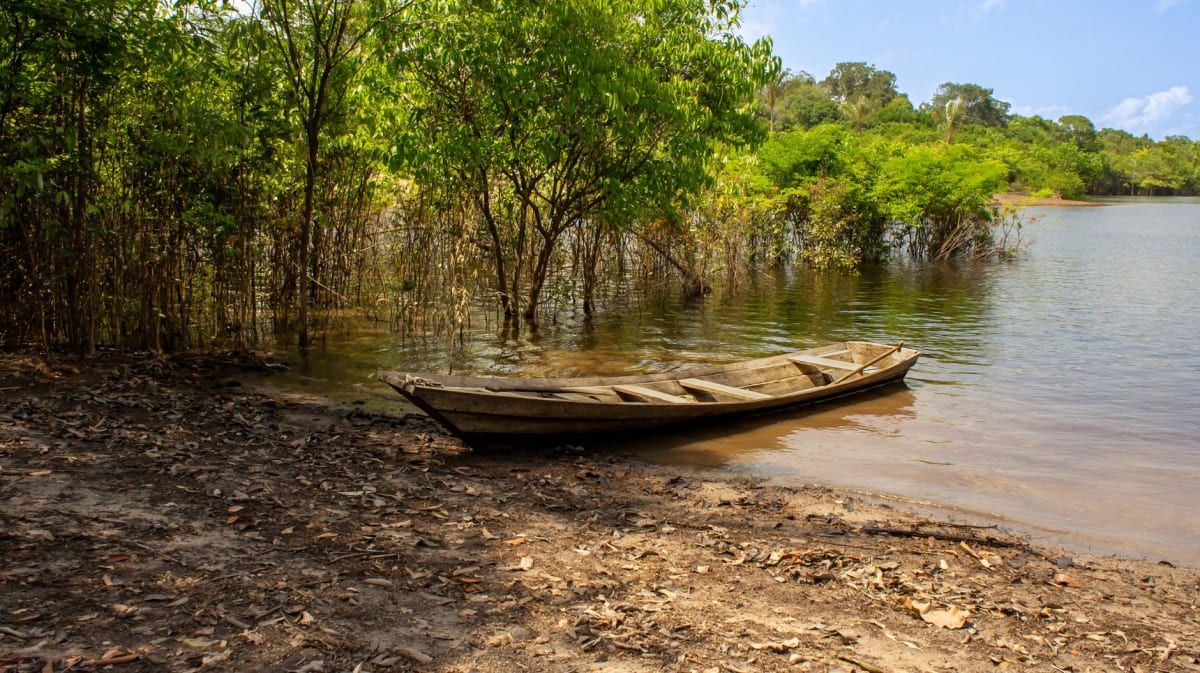
Novo Airão is a small river town two hours west of Manaus by boat, and the Anavilhanas start just offshore. I came in the middle of the flood season — March, the river at its highest — and the distinction between water and forest had become theoretical. The boat moved through the canopy. Tree branches hung at eye level. Palms stood knee-deep in the dark water. The forest was continuous and the river was continuous and the boundary between them had been dissolved by three months of rain.

The Anavilhanas Ecological Station covers roughly four hundred islands in the Rio Negro, about sixty kilometres upstream from Manaus. In the dry season, they emerge as distinct landforms — sandy beaches on their downstream edges, dense forest rising behind, narrow channels between them running fast and clear. In the wet season, the islands half-submerge and the river swallows the lower forest, creating an ecosystem called igapó: flooded forest, where fish swim between the tree roots and the biodiversity of water and land fold together in ways that took ecologists decades to begin understanding.
My guide, a woman from Novo Airão who had been running trips into the Anavilhanas for fifteen years, knew the channels like she knew the streets of her town. She took me through a passage so narrow the tree branches brushed both sides of the canoe, then opened into a wide dark lake ringed by kapok trees draped in Spanish moss, the surface perfectly still and the reflection so complete it was disorienting — impossible to tell sky from water. We found a three-toed sloth moving with glacial purpose along a submerged branch, its reflection rippling slowly below it.
The Anavilhanas are also one of the better places in the Brazilian Amazon to find river dolphins. The boto — the pink Amazon river dolphin — appears here in numbers, particularly near the mouths of the side channels. In Novo Airão, there’s a floating dock where wild botos have been coming for decades, lured by fish offered by the community. The practice is debated among conservationists, but the experience of having a wild dolphin surface directly in front of you, close enough to see the small dark eye set wide in the pink forehead, is not one I’ll describe away.
When to go: The two seasons offer genuinely different experiences. Dry season (June to November) means beach camping on the island shores, swimming in the channels, and the full visual clarity of the archipelago’s geography. Flood season (December to May) means canoeing through the submerged forest — weirder, more magical, and logistically harder to plan. Both are worth the journey.
Keep exploring
More from Brazilian Amazon
 amazon-brazil
Encontro das Águas
Where two rivers meet and refuse to mix for eight kilometres — the most astonishing natural fact I have ever witnessed.
Explore amazon-brazil
Ilha do Combu
A ten-minute boat crossing from Belem into a world of cacao groves, solar-powered chocolate stoves, and river silence.
Explore amazon-brazil
Jaú National Park
The largest fully protected stretch of Amazon rainforest on earth — black water, no signal, and an ecosystem untouched by the twentieth century.
Explore amazon-brazil
Mamirauá Sustainable Development Reserve
A flooded forest reserve where conservation actually worked — and home to the rare white uakari monkey found almost nowhere else.
Explore amazon-brazil
Manaus
A city of a million and a half people stranded in the forest, wearing its contradictions like a second skin.
Explore amazon-brazil
Marajó Island
An island the size of Switzerland at the Amazon's mouth, where buffalo roam the savanna and pre-Columbian ceramics emerge from the earth.
Explore