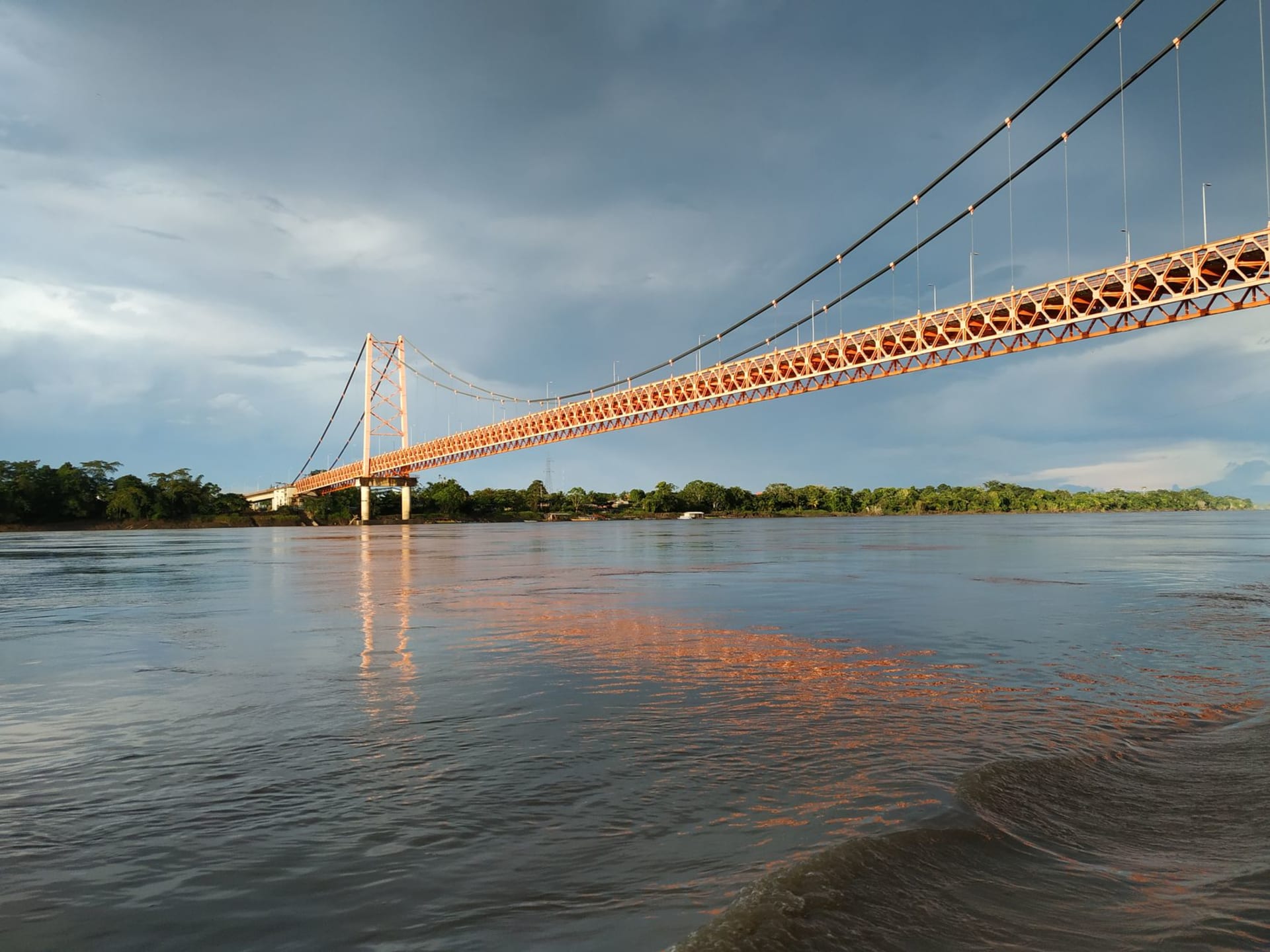
Puerto Maldonado
"Four hundred macaws hitting a cliff face at dawn — there are things in this world that will simply undo you."
The alarm went at four-fifteen and I was annoyed about it for exactly twelve minutes, until the boat rounded the river bend and the clay lick came into view. A collpa is a section of exposed riverbank where minerals concentrate in the clay — iron, calcium, sodium — and the parrots and macaws come to eat it, some complex metabolic need driving them to supplement their fruit-heavy diet with earth. I had read about this. I had seen photographs. Neither prepared me for the moment when four hundred macaws dropped out of the tree canopy above and hit the cliff face simultaneously, the scarlet and the emerald and the blue breaking across the orange clay like something poured from a height. I sat in the boat with my mouth open for what felt like a long time. The guide, who had seen this every day for years, was smiling at my expression.
Puerto Maldonado itself is a rough frontier city on the Madre de Dios River — the main Peruvian gateway to the southern Amazon, two hours by road from Bolivia and three by air from Lima. It smells of motorbike exhaust and river fish. The streets in the market district are chaotic in the way of small Amazonian ports: hammock sellers beside pharmacies beside stalls selling jungle honey and cat’s claw vine. There’s gold in the rivers here, and the small-scale gold mining has left its mark on the landscape north of town — open pits and mercury-contaminated water that sit in uncomfortable proximity to the lodges advertising pristine jungle. This contradiction is hard to ignore and worth knowing before you arrive.

The reason to come is the Tambopata National Reserve, which begins about forty minutes south of town by boat down the Tambopata River. The lodge system here is one of the better-developed in the Amazon — research stations have been operating in the reserve since the 1980s, and the guides have an institutional knowledge of the forest that shows in every walk. I spent two days at a lodge whose balcony looked over a lake full of giant river otters. They were enormous — nearly two metres long — and completely indifferent to us, surfacing to eat catfish a few metres from the dock with a businesslike efficiency that felt slightly reproachful, as if we were interrupting something important.
The Brazil nut economy is the soul of this region. The castanha do Pará, as Brazilians call it, grows only in old-growth forest — the trees take a century to produce their first fruit, and they reproduce only through a specific bee and a specific agouti rodent that buries the nuts and forgets some of them. The harvesters, called castanheiros, spend months deep in the forest during the nut-fall season, living in simple camps, collecting the pods. I met one in town: a man of about sixty with very callused hands who showed me, with quiet precision, exactly how to open a pod with a machete without losing fingers. The nuts inside tasted different from any I’d bought in Europe — richer, oilier, with a faint sweetness that I suspect is just what freshness tastes like.

Evenings at the lodge I would sit on the balcony after dinner and listen to the forest settle into its night sounds — the frogs beginning their overlapping calls around seven, then the deeper sounds starting after ten, a low churring from something I never identified, and once, very close and then receding quickly, what the guide confirmed was a jaguar. I didn’t sleep well after that, which I considered a success.
When to go: May through October is the dry season — trails are more accessible, the clay lick is most active, and the Tambopata River runs low enough to expose beaches. November through April is the wet season; the forest is extraordinary but trails can be impassable. June and July are the coolest and driest months and are generally considered the best time to go. Book lodges two to three months ahead for dry season.