Manaus
"An opera house in the middle of the Amazon. Not a metaphor. A building you can touch."
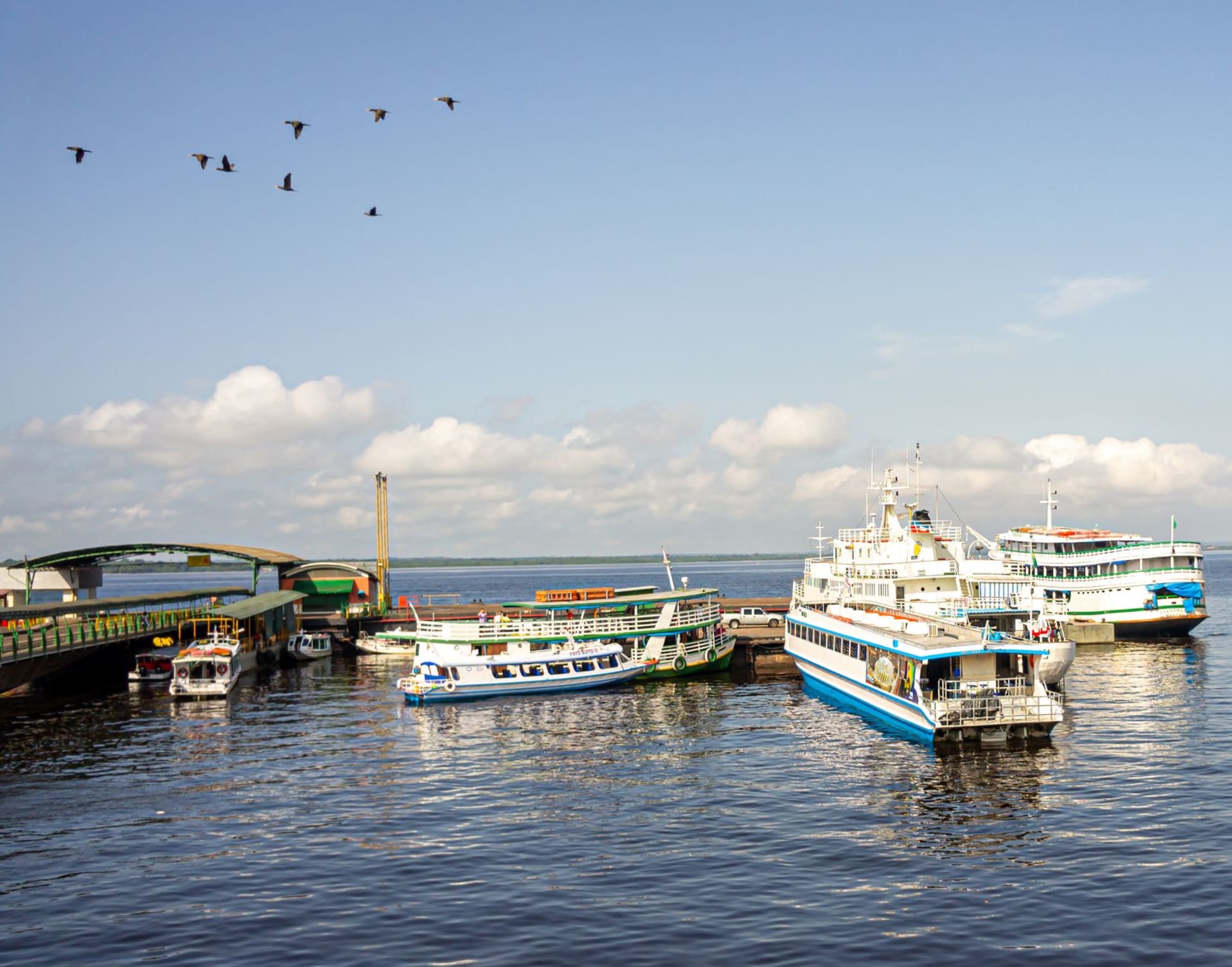
The boat docks at the Porto Flutuante just before dawn, and Manaus presents itself as a smell before it becomes a view — diesel, river mud, frying dough, something sharp and organic underneath it all that I eventually identified as smoked pirarucu. The floating port rises and falls with the river, its metal gangways adjusting to the season, and by five in the morning it is already heaving: dock workers with hand trucks, women carrying trays of tapioca, a man asleep on a pile of ropes who does not stir as the crowd moves around him. I stood at the top of the gangway for a while, just watching the light come up over the water, before anyone asked me to move.
Manaus is a city that should not exist and yet very much does. Two million people in the middle of the world’s largest rainforest, connected to the rest of Brazil by river and by air but not by road — the nearest highway is hundreds of kilometres away, and reaching São Paulo by land is a multi-day ordeal nobody chooses. The city was built on the rubber boom of the late nineteenth century, and the money shows in the architecture: the Teatro Amazonas, the opera house on the hill above the port, with its green-and-gold mosaic dome and its Italian marble and its four hundred seats, constructed at enormous cost to prove something about civilization and distance and the will of men who had become very rich very quickly. I arrived at it on my second morning and stood outside for a long time before going in.

Inside, the Teatro is all carved mahogany and painted ceilings and a floor that was designed to flex, sprung so that the vibrations of dancing wouldn’t carry into the street. The guide told me this with the quiet pride of someone who has watched a hundred tourists realize what they are standing inside. I sat in one of the balcony boxes and tried to imagine a rubber baron from the 1890s in this same seat, listening to an Italian opera company that had been shipped upriver at ruinous expense. The absurdity of it is the point — the opera house is proof that the Amazon made people feel they could do anything, and also that they could be staggeringly wrong about what to do with the money.
The mercado municipal, down near the waterfront, is where Manaus makes more immediate sense. The Adolpho Lisboa market — its iron structure imported from Europe in 1882, predating the opera house — sells everything the river produces. Smoked fish hangs in rows above the vendors’ heads, the pirarucu like planks of dark wood, filleted and preserved for upriver communities. A woman with deep brown hands presses the jambu leaf between her fingers and explains that it is for tacacá — the famous soup made with tucupi broth, dried shrimp, and jambu that makes your tongue go numb and electric. I ate three bowls across three different days and the sensation never fully made sense to me, which was part of the appeal.

The Encontro das Águas — the meeting of the waters — lies about an hour east of the city by boat. Where the dark-tea of the Rio Negro meets the silt-brown of the Rio Solimões, the two rivers run side by side for several kilometres without mixing, a visible seam of colour dividing the water. Temperature, velocity, density — the rivers maintain themselves as separate entities despite their proximity, which felt like a metaphor I kept trying not to overuse. I watched a pink boto dolphin surface near the boat’s wake and dive again before I could point at it. The guide said they came most reliably at dawn. I was up before five the next morning.
When to go: June through November is the dry season, when river beaches emerge and the streets of Manaus become navigable in the heat. February through May is flood season — the Rio Negro rises ten to fifteen metres and the várzea forests around the city are navigable by canoe, an extraordinary experience but one that requires booking ahead. Manaus is hot and humid in every season; the afternoon thunderstorms of the wet season are something to see from a covered terrace with a cold beer.