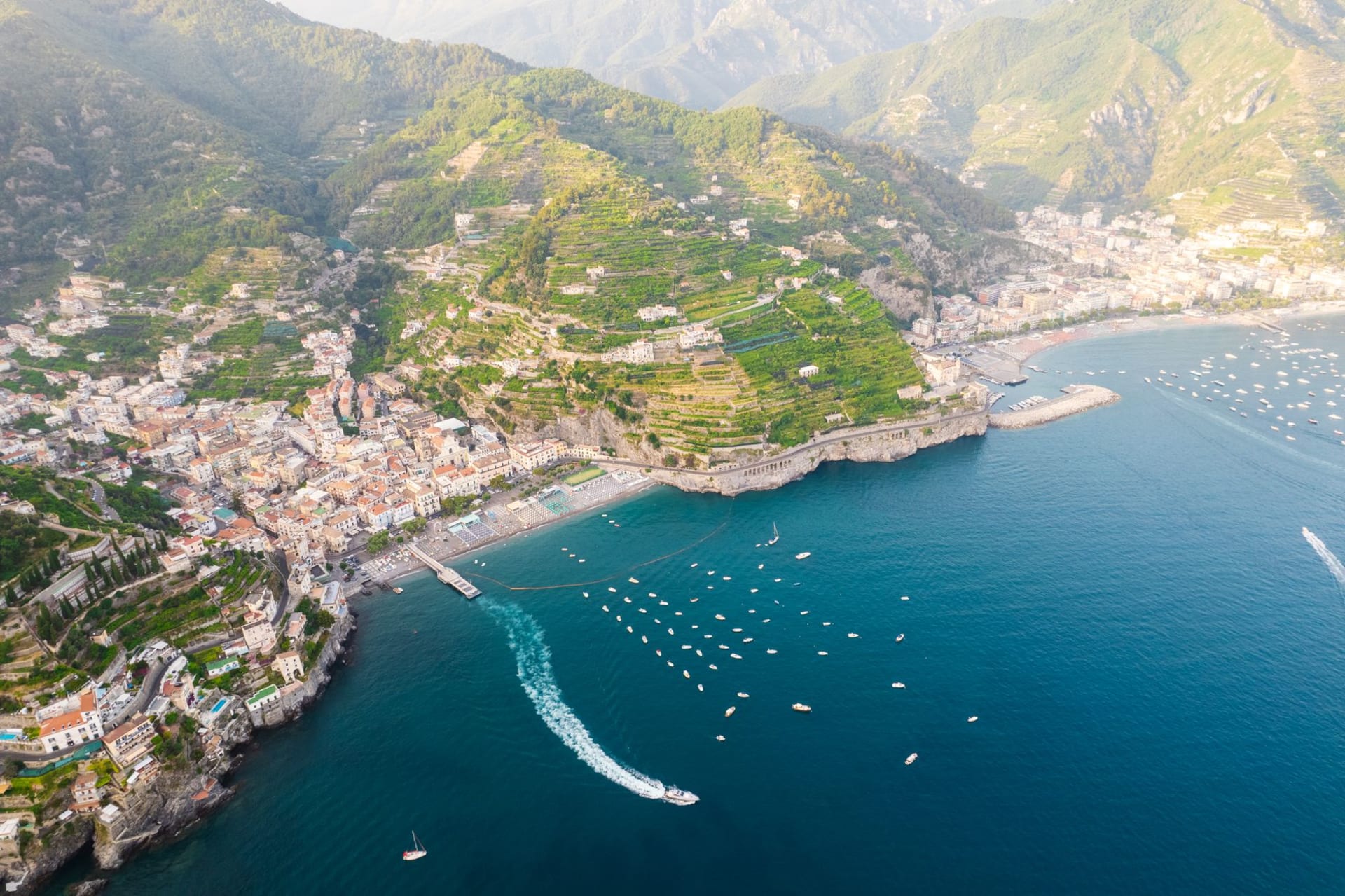
Vietri sul Mare
"You come for a ceramic bowl and leave understanding why people build whole collections around a glaze."
Vietri sul Mare marks the eastern edge of the Amalfi Coast, and it is the gateway most people enter without realizing they have. Coming from Salerno by bus or train, Vietri is the first town — the place where the ordinary Campanian coast transforms suddenly into the vertical drama of the Costiera. What stops you in Vietri isn’t the cliff scenery, though. It’s the ceramics. They are everywhere: stacked in doorways, tiled into facades, hanging from shop fronts in overlapping rows of plates and vases and urns and decorative panels. Walking the main corso feels like moving through the sample book of an impossibly productive workshop — every color combination tried, every decorative motif iterated.
The ceramic tradition in Vietri dates to the 16th century and was formalized by the German artist Richard Doelling, who came here in the 1920s and established the Solimene factory, which still produces. But the real history goes back further — the local clay, the quality of the water, the centuries of accumulated technique. The characteristic Vietri style is immediately recognizable: cobalt blue and manganese brown and lemon yellow on a bright white ground, often with stylized fish or roosters or geometric borders, fired to a glaze that has a particular depth you don’t get from the tourist-market facsimiles. The fakes are easy to spot once you’ve held the real thing — the weight is different, the glaze sits differently in the light.

I spent a morning at the Ceramica Solimene factory on the edge of town — the factory building itself is a 1954 design by Paolo Soleri, a zigzag of terracotta-and-glass tower structures that looks like a cross between a medieval watchtower and a brutalist fantasy and somehow works. The showroom occupies the base, and in the back you can watch the painters at their benches, moving the same brush strokes that have been practiced here for generations. A senior painter named Maria was doing the rooster motif on a set of dinner plates. I watched for about fifteen minutes. There was nothing she did that wasn’t completely assured. She noticed me watching and, without breaking rhythm, offered a small nod of acknowledgment.
The town above the factory — the old borgo, climbing steeply up from the coast road — has a quieter character than the commercial strip along the main road. The church of San Giovanni Battista at the top is faced entirely in majolica tiles, its dome a brilliant cobalt and gold visible for kilometers out to sea. The view from the terrace beside it encompasses the whole Gulf of Salerno, the flatlands around the city spreading south, and to the west the beginning of the coastal cliffs. It’s the view that reminds you: this is where the drama begins. Everything west of here is vertical.
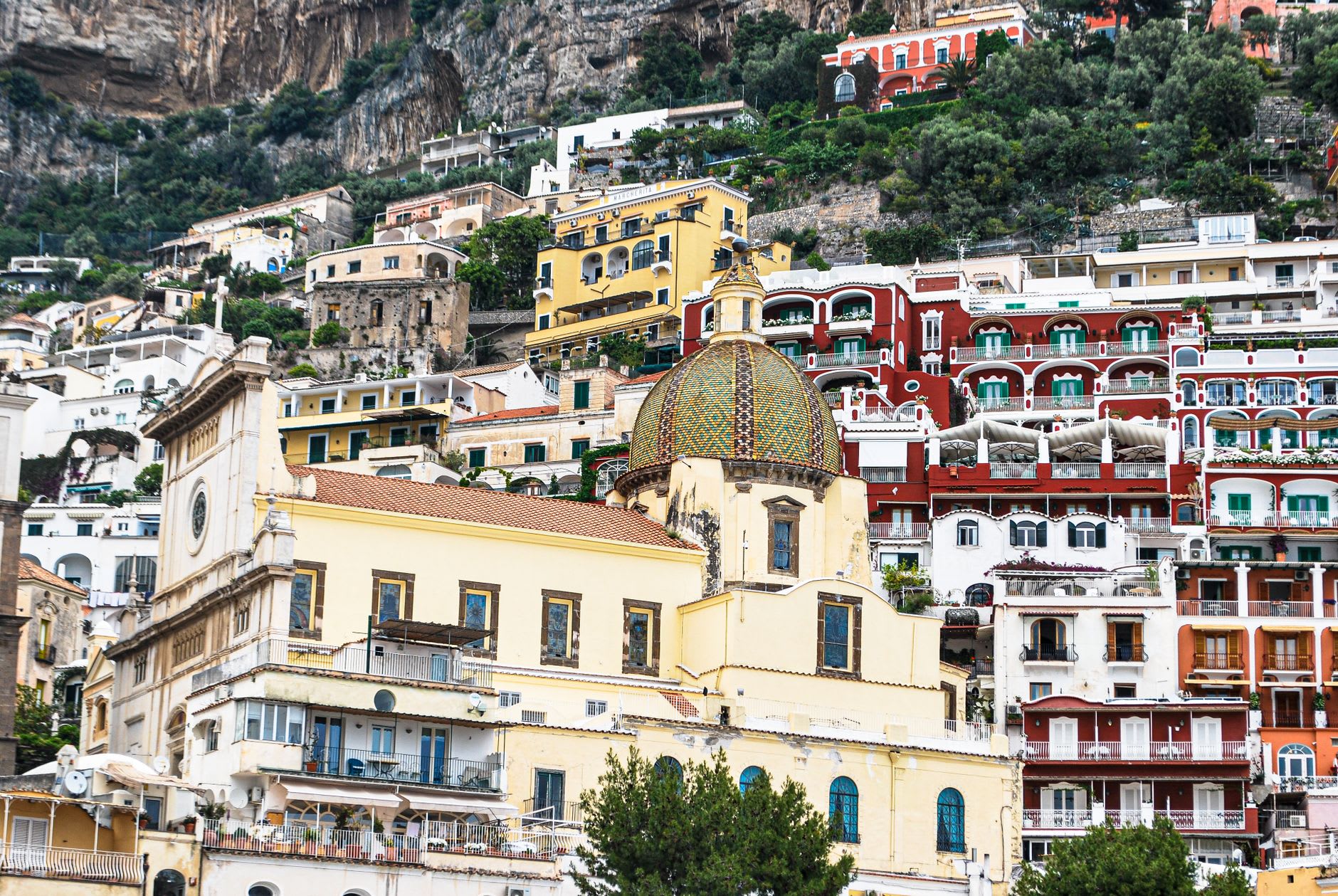
Eating in Vietri is a practical pleasure rather than a revelation — good fresh pasta, a seafood risotto at the trattoria below the church that had a sweetness from the local clams I wasn’t expecting, a granita stand on the main corso that makes a coffee granita in the afternoon that, combined with the ceramic shopping fatigue, functions as a complete sensory reset. I left with a set of espresso cups in cobalt and yellow, wrapped in newspaper. They survived the journey. They’re on my shelf in Mexico now and I drink from them every morning.
When to go: Vietri works year-round as a day trip from Salerno or the coast — the workshops are open most of the year, including in winter when the rest of the coast closes. Spring and autumn are most pleasant for walking. July and August: the shops are fully stocked and the heat is intense. The factory does workshop sessions in spring and early autumn where you can learn the basic brush techniques, which I deeply regret not doing.