
Ravello
"The Terrazza dell'Infinito doesn't exaggerate — you lean on the railing and the horizon just keeps going."
A hilltop town three hundred meters above the sea where Wagner wrote opera, the gardens have no bottom, and the crowds somehow never follow you up.

The bus from Amalfi climbs a switchback road so steep and narrow that you press yourself against the window as oncoming vehicles pass within inches, and then suddenly it stops in a small piazza and a woman says something in dialect and everyone gets off, and you are in Ravello. The air is different up here — cooler, lighter, faintly resinous from the umbrella pines. Below you, barely visible through the trees, the sea glints three hundred meters down. The town is spread along a ridge, and everything about it — the pace of people walking, the sound levels, the way shopkeepers don’t seem to urgently want your business — operates at a frequency removed from the frenzy of the coastal towns.
Ravello is famous for two things: its music festival and its gardens. The Ravello Festival runs through the summer in the open-air auditorium of Villa Rufolo, and the setting is absurd — an orchestra beneath the stars with the black Tyrrhenian below and the lit villages of the coast scattered along the clifftops like fallen stars. Wagner came here in 1880, looked at the garden at Villa Rufolo, and decided he’d found the inspiration for the garden of Klingsor in Parsifal. There’s a plaque. I stood at it in the early morning when the garden was empty and tried to understand what he saw, and I think I got some of it.

But it’s Villa Cimbrone that breaks you. The gardens stretch along the ridge, a long walk through rose gardens and classical statuary and shaded pergolas draped in wisteria, until you arrive at the Terrazza dell’Infinito — the Terrace of Infinity — a balustrade lined with marble busts at the absolute edge of the ridge. Below is three hundred meters of air and then the sea, stretching south toward Africa. The busts look out toward the horizon with expressions that seem appropriate: serene, slightly dazed. I stood there for twenty minutes. The sea changed color four times. A French couple behind me went completely quiet.

Ravello town itself rewards slow exploration. The cathedral of Santa Maria Assunta has a bronze door from 1179 and an interior that smells of candles and old stone, a certain particular silence that feels earned. The piazza outside it in the evening — tables out, a carafe of the local white wine which has a mineral quality the coastal towns never quite match, old men playing cards in the corner — is one of the more civilized scenes on this coast. Ravello doesn’t have a beach. It doesn’t need one. It has altitude and gardens and a view that makes everything else feel like it’s operating at the wrong level.
When to go: Spring and autumn, unambiguously. May brings the roses at Villa Cimbrone to full bloom and the air is soft. July and August see the festival in full swing, which is wonderful if you book ahead — the concerts are extraordinary — but prices spike and the town fills. October is ideal: the gardens thin out, the light turns amber, and you can have the Terrazza dell’Infinito to yourself on a weekday morning. In winter Ravello goes quiet to the point of near-abandonment, which has its own austere appeal.
Keep exploring
More from Amalfi Coast
 amalfi-coast
Scala
The oldest town on the Amalfi Coast, where quiet stone lanes and a Romanesque crypt sit above the crowds, facing Ravello across the ravine.
Explore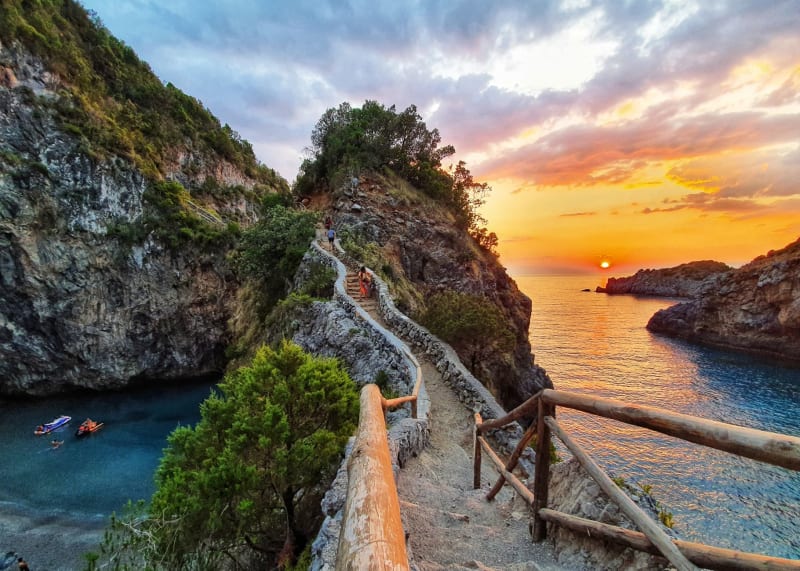 amalfi-coast
Sentiero degli Dei
The Path of the Gods — a ridge trail above the coast that offers the one view of the Amalfi Coast that the Amalfi Coast itself cannot give you.
Explore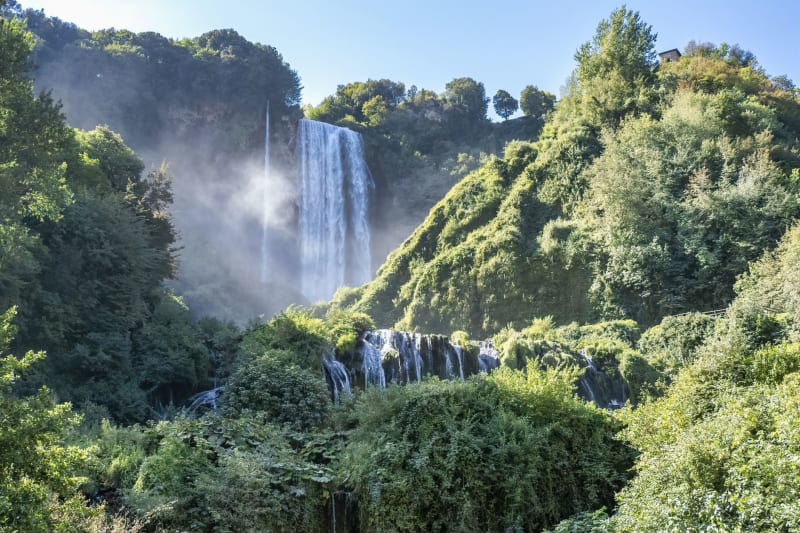 amalfi-coast
Valle delle Ferriere
A cool green valley above Amalfi where old paper mills rot beautifully among waterfalls, ferns, and lemon groves — the coast's only real escape from the coast.
Explore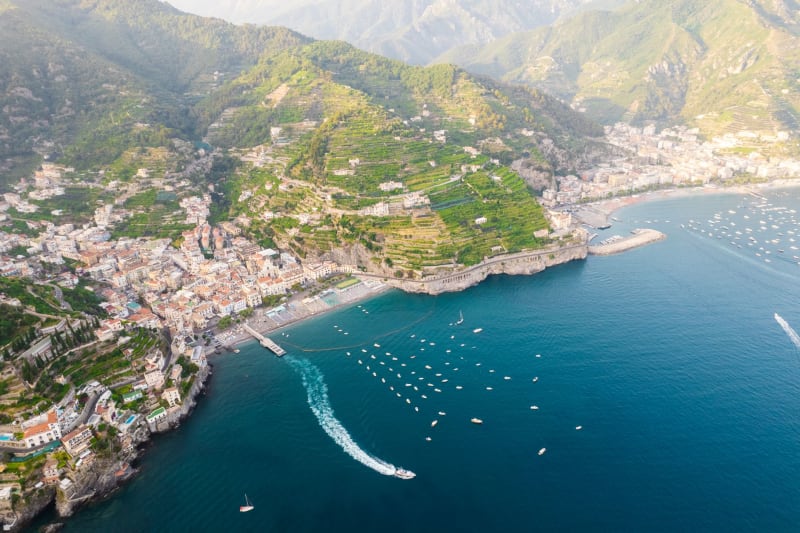 amalfi-coast
Vietri sul Mare
The ceramics capital of the Italian south, where every building facade is an advertisement and the workshops have been glazing the same cobalt-and-yellow patterns for four hundred years.
Explore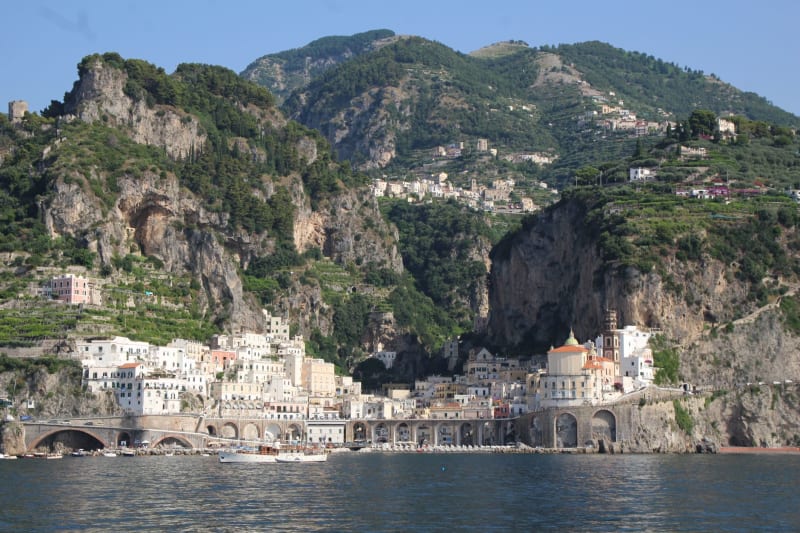 amalfi-coast
Amalfi Town
A medieval maritime republic squeezed into a gorge above the sea, with a cathedral that looks like a fever dream and lemons that taste like an argument against everything else.
Explore amalfi-coast
Atrani
Five minutes from Amalfi by foot but decades away in atmosphere — the smallest village on the coast still lives like it forgot it was supposed to become a tourist attraction.
Explore