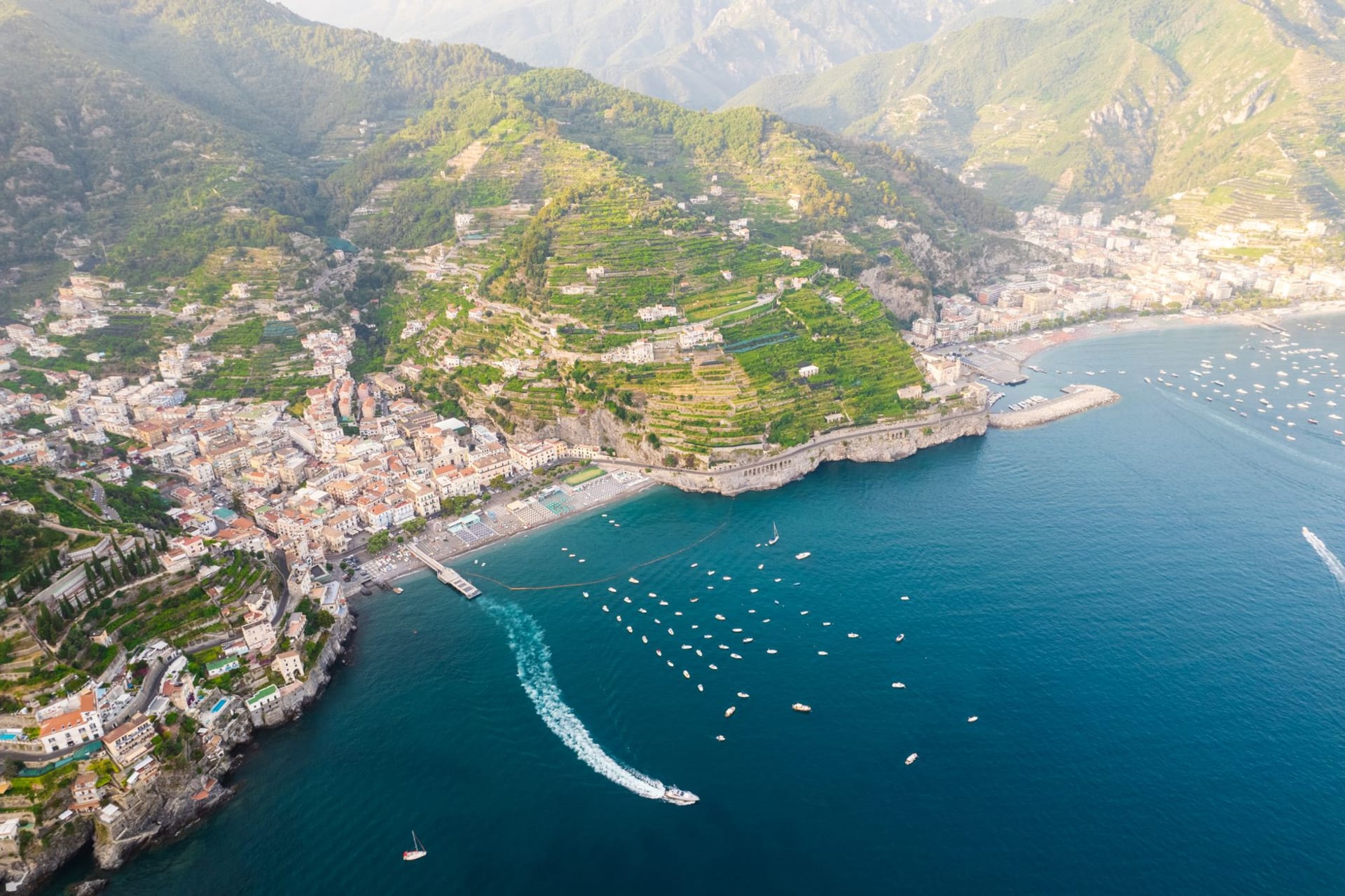
Most people pass Conca dei Marini without knowing they have. It sits on the corniche between Amalfi and Praiano, a knot of white houses spilling down a green headland to a cove so small it barely registers from the bus window. We only stopped because Lia, reading aloud from a scrap of guidebook, said the words emerald cave, and I will detour a long way for anything that sounds like that. It turned out to be one of the best decisions we made on the whole coast.
Down to the Emerald Grotto
The Grotta dello Smeraldo is the village’s headline act, and for once the hype is honest. You descend by a lift cut into the cliff, or by a long stair if the lift is having one of its moods, and at the bottom a boatman waits in the dim to row you out across the water. The cave was once above sea level; the floor sank over the centuries, drowning a forest of stalagmites that now rise eerily through clear green water. Light enters from below the surface, refracted, so the whole cavern glows an unearthly emerald, and the boatman’s oar drips little beads of green fire. There is, inexplicably, a ceramic nativity scene submerged on the cave floor, lowered there decades ago. Lia found it absurd. I found it absurd and rather wonderful.
The boatman talked the entire time in a Neapolitan dialect I caught perhaps one word in five of, gesturing at formations he had clearly named himself, and refused to be hurried. That refusal, I have decided, is the real spirit of Conca.

The Convent, the Pastry, and the Beach Below
Up on the headland stands the Convento di Santa Rosa, now a luxurious hotel, but its fame is sweeter than that. The nuns who lived here three centuries ago invented the sfogliatella Santa Rosa — the shell-shaped, ricotta-filled pastry that all of Naples now claims as its own. The story goes that a thrifty sister, faced with leftover semolina, folded it into layered dough and filled it with cream and candied fruit, and an obsession was born. I ate one, warm, from a bakery in the village that still makes them the old way, and the lemon-scented cream and the shattering crisp shell together very nearly stopped me in the street.

Below all this lies the cove, Marina di Conca, reached by a stairway that punishes the lazy. There is a stub of a beach, a single old watchtower on the point, and water of a blue so saturated it looks dyed. We swam out past the boats, floated on our backs, and watched the village climb the cliff above us in tiers of white and ochre. A handful of locals sunned themselves on the rocks. No tour groups, no selfie scrum, none of the Positano circus. Just a small, steep, perfect place getting on with its afternoon, and us briefly allowed to share it.
When to go: May, June, or September. July and August fill the cove and the grotto queue gets long; the shoulder months give you warm water, working boats, and the village more or less to yourself.