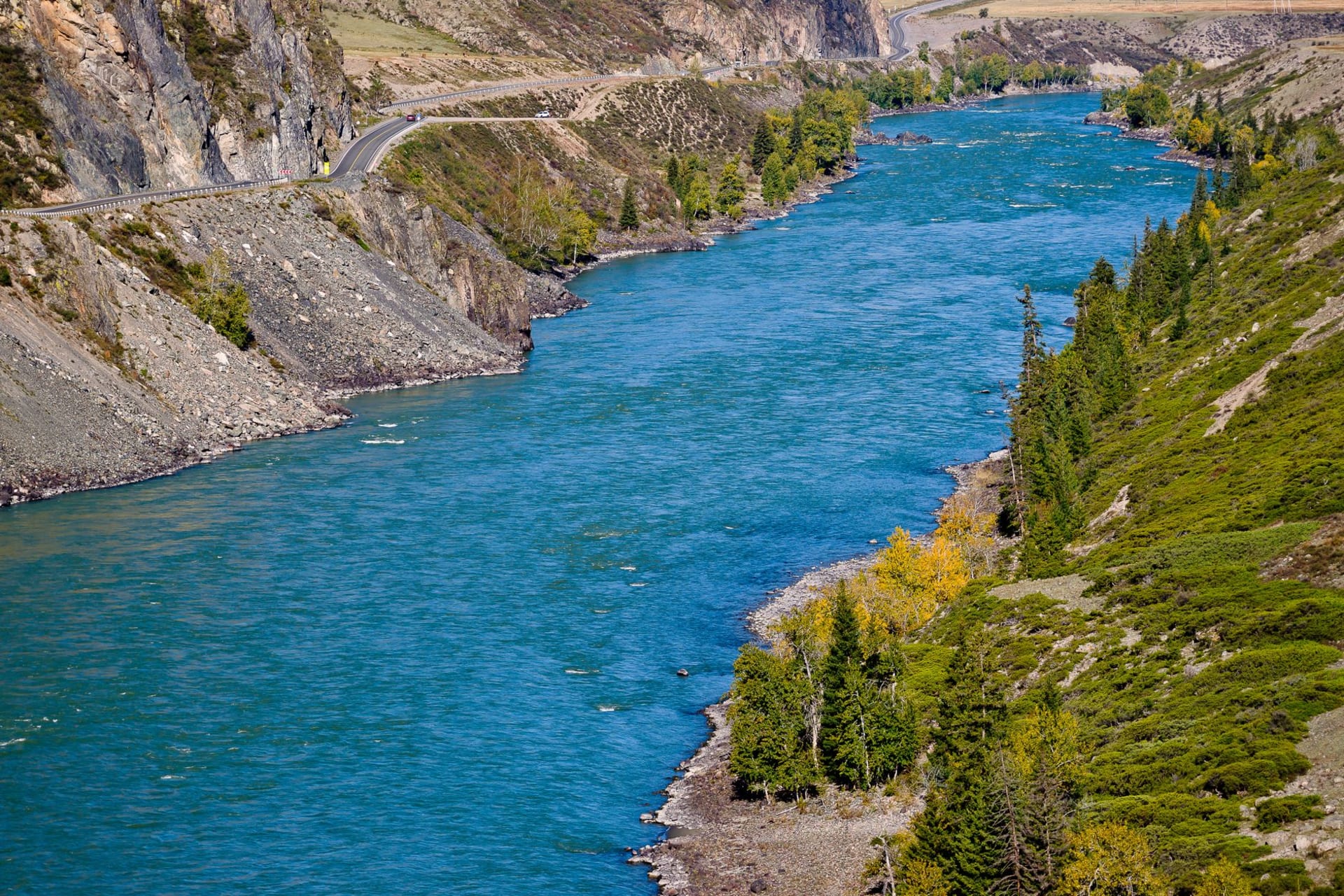
Katun Valley
"The Katun is the kind of river that makes you question whether the colour blue has been adequate your whole life."
The first thing that stops people on the Katun is the colour. Not the mountains around it, not the forest on the banks, not the scale of the valley — but the water itself, which runs a shade of turquoise that seems categorically wrong, the kind of blue that belongs in a travel advertisement and not in the physical world. Standing at the water’s edge for the first time, I actually crouched and put my hand in to confirm it was real. It was real. It was also very, very cold. The colour comes from glacial flour — fine mineral sediment suspended in the meltwater from the Belukha massif — and it intensifies in late summer when snowmelt is highest.
The Katun is the main river of the Altai Republic, running 688 kilometres from its source below Belukha all the way to its confluence with the Biya at Biysk, where together they form the Ob. But the section of valley between Gorno-Altaysk and the Chemal district is where most people first encounter it, and where the river earns its reputation. Here it runs between steep forested slopes, pulling small beaches of pale grey gravel out of the bends, surfacing occasionally into long flat stretches where the reflection of the sky doubles the blue. Rafters use these stretches. I watched a group of Russians in inflatable kayaks navigate a section of Class III rapids from a rock above the river, their paddling inefficient and their enthusiasm total.

The valley has its own small culture of summer tourism — campsite clusters, a few guesthouses run by local families, the occasional roadside stand selling smoked fish from the river itself. The fish is a variety of grayling, caught by the old men who appear at dawn with rods and rubber boots and a patience that seems constitutionally different from any other kind of patience. I bought a smoked fish for about fifty roubles from a man who had clearly been smoking fish beside this road for decades. He wrapped it in newspaper. It was extraordinary — dense, barely salty, with a flavour that tasted like cold water and mountain pine simultaneously.
Further upstream, past Chemal and toward Tyungur, the valley narrows and the character changes. The tourist infrastructure thins, the road deteriorates pleasantly, and the river reveals its upper nature: faster, louder, pushing through gorges where the canyon walls leave only a strip of sky visible overhead. At the village of Ust-Sema, where the Sema River joins the Katun, I sat on a pebble beach for an hour doing absolutely nothing productive. The sound of the water occupied the entire available space. It was, I realised, the Altai doing what the Altai does best: filling all the silence with something better.

The valley also holds several Scythian-era archaeological sites — kurgans and deer stones visible from the road in the Ust-Kan and Ongudai areas — and the rock art that clusters wherever the valley walls are dark enough to hold the pecked marks of ancient hands. The Katun is not only beautiful; it is ancient in a way that the landscape communicates quietly but continuously.
When to go: July and August are peak season along the Katun — warm enough to swim (briefly), the river at its most vivid blue. Late August and September bring the first autumn colours to the slopes, which turn the valley into something with a completely different aesthetic. Rafting season is May to September.