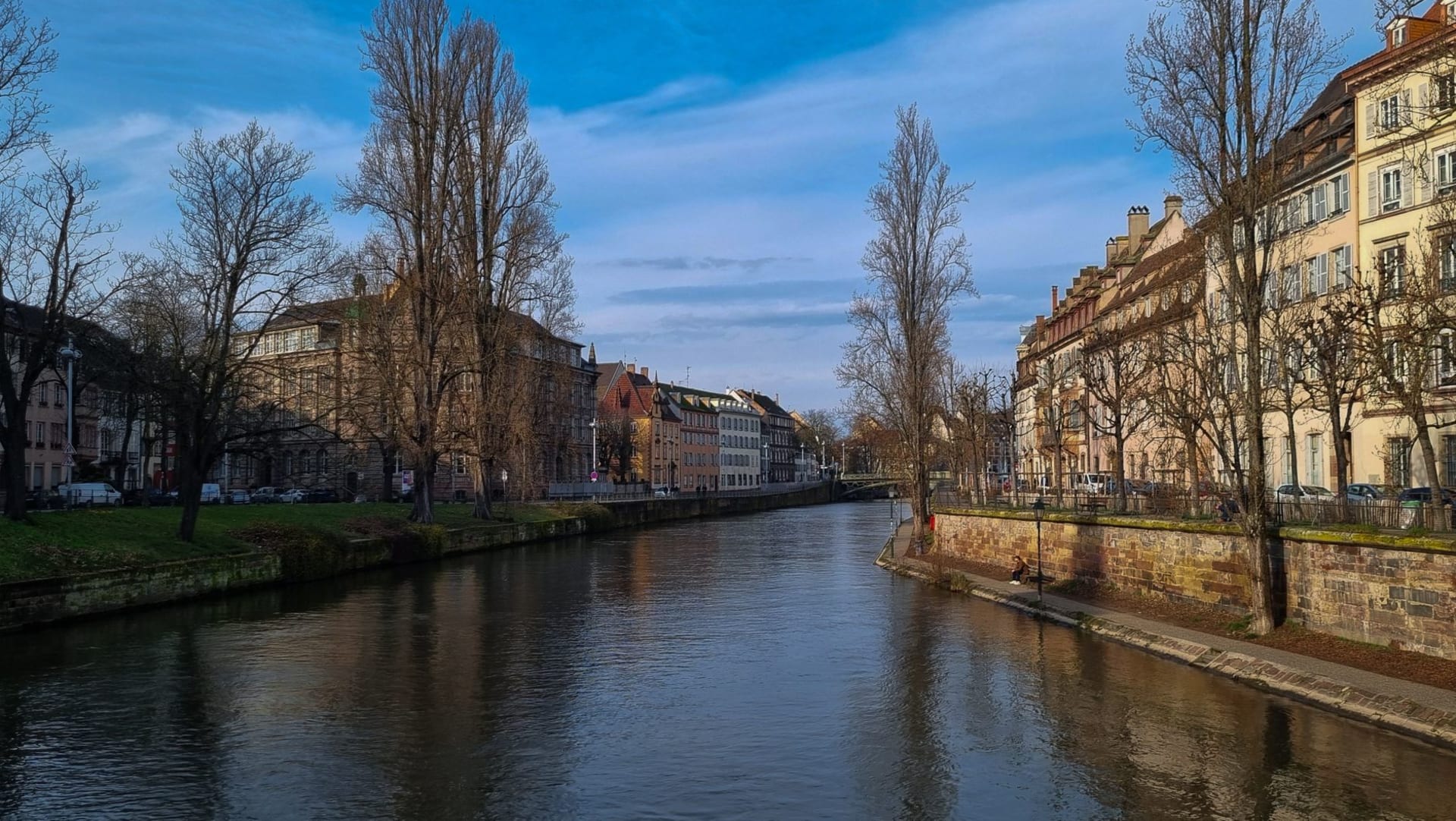
Strasbourg
"A city that has been French and German so many times it simply decided to be both at once and not apologize for it."
The cathedral appears before Strasbourg makes sense. I was still navigating from the tram stop, following the map on my phone through narrow streets of half-timbering and corner wine bars, when the pink sandstone tower climbed out of the rooftops and refused to stop. It is 142 meters and was the world’s tallest building for two centuries, and it has none of the abstract majesty of Notre-Dame. It is detailed, elaborate, almost overworked — a building that could not stop adding things — and standing directly beneath the western façade produces a specific kind of vertigo.
The Grande Île is the island at the center of the city, bounded by the arms of the Ill river, and it holds most of what matters. The streets run narrow and half-timbered and generally refuse to go straight. I spent two days walking them without a fixed destination, finding courtyards behind wooden gates, wine bars in converted stables, and a covered market in the Halles de la Krutenau that sold Alsatian sausages and Munster cheese and a walnut oil so dark and nutty it tasted like autumn condensed into a bottle.

The Petite France quarter occupies the southwestern corner of the island, where the tanners and millers once worked the river. The wooden-frame houses here are the oldest and most elaborate in the city, their upper floors corbelled out over the street, their reflections falling into the canal locks that still operate below. It is deeply picturesque in a way that requires you to squint past the tour groups to enjoy it, but the early morning or the rain handles this effectively.
What distinguishes Strasbourg from Colmar, apart from scale, is its contemporary European identity. The city hosts the Council of Europe and the European Parliament, and there is a particular atmosphere that comes from being simultaneously a French provincial capital, a German regional memory, and a European federal experiment. The restaurants mix influences without apologizing — you can eat choucroute at noon and a proper bouillabaisse at dinner within three blocks of each other, and nobody thinks this is strange.
The best winstubs are in the Grande Île and charge fair prices for unfair quantities of food. Order the baeckeoffe — the slow-braised meat pot sealed under pastry — and a carafe of Pinot Gris, and take up your table for as long as you like.

Walk across to Neustadt, the German imperial district built after 1870 when Strasbourg became German again. The buildings are sandstone and confident and operatic in scale — boulevards designed to demonstrate administrative power. It is a strangely melancholy area to walk through, neither fully French nor German, a ghost of a political idea that lasted forty-eight years and then dissolved. The architecture remains, slightly embarrassed by its origins, now home to government offices and apartment blocks and a particularly good natural wine bar I found on a Tuesday afternoon and cannot remember the name of.
When to go: April through June for the city without the tourist peak. The Christmas market in December is genuinely one of Europe’s best — if you can tolerate the crowds, which is a personal question. Avoid August if crowds bother you; the cathedral queues stretch around the block.