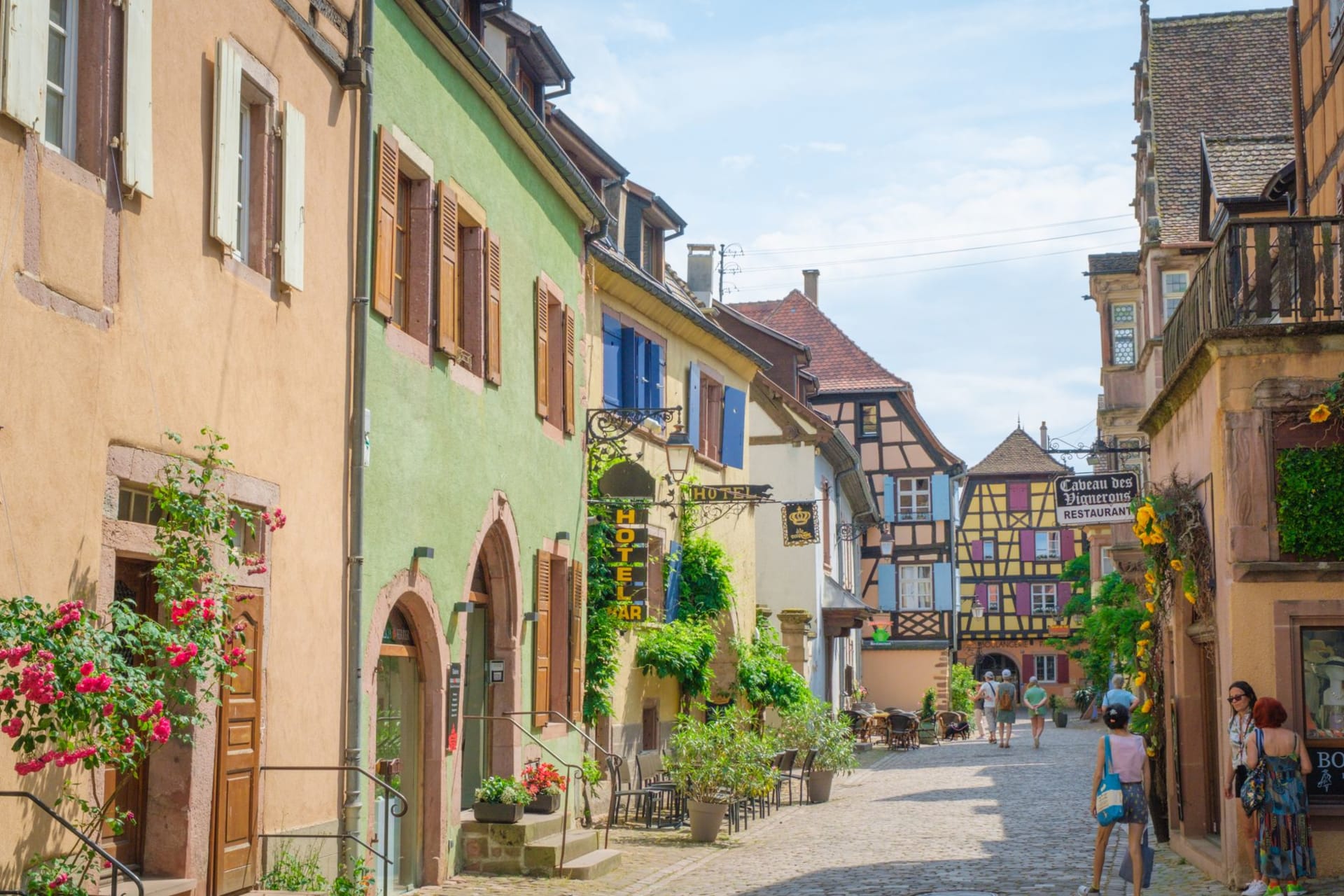
Riquewihr
"They built the wall to keep out invaders. It now keeps out the twenty-first century, which is more impressive."
I walked to Riquewihr through the vineyards, coming from Ribeauvillé along a path that threads between rows of Riesling and Gewurztraminer, the grapes already harvested in October, the leaves gone yellow and rust. The village appeared gradually — the Dolder tower first, then the tops of the half-timbered houses, then the whole thing framed against the Vosges foothills behind it. After twenty minutes of walking between dormant vines, arriving at a medieval gate felt almost chronologically disorienting.
Inside the walls, the main street runs straight from the Dolder gate to the upper fortification, flanked by houses that are so uniformly beautiful it takes a while to distinguish one from another. Window boxes even in late October held the skeletal remnants of what had been geraniums. The paintwork — ochre, Burgundy red, sage green — was chipped in exactly the right places, worn by a century of use rather than staged for a photoshoot. I bought a glass of Riesling at the first wine shop I found, stood in the street and drank it, and decided immediately that this was the correct approach to visiting Riquewihr.
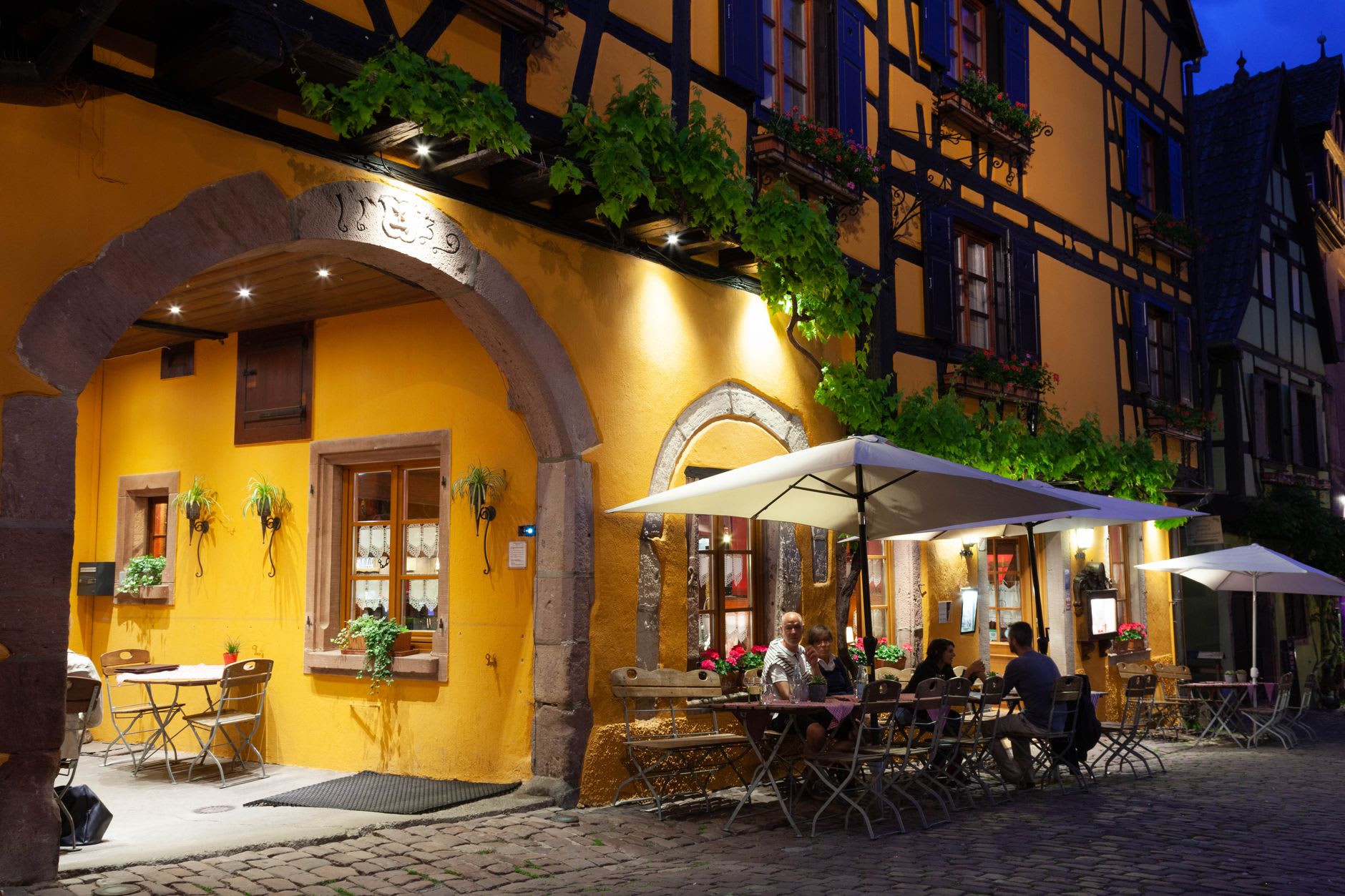
The wines here are the reason Riquewihr exists. The grand cru Schoenenbourg vineyard climbs the hill behind the village, and the families who have worked it for generations sell from cellars that open directly onto the street. I knocked on the door of a domaine whose name I’d been given by a winemaker in Ribeauvillé, and a teenager answered and led me without ceremony down into a cellar that smelled powerfully of fermentation and stone. The father arrived in work clothes, poured three vintages of the same Riesling from the same plot without commentary, waited for my reaction, and then talked for an hour about how the limestone and sandstone mix changes between the upper and lower slopes. This is the real education of the Alsace wine route: not the grand estates with tasting rooms and parking lots, but the family producers you find by asking other family producers for a recommendation.
Riquewihr is small enough to walk completely in twenty minutes, which means it is also the kind of place where you keep walking the same circuit, finding different things each time — a courtyard you missed, a sign for a cave à vins, a cat sleeping on a window ledge in the last of the October sun.

The village fills completely in summer, when the Route des Vins becomes a procession of tour buses and the wine shops stack three customers deep. I was there in October and had long stretches of the main street essentially to myself. The winstub near the upper gate was full at noon — all locals, all eating choucroute, nobody photographing their plate. I ordered the tarte flambée and a carafe of the house Sylvaner and took my time, and the woman who brought it seemed genuinely pleased that I was not in a hurry. Outside the window the vines caught the last of the afternoon light and held it just long enough.
When to go: October for harvest season and tasting rooms at their most generous. March and April for blossom in the vineyards with minimal crowds. Avoid summer weekends entirely — the village hits a density that its medieval infrastructure was not designed to absorb.