Eguisheim
"Every street in Eguisheim curves back toward its own center — the village is a kind of argument about how a place should be built."
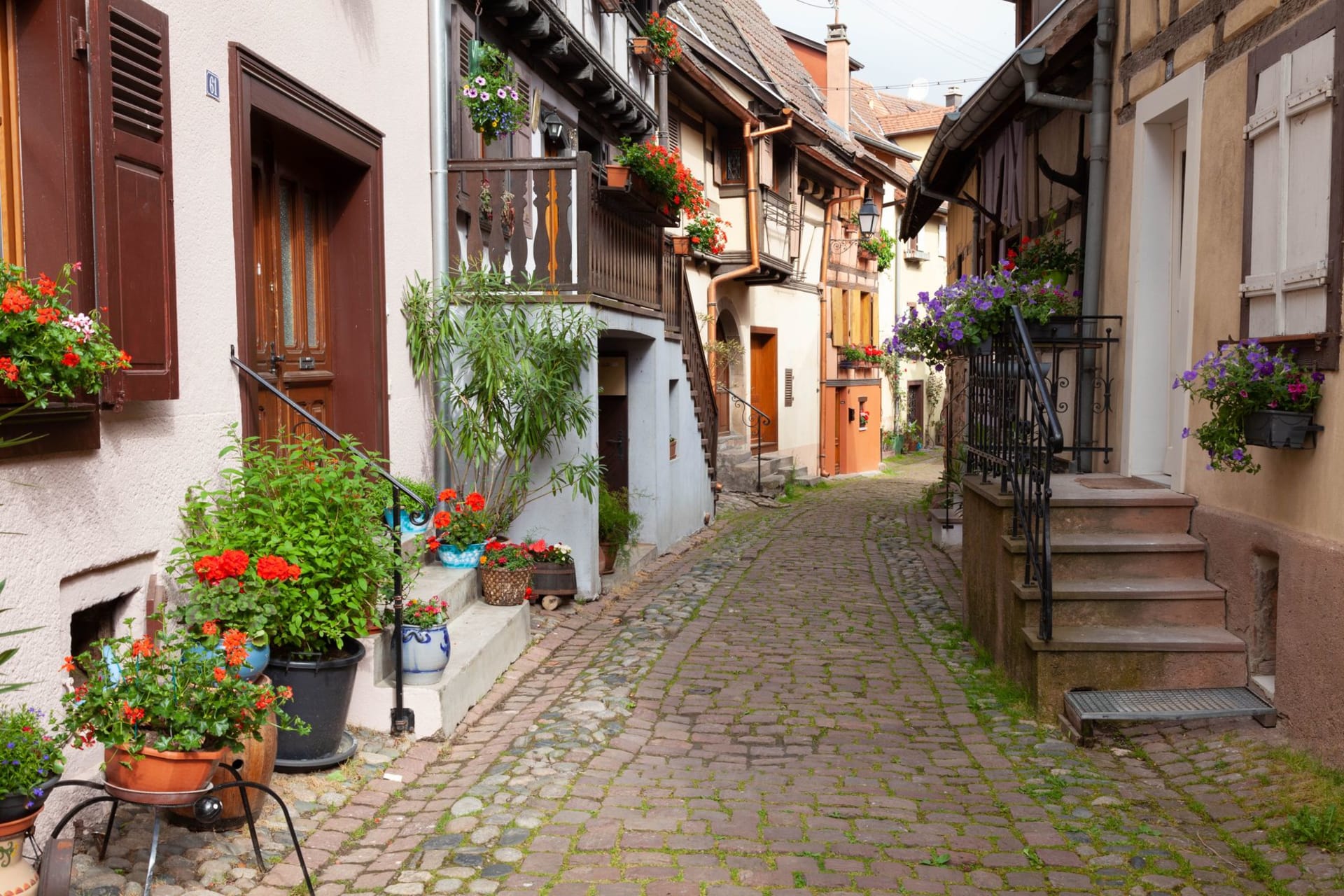
I’d been told that Eguisheim was laid out in concentric rings — that the village had been planned as a set of circular streets radiating from the old castle in the center — but I didn’t understand what that meant for the experience of walking it until I was actually there. You enter through a gate in the outer wall, turn left along the Rue du Rempart, and the street curves. It keeps curving. You follow it expecting to reach a corner and instead you simply continue in an arc, passing one painted facade after another, until you realize twenty minutes later that you have completed a full circle and are back near where you started. The geometry is so old it feels organic.
Eguisheim is smaller than Riquewihr and less famous, which in this region means something specific: fewer wine shops aimed at tourists, more wine producers who treat you as a buyer rather than a spectator. I found the domaine that would define my understanding of Alsatian wine not through a guidebook but simply by walking until I found a door propped open and a hand-written sign in German and French offering tastings. The woman inside was in her seventies, her hands permanently stained by her work, and she had three different plots on the grand cru Eichberg hillside. She poured me through them without hurry.

The Gewurztraminer from her upper plot was extraordinary — not the perfumed, slightly cloying style you sometimes find, but tight and spiced and precise, with an acidity that kept it from collapsing under its own richness. She explained the difference between the limestone-dominant lower plots and the sandstone and clay further up the slope, speaking with the technical specificity of someone for whom this is not charm but explanation. I bought six bottles and had to reorganize my entire backpack around them.
The castle courtyard at the center of the village dates to the ninth century and holds a small church where Pope Leo IX was born — Eguisheim claims him as its most famous son with a certain bemused civic pride. On October weekdays the courtyard is almost always empty, and you can sit on the stone steps while the village goes about its business in the rings around you. There is something almost mathematical about the calm here, the sense of a life organized around a center that holds.
Eat lunch at one of the winstubs on Rue du Rempart — the choucroute is excellent and the Pinot Gris by the carafe costs almost nothing. The women who run these places have been running them forever and will bring a second carafe without being asked if you finish the first, which I found to be a deeply civilized arrangement.

The Harvest Festival at Eguisheim happens in late September or early October and transforms the circular streets into a procession of wine floats and folk costumes. I arrived just after it ended and found the village still slightly flushed with the aftermath — wine stains on cobblestones, a few leftover decorations in shop windows, residents with the satisfied look of people whose event had gone well. Even in the aftermath, I could feel what the place becomes when it turns itself fully outward.
When to go: October for harvest time and the best Gewurztraminer from the Eichberg. March through May for blossom without summer crowds. The Harvest Festival in late September is worth timing your trip around if crowds don’t deter you.