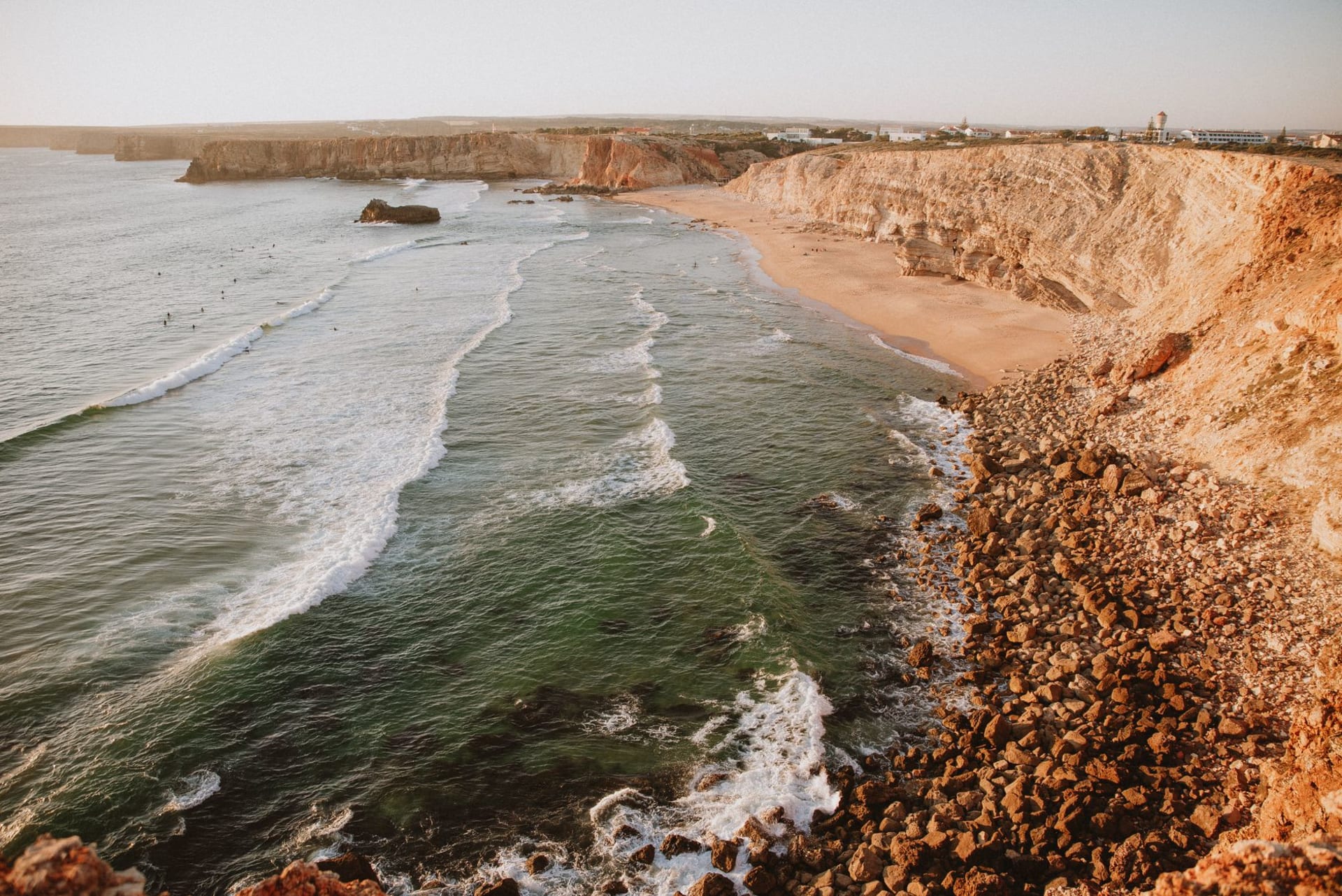
The road to Sagres runs through scrubland the color of pale gold, and the wind starts before you even get there. You feel it in the steering. By the time you park near the Fortaleza, it is coming off the Atlantic at an angle that suggests it has not hit anything solid since Nova Scotia. The Portuguese have a word for this place — fim do mundo, end of the world — and standing on the cliffs at Cabo de São Vicente, a few kilometers west of the town, watching the waves break sixty meters below, you understand exactly why the old cartographers put sea monsters just offshore. I had driven the whole western Algarve coast in a single afternoon and when I parked here and got out, the wind hit me so hard I had to brace myself against the car door. That felt honest.

The Fortaleza itself is not exactly a fortress in the cinematic sense — more a vast stone enclosure on a flat-topped promontory, with a Rosa dos Ventos, a giant compass rose made of stone, laid into the earth inside. The scale of the promontory makes the compass rose seem almost humble. Henry the Navigator is said to have gathered his cartographers and sailors here in the 15th century, planning voyages into the unknown Atlantic, and whether that’s historically precise or somewhat mythologized, the place does feel like somewhere important decisions were made. There’s a plainness to it. No baroque excess, no gilding. Just flat rock and sky and wind, and the occasional pilgrim standing at the edge looking west. The lighthouse at Cabo de São Vicente — the last lighthouse on continental Europe as you head into the Atlantic — closes at six, but if you’re there at five-thirty and the light is going orange and horizontal, the white tower catches fire in a way that is specifically worth the drive.

The town of Sagres itself is a blunt, functional little place — one main street, a few surf shops, some restaurants that cater to the surfers who come for the consistent breaks at Praia do Tonel and Praia da Beliche. It is not charming in the Lagos sense. But there’s a restaurant near the main square — I won’t name it because I don’t trust these things to last — with plastic chairs and a hand-written menu that does a grilled dourada for nine euros, served with boiled potatoes and a bottle of Sagres beer. The fish was better than anything I’d paid forty euros for in the preceding month. This is the other thing Sagres does well: it hasn’t quite figured out how to be expensive yet, which is remarkable given the scenery.
When to go: June through September for warm weather and manageable wind, though the surf crowd thins in late September. October and November are spectacular for dramatic light and empty cliffs — the wind is extraordinary but you’re not fighting it in the heat. Avoid January and February unless you specifically want a ghost-town experience.