Monchique
"Twenty minutes from the coast and a thousand years removed from it — Monchique operates in a different climate in every sense."
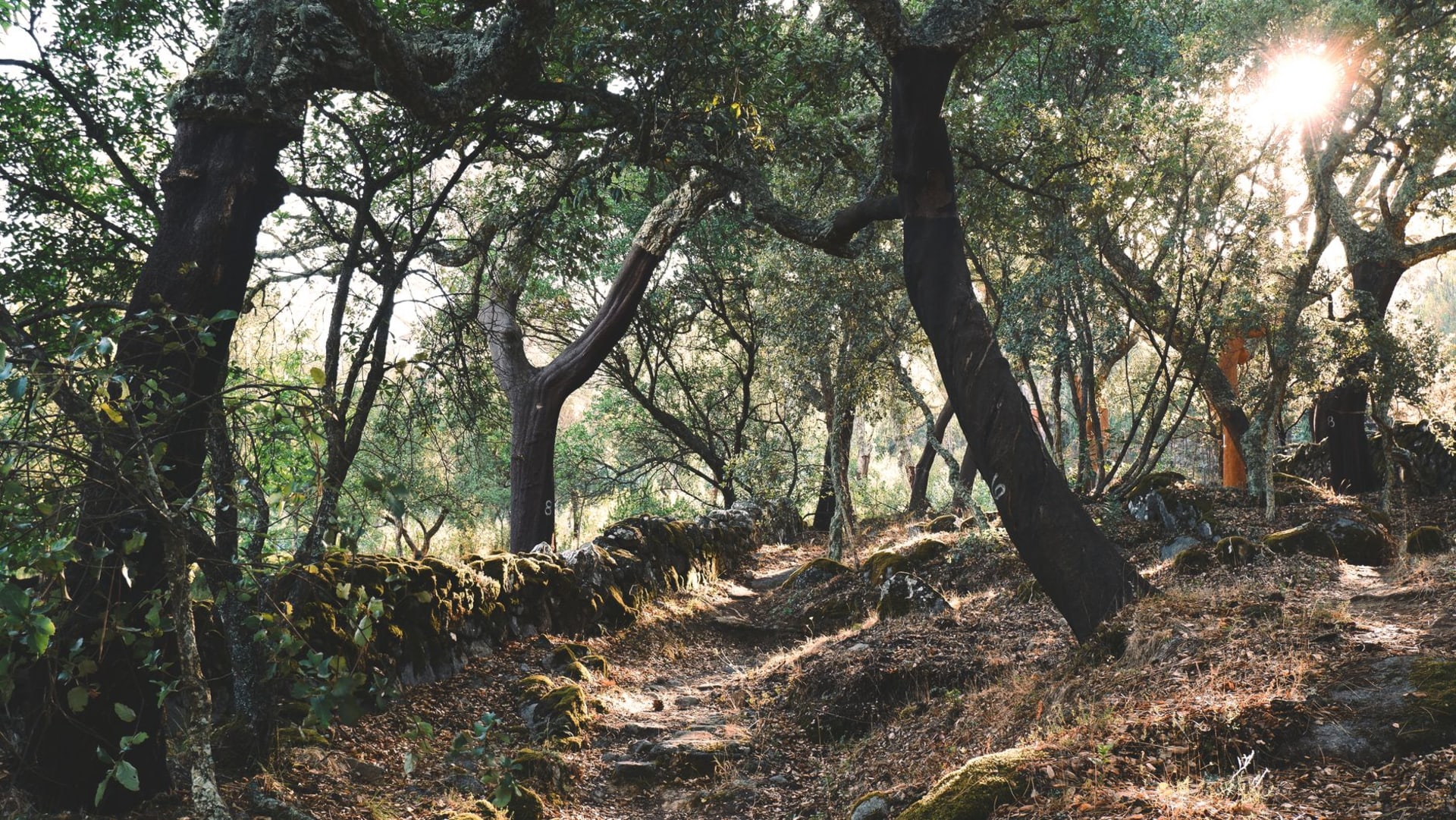
You drive up to Monchique from the N266 out of Portimão and the temperature drops a degree for every hundred meters of altitude, which in July means arriving at the village in something resembling actual coolness after a week of coastal heat that sits on you like a hand. The Serra de Monchique is the highest point in southern Portugal, and the landscape up here is nothing like the coast — dense cork oak and eucalyptus forest, ferns along the roadside, mist in the valleys even in midsummer. I had the windows down and the smell coming in was pine and something fungal and alive, the smell of a working forest rather than a scenic one. When I parked in the village square and got out, a rooster was crowing from somewhere in the lower lanes. Everything felt improbably rural for a place twenty kilometers from a major resort coast.

The village of Monchique is small and steep — its lanes climb at angles that make you grateful for flat shoes — and the whitewashed houses and the Igreja Matriz with its Manueline doorway cluster on the hill in a way that seems entirely unconscious of the tourist trade. There’s a market on Fridays where the local honey — deep amber, almost savory, from the arbutus blossom — comes in unlabeled jars. An older man sold me a jar of medronho brandy from the back of a van, assuring me it was the real thing, homemade, not the commercial version. He poured a shot into a plastic cup. It tasted of fire and wild strawberries and I immediately bought two more jars. Above the village, the road continues to Fóia, the summit at 902 meters, and on clear days you can see both the Atlantic and the distant Serra da Estrela to the north. On cloudy days you see only cloud and the tops of cork oaks, which is its own kind of beautiful.

Below Monchique, the spa town of Caldas de Monchique sits in a gorge so narrow it barely sees sunlight before midmorning. The thermal waters here have been used since Roman times — the Romans built baths, the Moors used the springs, the Portuguese built an elegant 19th-century spa complex around them, and now the whole ensemble is part health spa and part historical curiosity. The buildings are painted in faded ochre and terracotta, the gardens running along a stream, and the whole place has a slightly melancholic air of a place that was once very fashionable and has made a quiet peace with no longer being so. I took a glass of the mineral water from the public fountain. It tasted of iron and time.
When to go: Any time of year, but particularly valuable in July and August when the coast becomes oppressive — the Serra is reliably ten degrees cooler. Spring brings wildflowers and the whole forest smells of arbutus blossom. Come for lunch, stay for the afternoon, drive back to the coast at sunset along the N266 when the light turns everything orange.