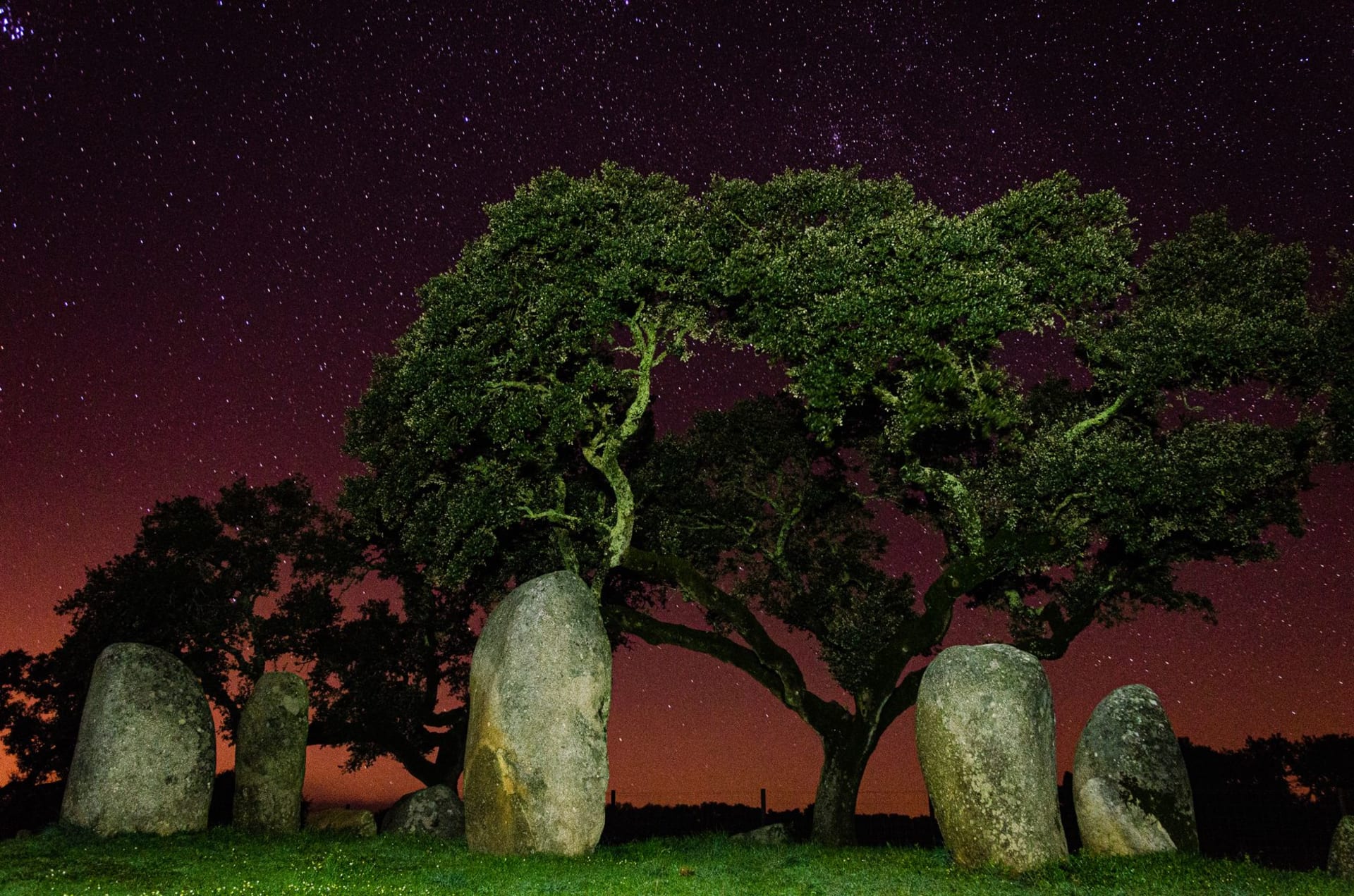
Cromeleque dos Almendres
"Seven thousand years old, completely unwatched — the Alentejo trusts you with its oldest secret."
I found the dirt track turning off the main road at a small brown sign I nearly missed, and drove through olive groves for about two kilometers before the car park appeared — a patch of gravel, no attendant, two other cars, a trailhead. The walk from there takes perhaps ten minutes through the trees, the ground red and dry underfoot, the morning light filtering through silver olive leaves. I heard woodpeckers. Then I came around a bend and the stones were simply there: ninety-five granite megaliths, oval-shaped and roughly chest-height, arranged in two concentric horseshoe curves across a gentle slope. No fence. No interpretive center. No roped-off area. Just the stones and the olive grove and the distant sound of a tractor somewhere over the hill.
The Cromeleque dos Almendres is thought to be around 6,000 to 7,000 years old, which makes it older than Stonehenge by a comfortable margin. Neolithic people began assembling it sometime around 5000 BCE, continuing to modify and add to it over perhaps two thousand years — which is itself a more sustained human enterprise than most things we would call civilization. The purpose is not agreed upon: ritual, astronomical calendar, community gathering site, something we have no category for. What is agreed upon is that the stones align with specific celestial events at the solstices, which means whoever placed them here was watching the sky with great patience and more intelligence than the word “prehistoric” implies.
I walked among the stones for an hour, which is more time than I expected to spend. Some of them have cup marks and carved symbols — spirals, circles, a rough cross — barely visible unless you are looking directly at the surface with the sun at the right angle. One stone, toward the northern end, is taller than the others and has what might be a face carved into it, two hollowed eyes looking west, or might be entirely accidental. I sat beside it for a while and thought about the hands that chose this place, found these stones, moved them here from somewhere else, arranged them in this specific pattern. The absence of any barrier between me and them felt like either great negligence or great respect, and I could not decide which.

The nearby menhir of Almendres, a single standing stone about a kilometer before the cromlech on the same dirt track, is worth the stop. It stands alone in a field with a low wire fence that is clearly only there to stop cattle, and it has been carved with enough symbols that archaeologists believe it may have been a kind of boundary marker or gathering point. The two sites together — the menhir and the cromlech — make the area feel like a landscape that was once entirely organized around something we have entirely forgotten.
When to go: Early mornings in spring (March to May) are the finest, when the wild cistus flowers are blooming among the stones and the air is cool enough to walk without sweating. Go on a weekday to have the best chance of solitude, which is genuinely possible here even in season.