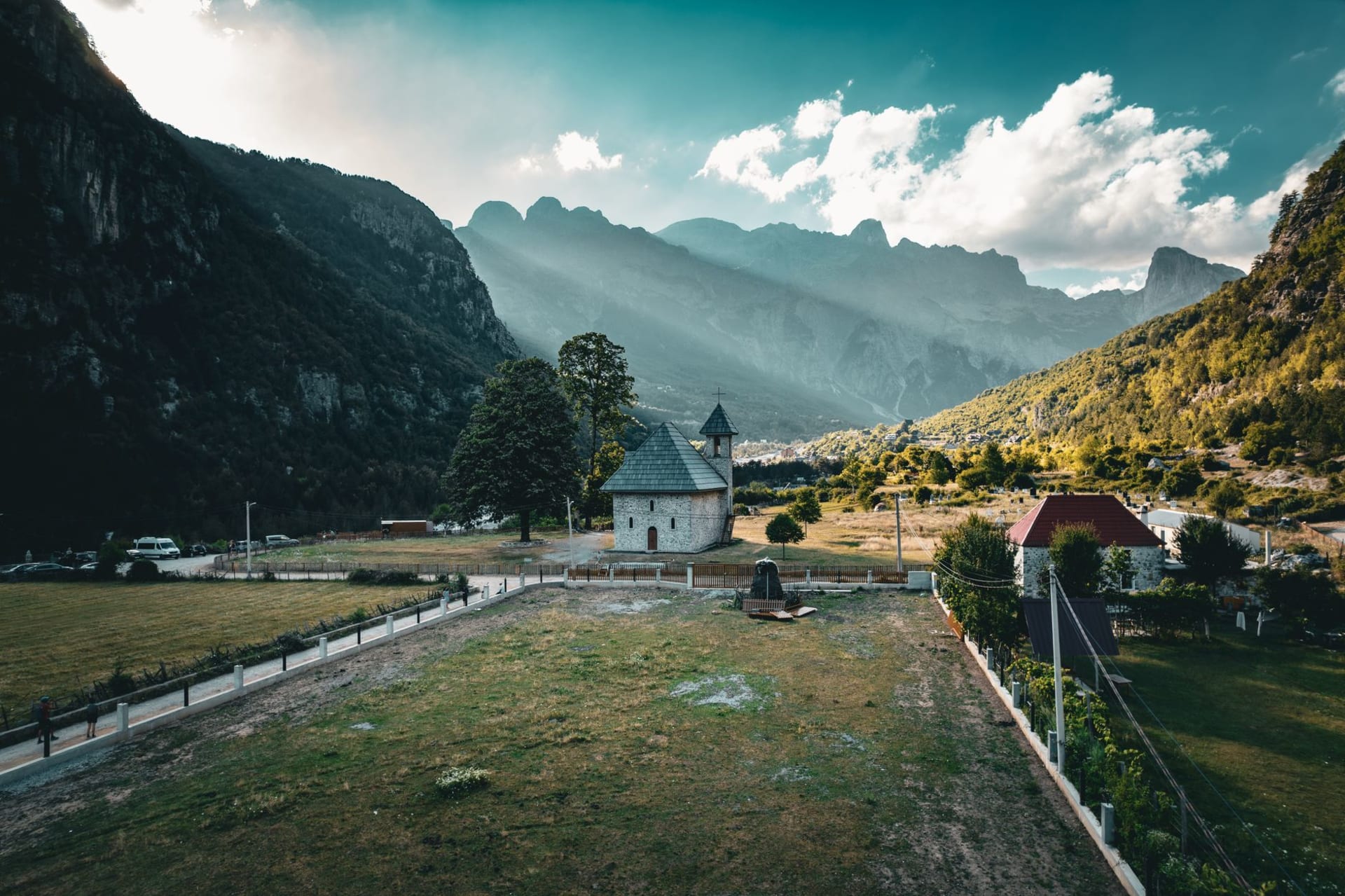
The road into Theth nearly ended us before we arrived. It has been paved now, which the guidebooks treat as a tragedy and I treat as a mercy, because the old version was a four-hour ordeal of switchbacks and prayer. Even paved, the descent from the Qafa e Thorës pass into the valley is the kind of drive where Lia stops talking and grips the door handle and I pretend to be calm. Then the trees open, the limestone walls of the Accursed Mountains rear up on every side, and the little white church appears in its meadow, and all of that is instantly forgiven.
The Village in the Bowl
Theth is not really a village in the tidy sense — it is a scatter of stone houses across the valley floor, linked by rough tracks and the river. The famous photograph is the church of Saint Mary, a simple whitewashed thing with a grey shingle roof, standing alone in the grass with the peaks behind it. It looks staged and is not. We stayed in a guesthouse run by a family who fed us byrek and homemade raki and a mountain tea brewed from something they picked on the slope that morning, and the grandfather, who spoke no language we shared, communicated everything important through eyebrows and refills.
Up the hill stands the kulla, the lock-in tower. These stone towers exist because of the Kanun, the old code of customary law that governed blood feuds in the northern mountains. A man marked for vengeance could shut himself inside and survive there, sometimes for years, while women brought him food. Standing in that cold, narrow room with its tiny gun-slits, I found the whole thing far more sobering than any museum could make it. The code was real, the towers were used, and not so very long ago.

Waterfall, Blue Eye, and the Long Way Out
Two walks define a stay here. The shorter one climbs to the Grunas waterfall, which thunders down a rock face in a single white ribbon; we got close enough to be soaked by the spray and stood there grinning like idiots. The longer, harder pilgrimage is to the Blue Eye of Theth — Syri i Kaltër — a spring pool of such impossible, electric turquoise that I assumed the photos were faked until I was standing over it. The water is glacial. Lia put a foot in and that was the end of any swimming ambitions.

The real test, for the fit and the stubborn, is the day hike over the pass to Valbona, a long climb through beech forest and scree that connects the two great valleys of the Albanian Alps. We did half of it and turned back, which I refuse to feel bad about. Some views you earn slowly, and Theth gave us plenty without the full ordeal.
When to go: June to September. The pass road and most guesthouses close in winter, and the valley genuinely cuts itself off under snow. July and August are busiest; come in June for wildflowers and elbow room.