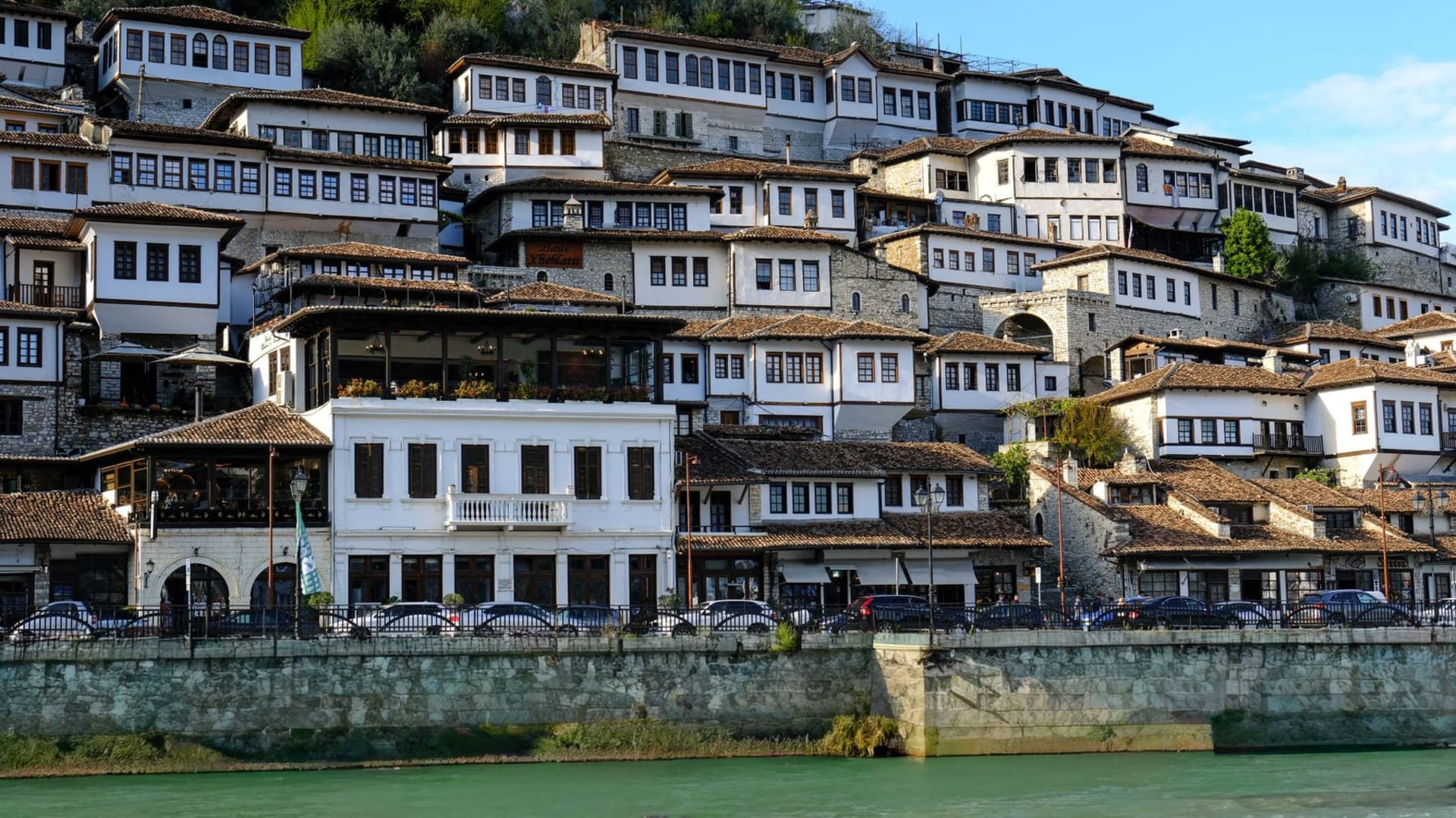
The 'City of a Thousand Windows' rises in white Ottoman tiers on a hillside above the Osum river, a UNESCO gem still undiscovered.
I arrived in Berat on a morning when the mist was still trapped in the Osum gorge below, and the white mansions of Mangalem quarter floated above it like something half-remembered from a dream. The city rises on both banks — Mangalem on one side, Gorica on the other — each neighborhood stacking its Ottoman houses so tightly up the slope that from across the river they form a single white wall of windows. Hundreds of them, arched and symmetrical, each framed in dark wood, each holding a rectangle of sky.
The Hill and the Castle Above It
We climbed to Kalaja fortress before most of the town had woken up. The cobblestones on Rruga e Kalasë were slick with dew and the air smelled of woodsmoke and something floral I never identified. Inside the castle walls a small community actually lives — families, a few guesthouses, a Byzantine church or two still plastered in faded frescoes. Onufri Museum, carved into the Church of the Dormition, holds icons so vivid they looked almost wet. The reds especially. Onufri mixed his pigments with human blood, according to local legend, and standing in front of his work in that dim room I was willing to believe it.
The surprise came later: ducking through a low gate on the eastern rampart I found a woman hanging laundry between two Byzantine columns, a satellite dish bolted to a thirteenth-century wall beside her. Berat makes no apology for the living pressing up against the ancient. That collision is the whole point.
Along the Osum and Into the Old Quarter
Lia found the restaurant — she always does. A terrace on the Gorica side, wooden tables almost overhanging the river, a handwritten menu offering tavë kosi, the Albanian baked lamb and yogurt dish that arrives in a clay pot still spitting from the oven. We ate slowly and watched the light change on Mangalem across the water, the windows going from white to gold to a deep amber as the afternoon wore on. That view, a bowl of tavë kosi, a carafe of local Berat red — it is not complicated and it is almost perfect.
The bazaar below the old quarter, Pazari i Vjetër, smells of dried herbs and diesel in roughly equal measure. Old men play dominoes outside a café that appears to have no name. Nobody is trying to sell me anything. That alone felt worth the journey.
When to go: April through June offers warm days, green hillsides above the Osum, and almost no crowds. September and October are equally good — harvests bring activity to the valley and the light turns golden in a way that makes every window in Mangalem look lit from within.