Föglö
"No one on Föglö appeared to be going anywhere quickly, and I found this deeply reassuring."
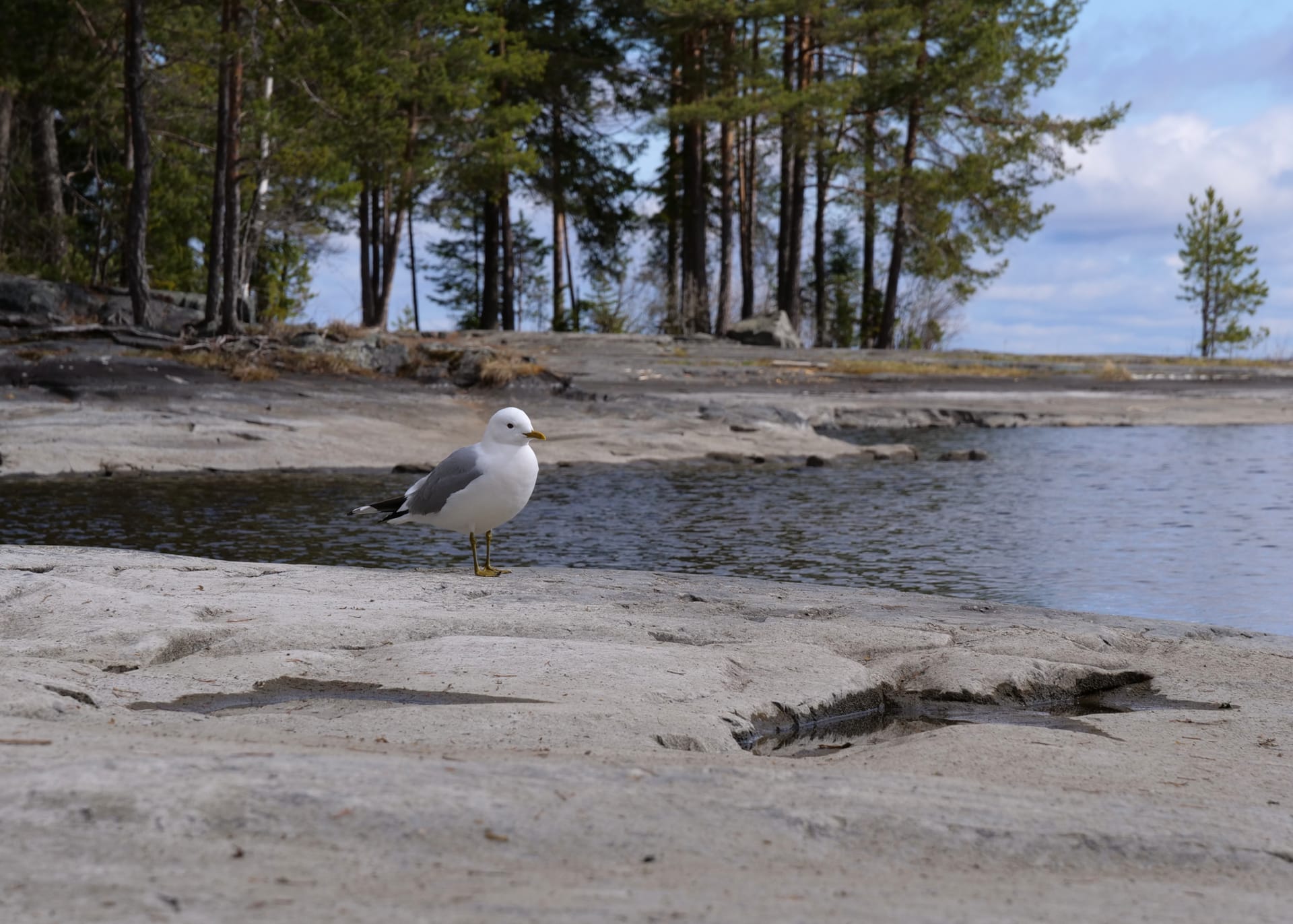
The cable ferry to Föglö runs on a loop — it connects with Svinö on the Åland mainland, crosses the straight, and comes back, running continuously from morning until late evening without any ticketing ceremony or announced schedule. You drive on, it moves, you drive off. I did not have a car, which meant I stepped off with my bicycle onto the Föglö dock and found myself standing in the kind of silence that is not quite silent — wind in the birch leaves, a gull somewhere offshore, the faint creaking of the cable ferry pulling back across the straight behind me. There was a hand-painted sign pointing inland. I followed it.
Föglö is an island of farms and inlets, its interior a patchwork of hay meadows and small lakes, its coastline a jigsaw of protected bays where the water is so shallow over the pale sand bottom that it turns turquoise in a way that seems implausible this far north. The farms here are the traditional Swedish-Ålandic type — long red buildings with white trim, black roofs, organized around a central yard. Several of them have hand-lettered signs out front advertising smoked fish, new potatoes, or eggs left in an unattended box with a slot for coins. I stopped at every one of these.

Lunch was arranged in the most direct way possible: a woman at a farmhouse near Degerby, the island’s tiny village center, sold me a portion of smoked pike wrapped in foil still warm from the smoking shed. She pointed me toward a picnic table near the water. The pike was golden and falling off the bone, with the particular sweetness of freshwater fish that has spent its whole life in cold, clear Baltic water. I ate it with my hands and felt absolutely justified in this. Degerby itself has a church, a small post office that doubles as a grocery, and a harbor where a few fishing boats and private yachts share space without any apparent hierarchy. That is, genuinely, the entire village.
The cycling is the reason to come, and it is completely without pretension. The roads are thin and flat and carry almost no traffic — I rode for three hours one afternoon without passing more than four cars. The landscape rewards slow movement: the roadside wild flowers are extraordinary in July, knee-high drifts of clover and yarrow and the occasional stand of lupine that has escaped some garden and gone native. The bike feels like the exact right speed for this place, fast enough to cover ground, slow enough to smell the hay.

I stayed two nights in a cottage that had been, not many decades ago, a working fisherman’s storage shed. The conversion was thoughtful rather than stylish — a wood stove, a narrow wooden bunk, a small kitchen with a gas ring and a window facing the inlet where the morning light came in flat and silver. On the second morning I woke early and sat on the dock with coffee, watching an osprey work the water fifty meters out, plunging twice before it caught something and disappeared north. Then I packed my bike and took the cable ferry back, and felt the particular regret of leaving a place that asked nothing of you and gave you everything you needed.
When to go: June through August is the sweet spot — the wildflowers are in full bloom, the swimming inlets are warm enough to be genuine, and the cable ferry runs extended hours. July is when the visiting yacht traffic peaks, which adds some life to Degerby’s harbor without overwhelming anything. May works well for birdwatchers and cyclists who prefer empty roads.