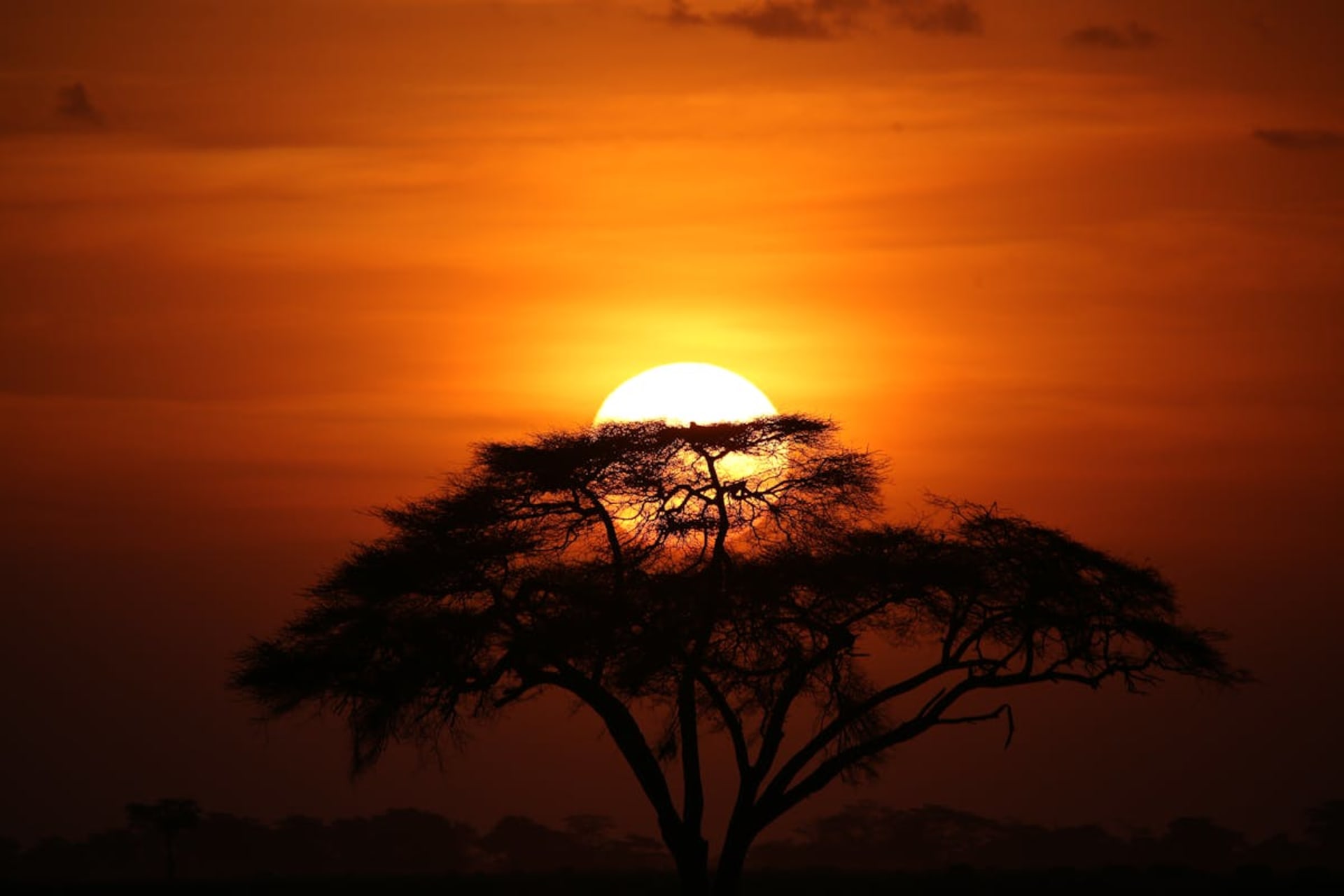
The Serengeti at Dawn — Where the Planet Remembers It Is Wild
The Dawn
The alarm goes off at five in the morning and for a moment you do not know where you are. The canvas walls of the tent ripple in a wind that smells of dry grass and woodsmoke. Outside, someone is already moving — the soft clink of a coffee pot, the crackle of a fire being coaxed back to life. Then you remember. You are in the Serengeti. You are in a place where the darkness contains things that can eat you, and you paid money for this privilege, and you would pay it again without hesitation.
Coffee by the fire. The staff appear from the darkness like apparitions, quiet and smiling, handing you a tin cup that burns your fingers and warms everything else. The southern sky is still thick with stars — a density of light that city dwellers have forgotten exists. Someone points out the Southern Cross, low on the horizon, and you realize you have never been this far south, this far from anything that feels like your own life. The guide arrives in the Land Cruiser, headlights cutting across the camp. He does not say good morning. He says, “The lions were calling near the kopjes. We go.”
The drive into the Serengeti at dawn is one of those experiences that dismantles the barrier between seeing and feeling. The light comes slowly — not the sudden tropical sunrise of the equator but a gradual bleeding of pink into grey, the grasslands emerging in layers, first the nearest acacias and then the middle distance and finally the horizon itself, which is so far away and so flat that the earth’s curvature is not a theory but a visible fact. The Land Cruiser moves at the speed of attention. The guide drives with the windows down, listening. Every sound is information — the alarm call of a francolin, the distant rumble of wildebeest, the silence that means a predator is near.
You see your first lion forty minutes after leaving camp. She is on a rock — a kopje, the guide calls it, one of those granite islands that rise from the savannah as if the earth pushed its bones through the soil. She is watching the plains below with the concentration of something that is always calculating, and when the Land Cruiser stops fifty meters away she gives it a glance of such magnificent indifference that you understand, viscerally, that you are not at the top of the food chain here. You are not even particularly interesting. You are a metal box that smells wrong and makes noise, and you are tolerated because you are not worth the effort.
The guide turns off the engine. For twenty minutes you sit in silence, watching the lion watch the world. Below the kopje, two cubs emerge from the grass and begin wrestling with the commitment of creatures who do not yet know what their bodies are for. The light strengthens. The plain turns gold. You take photographs that will never capture what this feels like, and you take them anyway because the alternative — not trying — feels like a betrayal of the moment.
The Migration
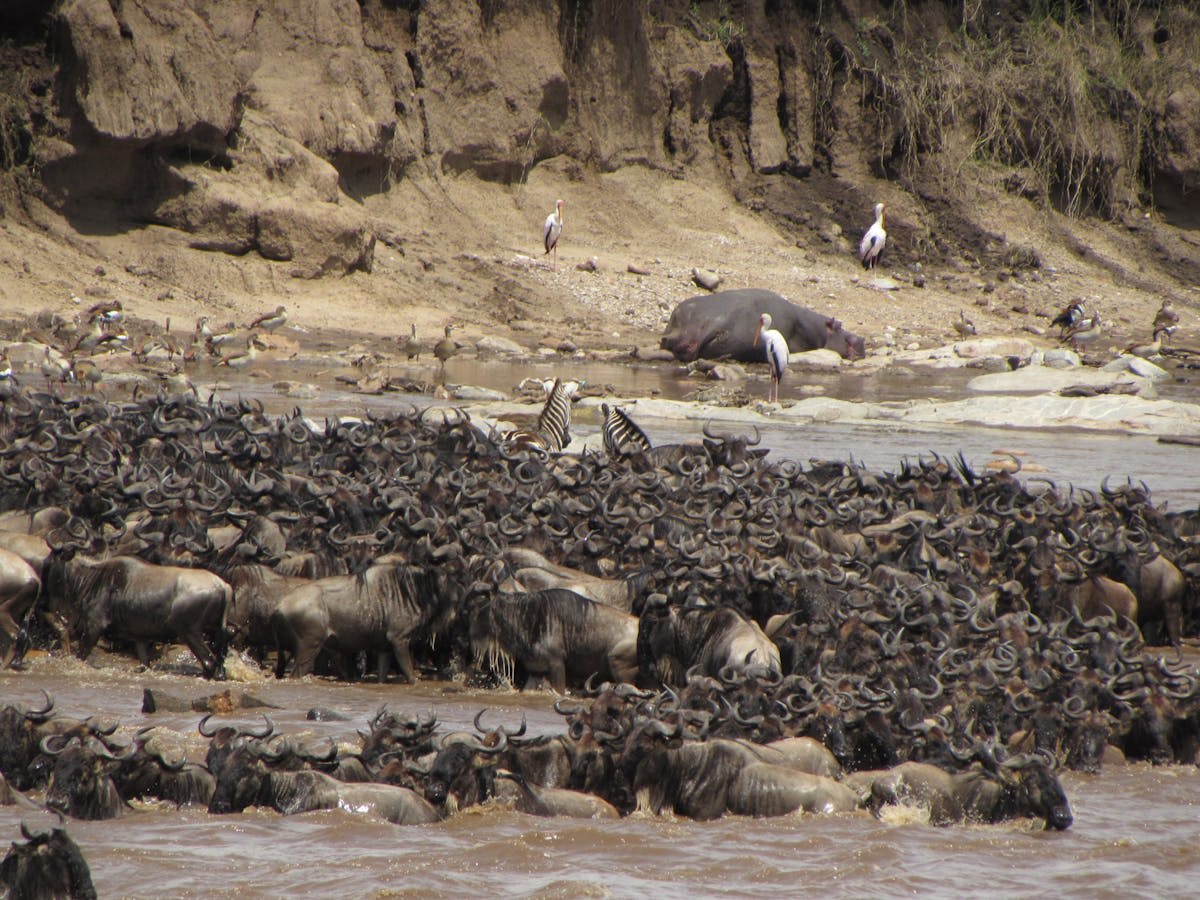
Nothing prepares you for the numbers. You have read that the Great Migration involves approximately 1.5 million wildebeest, 400,000 zebra, and 200,000 gazelle moving in a continuous circuit across the Serengeti-Mara ecosystem. You have seen the documentaries — the river crossings, the crocodiles, the dramatic narration. But the reality of standing in the Serengeti and watching a herd of wildebeest that extends to the horizon in every direction is something that the screen cannot convey because the screen cannot transmit scale.
The sound reaches you first. A low, continuous rumble that is not thunder but hooves — hundreds of thousands of hooves on dry earth, a vibration that you feel through the floor of the Land Cruiser before your ears make sense of it. Then the grunting. Wildebeest are not elegant animals. They look like they were designed by a committee that could not agree on proportions — the heavy shoulders, the thin legs, the beard, the perpetually startled expression. But in migration they achieve a kind of grandeur that transcends their individual absurdity. A single wildebeest is ungainly. A million wildebeest moving together across an open plain is one of the most magnificent things the natural world produces.
The guide drives into the herd. Not through it — into it, slowly, the wildebeest parting around the vehicle like water around a stone and closing again behind. You are inside the migration now. The animals are close enough to touch, their flanks dusty, their eyes rolling with the low-grade anxiety that is their permanent emotional state. Calves trot beside their mothers. Bulls shoulder each other at the margins. The sound is extraordinary — that collective grunt, which up close resolves into individual voices, each animal calling to maintain contact in the chaos of movement.
We stopped on a rise and the guide handed me binoculars and pointed south. The column of wildebeest stretched to the limit of magnification and beyond, a dark river of bodies flowing north through the golden grass, following a route that their species has traced for longer than humans have existed. There was no beginning and no end. There was only movement — ancient, purposeful, indifferent to observation. I lowered the binoculars and sat there for a long time, saying nothing, because some things do not require language and are diminished by it.
The Crater
The descent into Ngorongoro is theatrical in a way that feels deliberate, as if the landscape has a sense of narrative. You drive along the crater rim through highland forest — cool, misty, the trees draped with old man’s beard lichen — and then the road tips over the edge and you drop six hundred meters into a caldera that contains, within its twenty-kilometer diameter, one of the densest concentrations of wildlife on the planet.
The floor of the crater is a self-contained world. A soda lake in the center draws flamingos by the thousand — a pink smear across the alkaline water that intensifies as you approach until individual birds resolve from the mass, each one balanced on a single improbable leg. The grasslands around the lake support a population of black rhino that is easier to see here than anywhere else in East Africa, because the crater walls function as a natural enclosure and the animals have nowhere to disperse. We saw three in a single morning, which the guide said was unusual and then admitted, with a grin, that he says that every time because the guests appreciate feeling lucky.
The density is what sets Ngorongoro apart. In the Serengeti, the wildlife is spread across fourteen thousand square kilometers of savannah. In the crater, the same species are compressed into two hundred and sixty. You drive for ten minutes and encounter a pride of lions on a buffalo kill. Another ten minutes and there are elephants — old bulls with tusks that nearly touch the ground, moving through the fever trees with a slowness that is not lethargy but sovereignty. Hyenas everywhere, trotting with that sloped, purposeful gait, always working, always calculating. Jackals. Warthogs running with their tails straight up like antennae. The crater is an ecosystem operating at maximum capacity, every niche filled, every predator-prey relationship visible and active and ongoing.
You eat lunch at a designated picnic site on the crater floor while black kites circle overhead, waiting for someone to leave a sandwich unattended. It is not wilderness in the pristine sense — there are other vehicles, other tourists, a ranger collecting fees. But the crater does not care about its audience. The lions still hunt. The flamingos still breed. The rhinos still move through the grass with the armored patience of animals that have survived ice ages and will probably survive us. You are witnessing something that functions, and the functioning is the point.
The Island
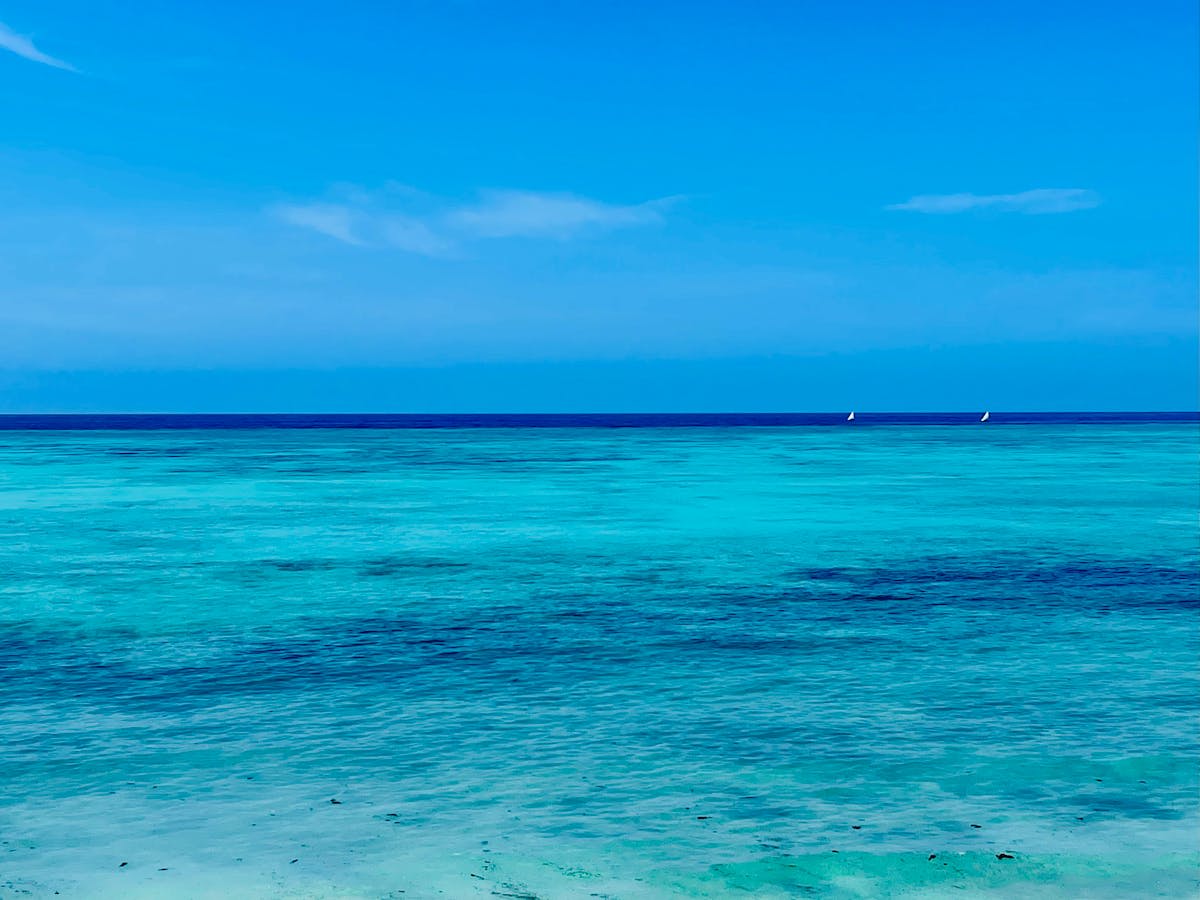
Zanzibar arrives like a different country, which in many ways it is. The flight from Arusha crosses the mainland — brown and green and vast — and then the Indian Ocean appears, turquoise and ridiculous, and the island materializes as a low green shape fringed with white sand and dotted with the triangular sails of dhows. The airport is small. The air is humid and scented with clove and diesel and frangipani. After a week of khaki and dust and five-thirty wake-up calls, the tonal shift is so complete that it takes a full day to stop scanning the horizon for wildlife.
Stone Town is the antidote to the savannah’s openness. The streets are narrow, labyrinthine, shadowed by buildings that lean toward each other as if sharing secrets. The architecture carries layers of history — Arab, Indian, Portuguese, British — all compressed into carved wooden doors and crumbling balconies and mosques that call the faithful five times a day with a sound that echoes off the coral stone and seems to come from everywhere at once. You get lost. This is intentional. The town is designed to be navigated by intuition and scent — follow the smell of grilling seafood and you find the Forodhani night market, where vendors sell octopus and Zanzibar pizza and sugarcane juice under strings of lights by the waterfront.
The beaches on the east coast are the kind that make you distrust your own eyes. The sand is white to the point of absurdity. The water moves through shades of blue and green that you thought existed only in retouched photographs. At low tide, the ocean retreats hundreds of meters, leaving pools and sandbars where women in bright kanga cloth harvest seaweed in ankle-deep water, bending and rising in a rhythm that has not changed in centuries. You swim. You read. You eat grilled fish at a beachside shack where the owner’s children play in the shallows and the playlist is a mixture of Swahili pop and Bob Marley. The urgency of the safari — the early mornings, the constant scanning, the adrenaline of proximity to predators — dissolves into something slower and warmer, and you realize that Tanzania designed itself as a journey from intensity to rest, and Zanzibar is the rest you earned.
A day trip to a spice farm in the island’s interior reveals the source of Zanzibar’s historical wealth and its persistent fragrance. A guide walks you through groves of clove, cinnamon, vanilla, black pepper, nutmeg — the spices that drew Arab traders, Portuguese colonizers, and eventually the British, each leaving their architectural and cultural residue on Stone Town. You taste fresh turmeric root and it bears no resemblance to the powder in your kitchen. You smell vanilla on the vine and understand why it costs what it costs. The guide climbs a coconut palm barefoot and drops a green coconut that he opens with a machete, and you drink the water standing in a grove of cinnamon trees, and the Serengeti feels like something that happened to a different version of you.
What Africa Does to You
I have traveled to places that impressed me, places that delighted me, places that challenged everything I thought I knew about how humans can organize their lives. Tanzania did something different. Tanzania made me feel small — not diminished, but correctly proportioned. The Serengeti at dawn, with a million animals moving across a plain that predates human memory, is a reminder that the natural world is not a backdrop to our story. It is the story. We are a subplot, recent and provisional, and the wildebeest have been walking this route since before we learned to walk at all.
The crater drove the point deeper. Standing on the rim of Ngorongoro, looking down at a complete ecosystem functioning inside a collapsed volcano, you confront the reality that life does not require us. It preceded us by billions of years and it will continue, in some form, long after we have finished whatever it is we are doing. This is not a depressing thought. It is a liberating one. It frees you from the tyranny of human importance and replaces it with something better — the privilege of witnessing. You were here. You saw the lions on the kopje. You stood inside the migration. You watched the flamingos turn a crater lake pink. That is enough. That is more than enough.
Zanzibar softened the lesson without dulling it. Lying on a beach that has been beautiful since before anyone was there to notice, swimming in water that does not care about your problems, eating food seasoned with spices that shaped the history of global trade — it is a gentle reminder that the world offers experiences of staggering richness to anyone willing to show up and pay attention. Tanzania does not perform for its visitors. It does not curate the experience or soften the edges. The roads are rough. The dust gets into everything. The wildlife operates on its own schedule and sometimes you drive for hours and see nothing but grass.
But when it gives you something — a lion at dawn, a million wildebeest on the move, a sunset over the Indian Ocean that turns the dhow sails to gold — it gives you something that bypasses the intellect and lands somewhere in the body, in the part of you that remembers what it is to be an animal on a planet that is still, despite everything, astonishingly alive. I have not been the same since. I do not expect to be. That, I think, is the point.
Travel with intention
Curated guides, quiet destinations, and stories worth reading — delivered when we have something worth sharing.
No spam. Unsubscribe anytime.