
The Colours of Rajasthan — A Desert That Refuses to Be Dull
The Pink City
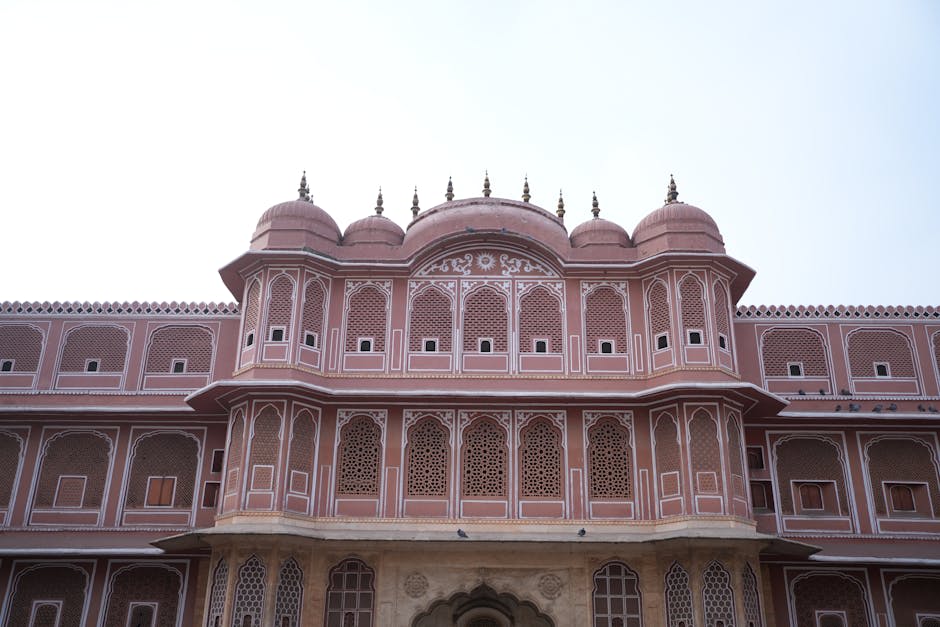
Jaipur is pink the way Paris is grey — not as an accident of material but as a decision, a civic commitment to a single hue that has been maintained for nearly three centuries. In 1876, Maharaja Ram Singh had the entire old city painted terracotta pink to welcome the Prince of Wales, and the city has kept the colour ever since, repainting its walls with the regularity of a ritual. The result is a city that looks, from certain angles and in certain light, like it was carved from a single block of sandstone and then inhabited.
I arrived on a morning flight from Mumbai, and the drive from the airport into the old city was a gradual immersion in pink. First the outskirts — modern, unremarkable, the India of billboards and construction sites. Then the walls began. Terracotta pink, faded in places, vivid in others, framing every archway and shopfront and window with a uniformity that feels both ancient and slightly surreal. The Hawa Mahal — the Palace of Winds, a five-storey facade of nine hundred and fifty-three small windows designed so that the women of the royal court could observe street life without being seen — is the most photographed building in Jaipur, and I understood why the moment I saw it. It is not a building so much as a sculpture, a honeycomb of pink sandstone that catches the morning light and turns it into something edible.
The Amber Fort, eleven kilometres north of the city, is where Jaipur’s excess becomes truly imperial. The fort sits on a ridge above Maota Lake, its walls descending the hillside in a cascade of ramparts that took over a century to build. Inside, the Sheesh Mahal — the Hall of Mirrors — is a room where a single candle, placed on the floor, multiplies into a thousand points of light reflected in the mirrored ceiling, an effect so beautiful it silences even the loudest tour groups. I stood in the doorway and watched a guide light the demonstration candle, and the room erupted into stars, and for a moment I forgot I was inside a building and not standing under the sky.
The Blue City
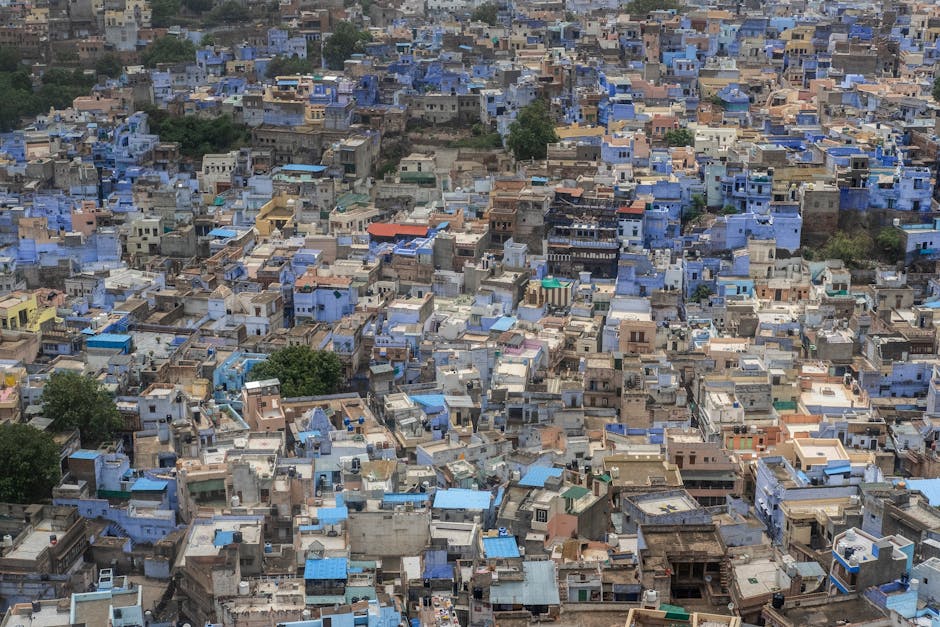
Jodhpur is a different proposition. Where Jaipur is curated — its colour deliberate, its tourism infrastructure polished — Jodhpur is raw. The blue houses of the old city were originally painted with indigo wash by the Brahmin caste to distinguish their homes, but the practice spread, and today the entire old town beneath the Mehrangarh Fort is a cascade of blue that has no equivalent anywhere I have travelled. Not Chefchaouen in Morocco, which is prettier but smaller. Not the blue towns of the Greek islands, which are white with blue accents. Jodhpur is blue completely, emphatically, the colour saturating every wall and every alley and every rooftop in a display that makes you feel as though you have fallen into a painting.
I spent two days wandering the lanes below the fort, getting lost repeatedly — the lanes have no logic, they curve and fork and dead-end and sometimes open onto views of the fort above that stop you mid-step. The residents go about their lives amid the colour: women in bright saris hanging laundry from blue walls, children playing cricket in blue courtyards, old men sitting on blue stoops drinking chai from clay cups that they smash on the ground when finished, a small daily destruction that has something philosophical about it. The colour photographs well, but no photograph captures the experience of being inside it — the way the blue changes with the light, deeper in the shadows, paler where the sun hits, and always, always, the massive silhouette of Mehrangarh above, a reminder that this city was built not for beauty but for defence, and that the beauty was an afterthought that outlasted the wars.
The Golden Fort
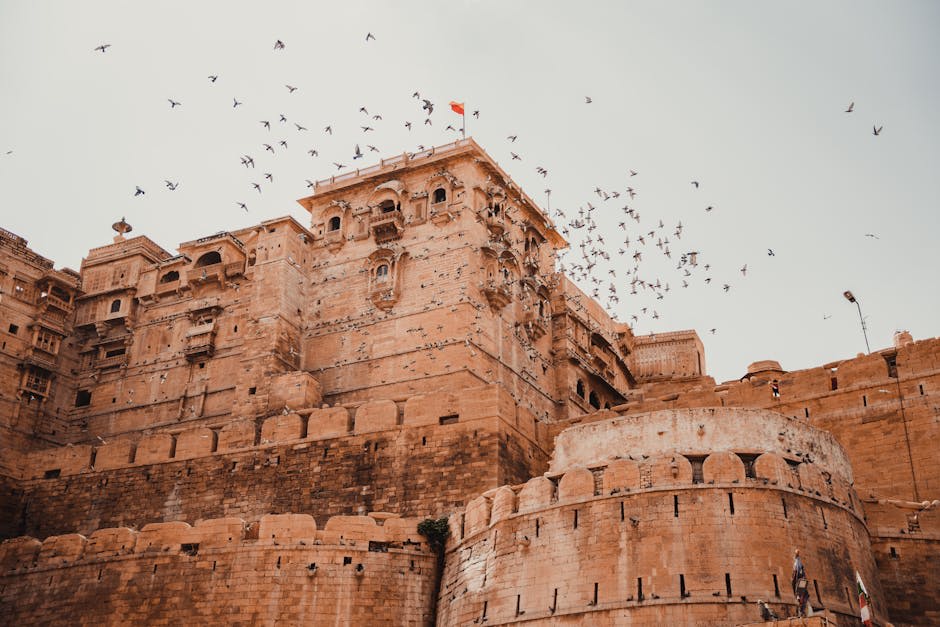
Jaisalmer is the city that should not exist. It sits in the Thar Desert, four hours west of Jodhpur, and its fort — one of the last living forts in the world, still inhabited by several thousand people — rises from the sand like something imagined. The sandstone is golden, and in the late-afternoon light it glows with an intensity that makes the rest of the desert look colourless. I arrived by train, a six-hour journey through increasingly barren landscape, and when the fort appeared on the horizon it looked exactly like a mirage — shimmering, improbable, too perfect to be real.
Inside the fort, the streets are narrow and the havelis — the carved merchant houses — are among the finest in India. Patwon ki Haveli, built by a Jain merchant in the mid-nineteenth century, has a facade so intricately carved that the stone looks like lace. The carvers worked the yellow sandstone with such precision that flowers, elephants, dancers, and geometric patterns emerge from every surface, and the detail rewards a closeness that most buildings cannot sustain. I pressed my face to the wall and studied a panel of carved musicians, each one six inches tall, each one playing a different instrument, each one rendered with an individuality that suggests the carver knew actual musicians and carved their portraits rather than their types.
The desert beyond Jaisalmer is the emptiest landscape in India. I took a camel safari into the Sam sand dunes — two hours on a camel whose gait I never quite adapted to — and when we stopped at the crest of a dune the silence was absolute. No engine, no voice, no bird, no wind. Just sand in every direction and a sky so large it felt oppressive. The guide lit a fire, cooked dal and chapati on it, and we ate in the dark while the stars appeared one by one, then in clusters, then in clouds, until the Milky Way stretched from horizon to horizon and I understood, for the first time physically, that we live inside a galaxy.
The White City
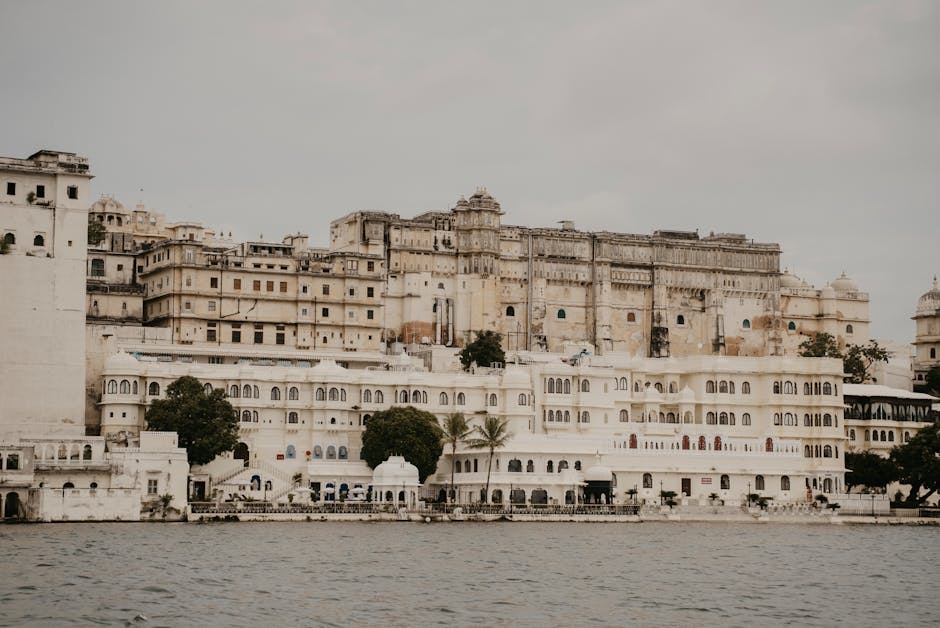
Udaipur is the palette cleanser. After the pink and the blue and the gold, the white marble of the City Palace and the Lake Palace feels like a rest for the eyes — a visual silence after the chromatic shout of the rest of Rajasthan. The city sits in a valley of the Aravalli Hills, surrounded by lakes that the Mewar kings created by damming rivers, and the effect is of an oasis in the desert, a city that has traded the severity of the Thar for the lushness of water and garden and marble.
I took a boat on Lake Pichola at sunset, and the Lake Palace — white marble, white walls, white courtyards, floating on the water like something from a fairy tale — glowed in the last light with a beauty so complete it felt engineered. Which, of course, it was. The Mewar kings built this city to be beautiful. They filled it with palaces and temples and gardens and paintings, and they arranged it around water because they understood, living in a desert, that water is not just necessity but luxury, and that the sight of a palace reflected in a still lake is one of the most powerful images the human eye can receive.
The old city around the palace is where Udaipur reveals its personality — not grand but intimate, not monumental but human. The rooftop restaurants serve thalis with views of the palace. The art galleries sell miniature paintings in the Mewar style, each one a window into a court that vanished centuries ago but whose aesthetic standards survive in the steady hands of painters who learned from their fathers who learned from theirs. The textiles are extraordinary — block-printed cottons and silks in patterns that repeat with the mathematical precision of Islamic geometry but depict the Hindu mythology of Rajput courts. I bought a tablecloth from a shop in the old city where the owner unrolled bolt after bolt of fabric on the floor, explaining each pattern and each dye, and what began as a purchase became a two-hour education in the relationship between colour and meaning in Indian textile art.
What Colour Means Here
Rajasthan taught me something about colour that I had never understood before, despite growing up in a country that has produced more than its share of painters. In France, colour is aesthetic — we appreciate it, we curate it, we frame it. In Rajasthan, colour is language. The blue of Jodhpur was caste. The pink of Jaipur was diplomacy. The gold of Jaisalmer was material — the desert giving its own colour to the city that grew from it. The white of Udaipur was aspiration — marble imported, carved, polished, and arranged around water to create a vision of refinement in a landscape that offered none.
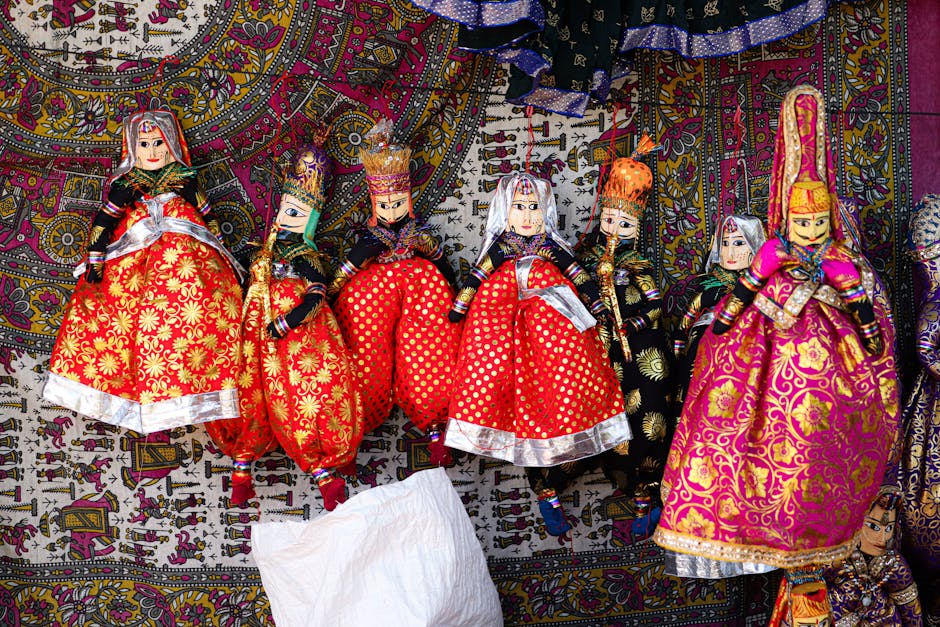
Every turban tells a story — the colour, the style, the way it is wrapped signals region, caste, occasion, season. Every sari is a statement. Every painted wall is a declaration. Rajasthan does not use colour for decoration. It uses colour for meaning, and the result is a state where the visual environment is not just beautiful but literate — where walking through a city is like reading a text written in a language of hue and pattern that you can learn to decode, slowly, over days, if you pay attention.
I left Rajasthan on a train to Delhi, watching the desert give way to agriculture and the colours of the landscape shift from gold to green, and I carried with me not souvenirs but a recalibrated sense of what colour can do when a culture decides to take it seriously. The rest of India would be extraordinary in other ways — the green of Kerala, the brown of Varanasi, the grey of Mumbai’s monsoon — but nothing would match Rajasthan’s chromatic confidence. This is a state that has looked at the desert — the most colourless landscape on earth — and decided, collectively, across centuries, to make it the most colourful place I have ever seen.
Voyagez avec intention
Guides sélectionnés, destinations paisibles et récits qui valent la peine d'être lus — envoyés quand nous avons quelque chose qui mérite d'être partagé.
Pas de spam. Désabonnement à tout moment.