The Nile Valley — Where History Becomes Physical
The Scale of It
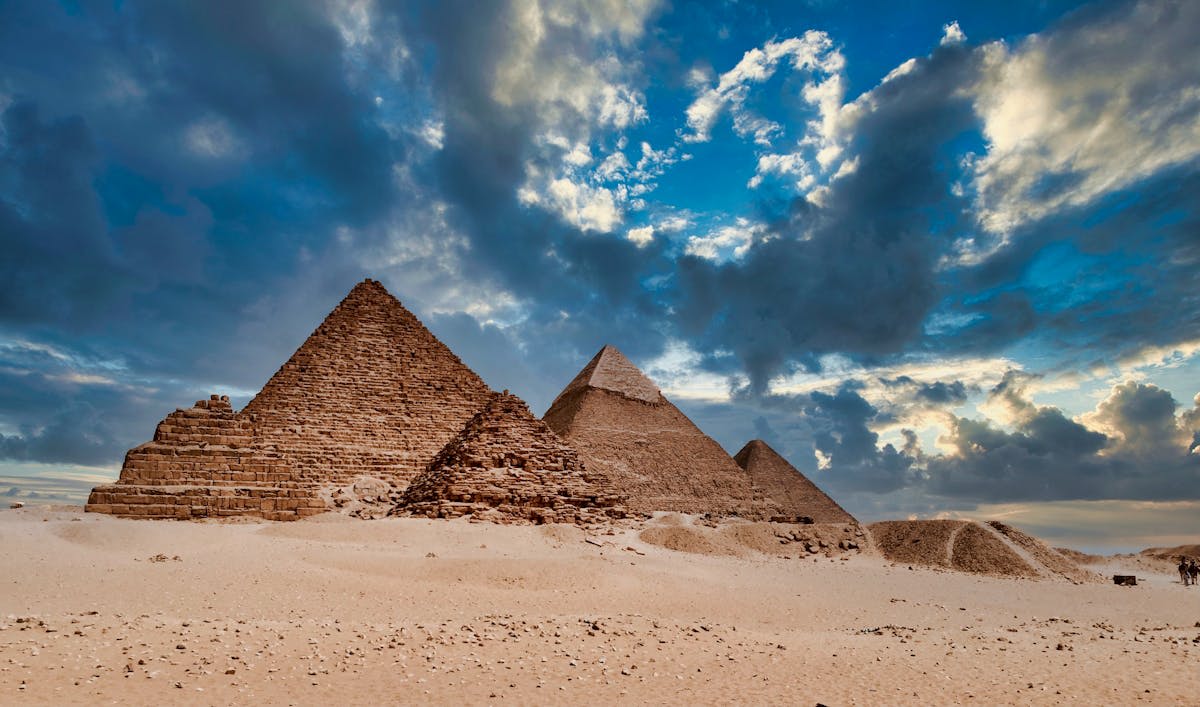
I have read about the Great Pyramid of Giza since I was a child. I have seen it in photographs so many times that I assumed the reality would feel familiar — reduced, somehow, by overexposure. I was wrong. Nothing prepares you for the scale. Not the numbers, not the documentaries, not the drone footage on YouTube that flattens the thing into geometry. You arrive at the Giza Plateau in the early morning, when the light is still soft and the tour buses have not yet disgorged their cargo, and the pyramid is simply there — an impossible mass of stone occupying the edge of a desert that stretches to the horizon in one direction and gives way to the chaotic sprawl of Cairo in the other.
Two point three million limestone blocks. Each one heavier than a car. Stacked with a precision that modern surveyors have measured and found accurate to within centimetres over a base that covers thirteen acres. The Great Pyramid was the tallest structure on earth for nearly four thousand years. I stood at its base, craned my neck, and tried to reconcile what I was seeing with what I knew about the tools available to its builders — copper chisels, wooden sledges, human muscle, and a civilizational ambition so vast it makes our skyscrapers feel temporary. Because that is the unsettling thing about Giza: the pyramids do not look old. They look permanent. They look like they will be here long after the glass towers of La Défense have crumbled and the steel bridges of the modern world have rusted into nothing. They are not ruins. They are arguments about time, and they are winning.
The Sphinx sits below, smaller than you expect and more eroded, its face smoothed by wind and sand into an expression that every visitor interprets differently — serenity, indifference, amusement, grief. I saw patience. The patience of something that has watched forty-five centuries of human activity pass before it and has not yet found a reason to comment. The hawkers sell miniature sphinxes for a dollar. The camels wait for tourists. The sound of traffic drifts from the city. And the monuments do what they have always done: they endure.
Cairo itself is overwhelming in the way that only cities with twenty million people and five thousand years of history can be. The Egyptian Museum on Tahrir Square is a labyrinth of artefacts stored with a density that borders on the absurd — sarcophagi stacked in corridors, gold jewellery in glass cases that belong in a crime novel, Tutankhamun’s death mask glowing in its own room with a gravity that silences even the loudest tour groups. I spent four hours inside and saw perhaps a tenth of it. The new Grand Egyptian Museum near Giza, when it fully opens, will change the experience entirely. But there is something about the old museum’s chaos that feels honest — a country with this much history cannot contain it neatly. It overflows.
Karnak at Dawn
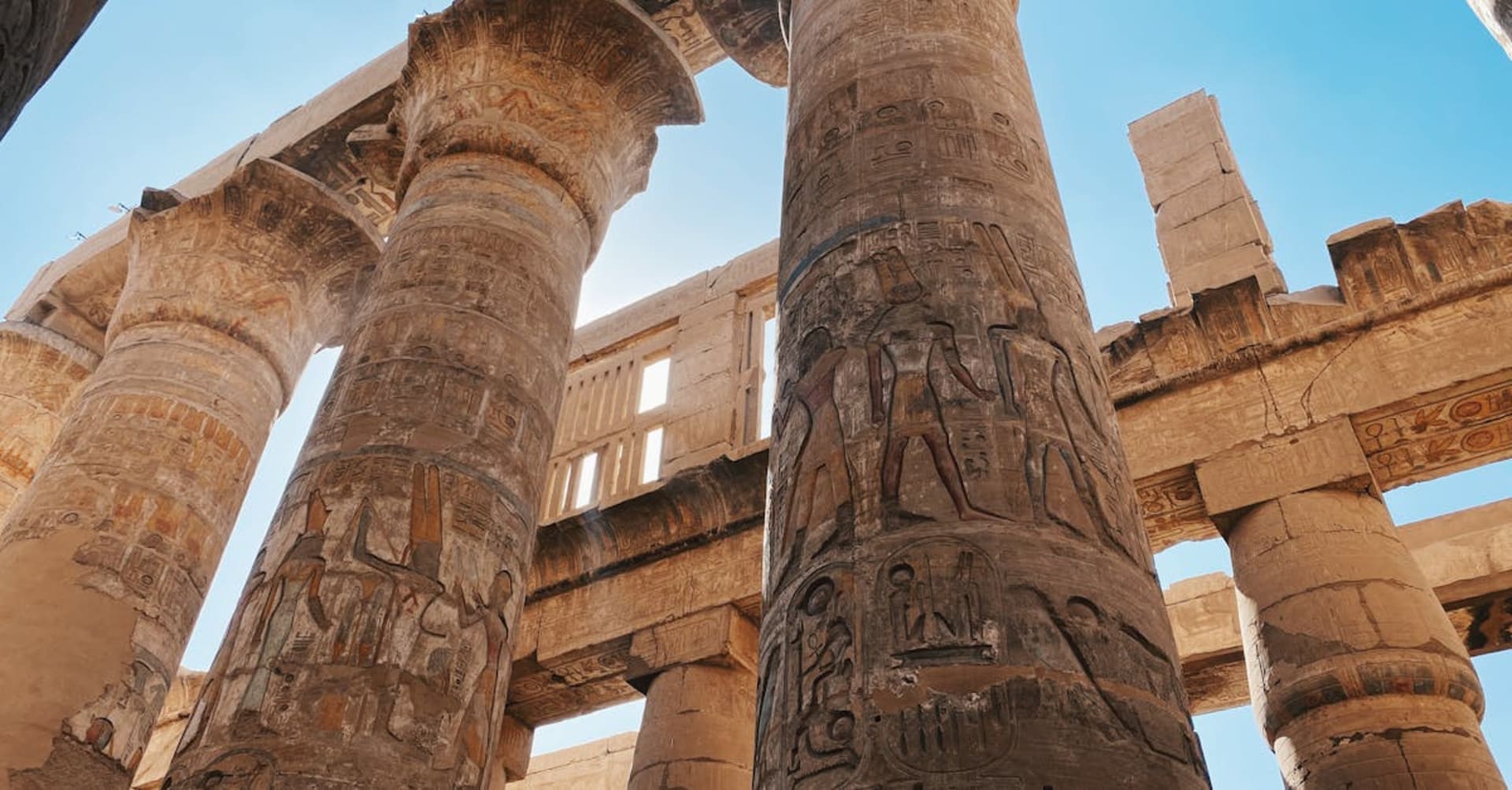
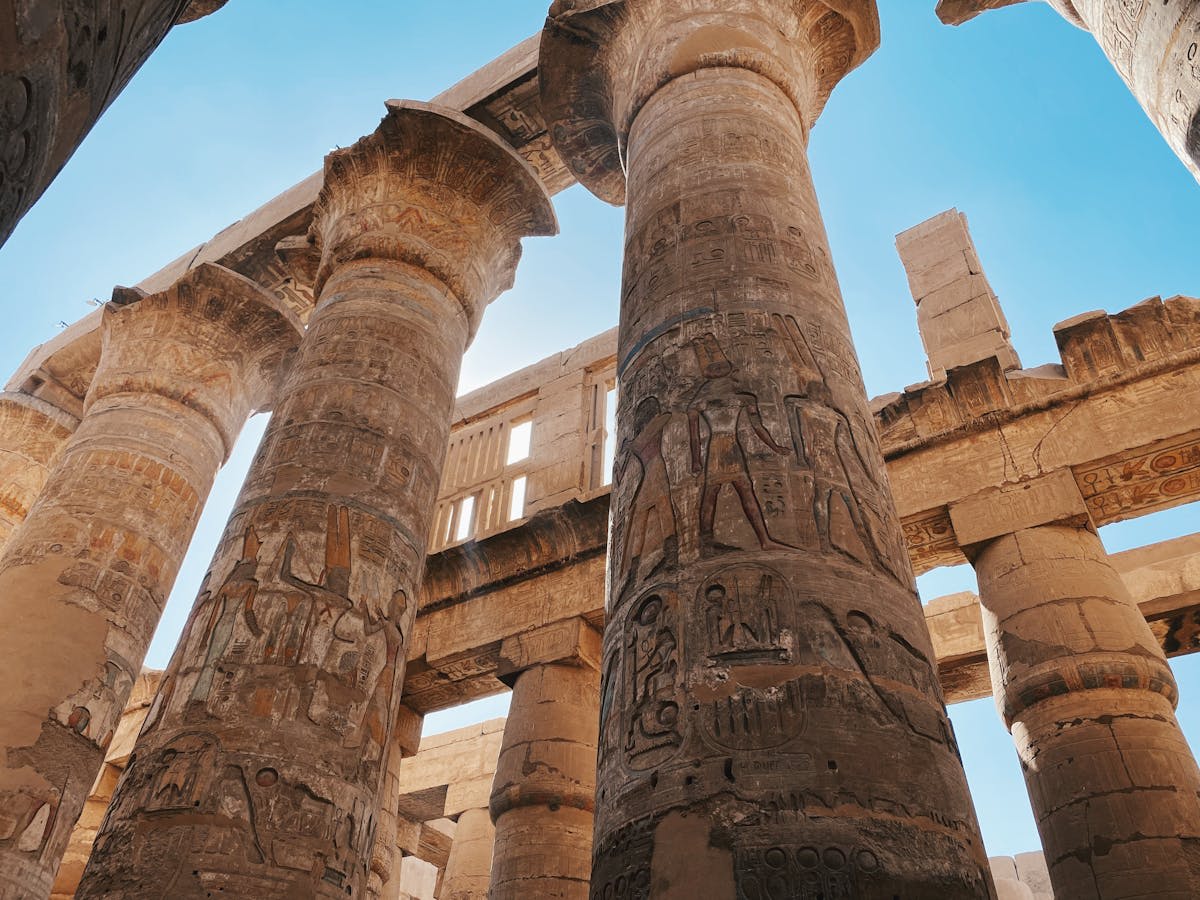
You must go early. This is not a suggestion — it is the difference between experiencing Karnak and merely visiting it. At six in the morning, when the gates open and the light is still low, the temple complex belongs to the birds and the silence and the particular quality of Egyptian dawn that turns sandstone into gold. The Hypostyle Hall — the forest of one hundred and thirty-four columns that Seti I and Ramesses II built to honour Amun-Ra — is, at that hour, one of the most extraordinary spaces on earth. Each column is twenty-three metres tall, carved with hieroglyphs from base to capital, and they are packed so closely together that walking among them feels like moving through a stone forest where the canopy is the sky and the trunks are the ambitions of pharaohs who believed they were gods.
I walked through it slowly, touching nothing — the guards watch, and rightly so — but letting my eyes trace the carvings: battle scenes, offerings to deities, the cartouches of kings whose names I had learned from books and was now reading on the stone they had commissioned. The detail is staggering. Three and a half thousand years ago, someone carved a falcon with outstretched wings into a column that already stood twelve metres above the ground, and the feathers are still sharp. The paint — traces of red and blue and yellow — is still visible in places where the roof once shielded it from sun and rain. You are not looking at history. You are standing inside it.
Luxor Temple, connected to Karnak by an avenue of sphinxes that has recently been excavated and restored, is a different experience — more intimate, more vertical, and best visited at night, when the columns are lit from below and the shadows climb the walls like something alive. I sat on a bench in the courtyard and watched the light shift on the colonnades of Amenhotep III, and a thought came to me that I have not been able to shake: these builders were not preserving their culture. They were projecting it forward, into a future they could not see but insisted on addressing. Every inscription is a message. Every cartouche is a signature. Every temple is a letter written to people who would not be born for millennia. And here I was, reading it.
The River
The Nile is not a backdrop to Egypt. It is the explanation. Everything — the temples, the tombs, the cities, the agriculture, the calendar, the mythology — exists because of the river. And the best way to understand this is to travel on it, slowly, by boat, watching the landscape unfold the way it has unfolded for every traveller since Herodotus.
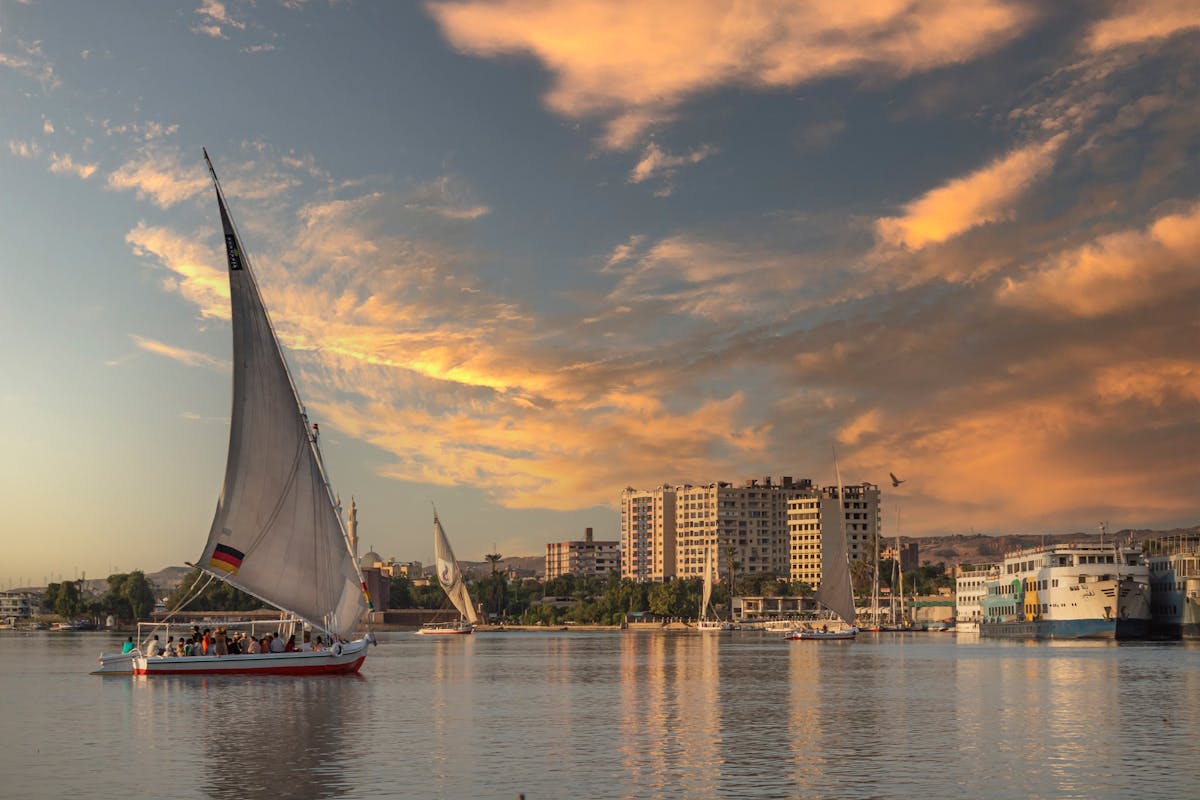
A felucca is a wooden sailboat with a single lateen sail that has been the standard vessel on the Nile for centuries. There is no engine. There is no schedule. There is the wind, the current, the boatman’s knowledge of both, and the slow revelation of a landscape that alternates between green cultivation and brown desert with a sharpness that still startles — the line between irrigated land and sand is often a single step, a border as precise as a knife cut. This is what the Nile does: it creates a corridor of life through a desert that would otherwise be uninhabitable, and everything Egyptian — every temple, every tomb, every village — lines up along that corridor like beads on a string.
Between Luxor and Aswan, the river passes Edfu and Kom Ombo — two temples that most cruise itineraries reduce to a couple of hours each but that deserve more. The Temple of Horus at Edfu is the best-preserved temple in Egypt, its pylons still towering, its inner chambers still dark and cool, the falcon god carved into every surface with a clarity that makes you forget you are looking at something built two thousand years ago. Kom Ombo sits directly on the riverbank, dedicated to two gods — Sobek the crocodile and Horus the falcon — and the symmetry of its twin design, visible in the doubled doorways and parallel sanctuaries, is architectural ambition rendered in stone. I visited at sunset, when the columns cast long shadows toward the river and a group of egrets took off from the bank in a white eruption that lasted three seconds and that I will remember for the rest of my life.
Aswan is where the Nile narrows, the granite boulders crowd the river, and the desert comes close. The town is quieter than Luxor, more Nubian in character, with a souk that smells of spices and henna and the particular sweetness of hibiscus tea that is served everywhere, in every shop, at every negotiation, as a gesture of welcome that is both genuine and strategic. Elephantine Island sits in the river opposite the corniche, reached by felucca, its Nubian villages painted in blues and yellows that glow in the late-afternoon light. I drank tea with a family who invited me in from the lane, and we communicated through gestures and a translation app and the universal language of hospitality that Egypt shares with Morocco and Turkey and every Mediterranean culture I have known.
Abu Simbel
The journey to Abu Simbel is part of the experience. You drive south from Aswan — three hours through a desert so flat and featureless that the road feels like a line drawn on paper, the only landmarks being the occasional checkpoint and the shimmer of heat on the asphalt. And then you arrive, and the desert opens, and there they are.
Ramesses II built Abu Simbel to intimidate. The four colossal statues of himself that guard the entrance are twenty metres tall — seated, serene, carved from the living rock of the cliff face with a precision that seems to mock the passage of time. The temple behind them extends sixty metres into the rock, its inner chambers aligned so that twice a year, on the 22nd of February and the 22nd of October, the rising sun penetrates the entire length of the temple and illuminates the statues of the gods in the sanctuary — a feat of astronomical engineering that the builders achieved without telescopes, without computers, without any tool more sophisticated than observation, mathematics, and the absolute certainty that what they were building mattered enough to get right.
But the truly astonishing story of Abu Simbel is not ancient — it is modern. In the 1960s, the construction of the Aswan High Dam threatened to submerge the temple under the rising waters of Lake Nasser. UNESCO launched one of the most ambitious engineering projects in history: the entire temple complex was cut into blocks — each weighing up to thirty tonnes — lifted, transported, and reassembled on higher ground, sixty-five metres above and two hundred metres back from its original position. The operation took four years, involved engineers and archaeologists from over fifty countries, and cost the equivalent of over three hundred million dollars in today’s money. It worked. The temple stands where it stands now not because Ramesses placed it there but because the twentieth century decided — collectively, internationally, at enormous expense — that what the thirteenth century BCE had built was worth saving.
I found this unbearably moving. Standing inside Abu Simbel, looking at the carvings on the walls — Ramesses in his chariot at the Battle of Kadesh, the bound prisoners, the offerings to the gods — I was aware of two acts of monumental ambition separated by three thousand years. The first said: I am eternal. The second said: we agree. The engineers who cut the temple from the rock were answering the pharaoh across thirty-two centuries, and their answer was yes.
What Egypt Does to You
I have not been to Egypt yet. I am writing this from a desk in France, surrounded by books and photographs and the itinerary I have been assembling for the trip I will take this autumn. Everything in this piece is built from research, from conversations with travellers I trust, from the accounts of writers who went before me — from Flaubert’s letters to Jan Morris’s essays to the quiet, precise observations of friends who have stood where I intend to stand and come back changed.
I am writing it anyway because Egypt has already done something to me, even from a distance. It has recalibrated my sense of time. I walk through Paris — a city I love, a city that feels ancient to most visitors — and I think about how the oldest stones here are perhaps eight hundred years old, and how the columns at Karnak were already two thousand years old when Paris was a Roman camp called Lutetia. I read about the alignment of Abu Simbel and I think about what it means to build something with such confidence in the future that you engineer it to interact with the sun on a specific date, forever. I look at the modern world — our glass towers, our digital infrastructure, our confident impermanence — and I wonder what will remain of us in three thousand years. The pyramids will still be there. Will anything we have built?
This is what Egypt does, even before you arrive. It asks you a question about permanence — not as an abstraction but as a physical fact, carved in stone, aligned to the stars, standing in the desert with the patience of something that has already outlasted everything it was built to outlast and shows no sign of stopping. The pharaohs were not modest men. They built to be remembered, and they succeeded beyond any reasonable expectation. Four thousand years later, we are still talking about them. We are still visiting their temples. We are still, in the case of Abu Simbel, spending fortunes to preserve what they made.
I do not know what I will feel when I finally stand in the Hypostyle Hall at dawn, or sail on the Nile at sunset, or see Abu Simbel emerge from the desert after three hours of driving through nothing. But I know what every traveller I have spoken to has told me, in different words but with the same conviction: that Egypt makes the modern world feel thin. That standing among monuments built before Rome, before Greece, before the written histories of almost every civilization on earth, produces a vertigo that is not unpleasant but that changes something — some internal calibration of what matters, what lasts, and what we owe to the people who built things they knew they would never see completed.
I am going. The itinerary is ready. The flights are almost booked. And I suspect that when I return, I will rewrite everything you have just read — not because it was wrong, but because Egypt, like all places that operate on a timescale larger than a human life, cannot be understood until it is felt. The stones will teach me what the books could not. They always do.
Voyagez avec intention
Guides sélectionnés, destinations paisibles et récits qui valent la peine d'être lus — envoyés quand nous avons quelque chose qui mérite d'être partagé.
Pas de spam. Désabonnement à tout moment.