The Scale of Australia — A Country That Takes Weeks to Comprehend
The Harbour
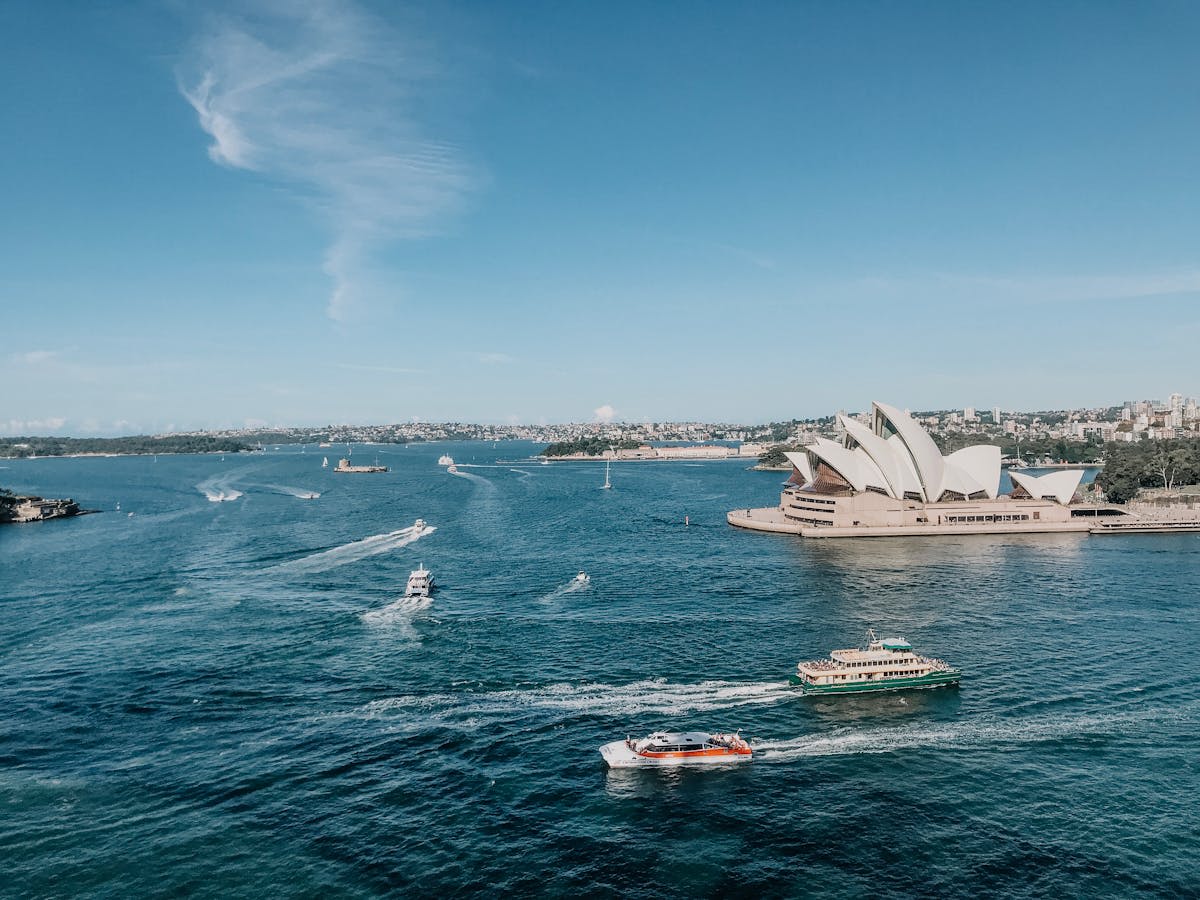
There is a moment, walking out of Sydney’s Circular Quay station for the first time, when the Opera House appears to your left and the Harbour Bridge rises to your right, and the entire scene is so absurdly photogenic that your brain briefly refuses to accept it as real. I have seen this harbour in a thousand photographs. None of them prepared me for the light — that particular Sydney light, hard and clean and impossibly bright, bouncing off the water and turning the Opera House sails into something that looks less like architecture and more like a living thing adjusting its posture in the sun.
I spent my first morning walking from Bondi to Coogee, the coastal path that threads along sandstone cliffs above beaches so perfectly formed they look art-directed. The water was turquoise in the shallows and navy where the depth dropped off, and surfers were already out at Tamarama despite the hour. Halfway along, I stopped at a kiosk and ordered my first Australian flat white — a drink I had been told repeatedly was superior to anything Europe produces. I am a Frenchman. I do not concede coffee supremacy easily. The flat white was exceptional. The milk was textured with a precision that bordered on engineering, the espresso was fruity and clean, and the whole thing was handed to me in a ceramic cup by a barista who clearly took this as seriously as any Parisian takes a crème. I drank it looking at the Pacific Ocean and accepted, reluctantly, that the Australians have a point.
Sydney is a city that wears its beauty without pretension. The harbour ferries double as public transport, which means your morning commute — if you are lucky enough to have one here — involves gliding past the Opera House at water level. Darling Harbour has reinvented itself. The Rocks still holds its colonial sandstone. And the food, even in the first twenty-four hours, made clear that this city has a culinary confidence that comes from being at the crossroads of Asian and European cooking traditions, with produce that benefits from soil and sun that Europe simply cannot match.
The Drive
The Great Ocean Road begins where Melbourne’s urban sprawl ends and the Southern Ocean begins its assault on the Victorian coastline. I picked up a car in Torquay and pointed it southwest, and within thirty minutes the road had narrowed to two lanes tracing the cliff edge, the ocean enormous and grey-green to my left, the eucalyptus hills rising to my right. This is one of the world’s great drives, and it earns the title not through drama alone but through rhythm — the way the road alternates between coast and forest, between wide panoramic sweeps and intimate tunnels of overhanging trees.
The distances in Australia are the first thing that recalibrates you. The Great Ocean Road is two hundred and forty kilometres from Torquay to Allansford, and the guidebooks suggest two to three days. In France, two hundred and forty kilometres is a morning’s autoroute drive. Here, the road is so winding, the stops so frequent, the pull-over viewpoints so relentlessly compelling, that you cover sixty kilometres in a morning and feel like you have lived a full day.
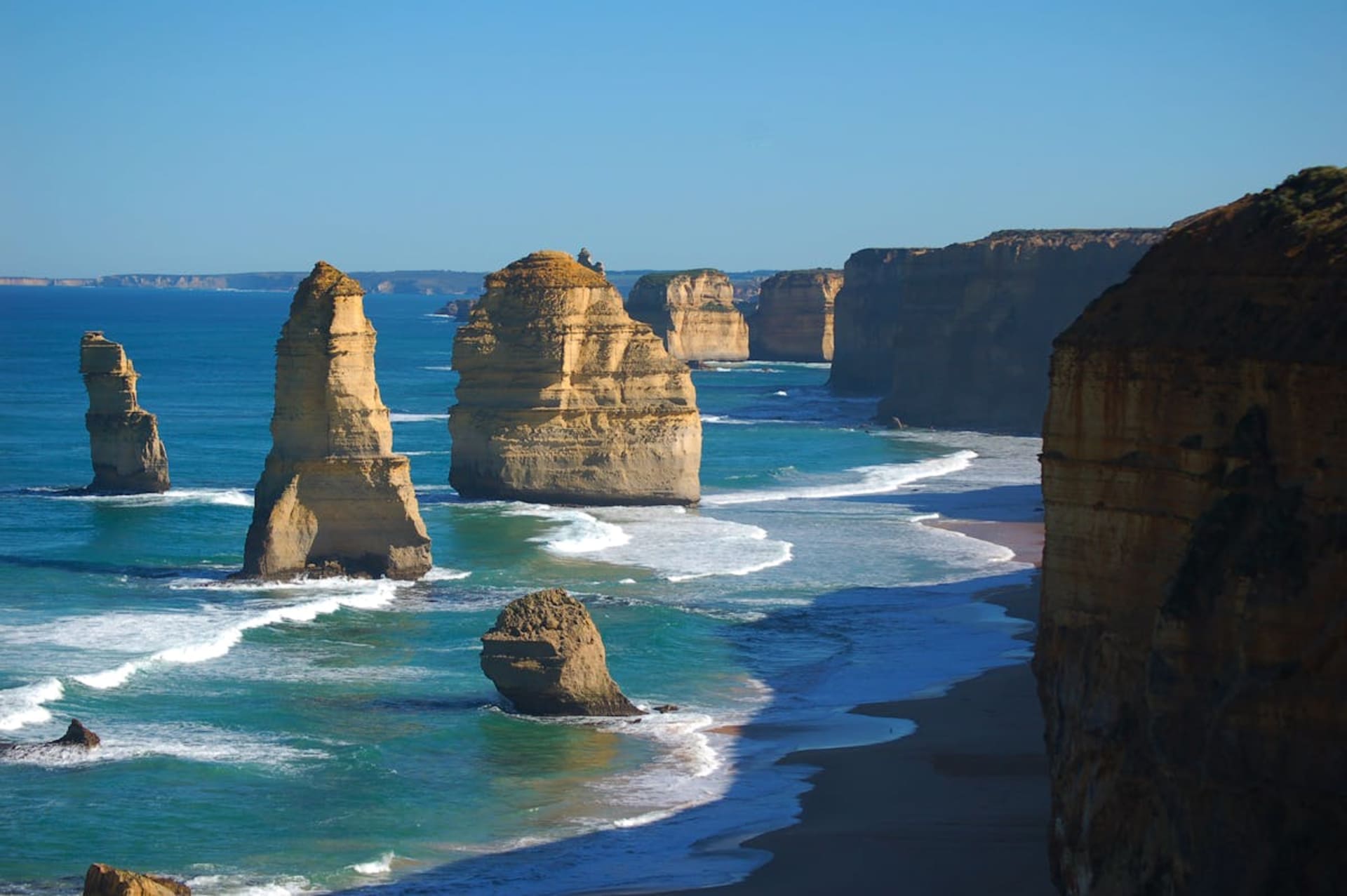
The Twelve Apostles are the headline act, and they deliver. These limestone stacks, battered by the Southern Ocean into forms that look sculpted by a furious artist, stand in water that churns and foams around their bases with a violence that is mesmerising. I arrived at late afternoon, when the light turns golden and the stacks cast long shadows across the beach below. There were other people — this is not a secret — but the scale of the coastline absorbs them. You can walk five minutes along the cliff and find yourself alone with the wind and the sound of waves hitting rock.
What the Great Ocean Road teaches you is the Australian relationship with driving. This is a country built on distances, and the road trip is not recreation here — it is culture. Every Australian I met had a road trip story, a favourite stretch of highway, a campsite they return to. The car is not transport; it is how you have a conversation with the landscape. I understood this on the second day, somewhere between Apollo Bay and the Otways, when I stopped trying to reach the next destination and started treating the drive itself as the point.
The Reef
Nothing I had read about the Great Barrier Reef prepared me for the scale of what I saw beneath the surface. I had expected beauty — I had not expected the overwhelming density of life, the sense of entering a city that has been functioning for millennia without any human input. The outer reef, beyond the tourist platforms, is a world that makes terrestrial nature feel static by comparison. Everything moves. The coral pulses with feeding polyps. Fish schools shift direction in unison like flocks of starlings. Anemones sway. Sharks patrol. And the colour — the colour is not describable in language that does justice to it. You would need to invent new words.
I snorkelled at Agincourt Reef, ninety minutes by boat from Port Douglas, and within the first minute I was hovering above a green sea turtle so close I could count the pattern on its shell. It looked at me with an expression that communicated either ancient wisdom or total indifference — with turtles, these are the same thing. Below, the coral was alive in the fullest sense: branching, plating, mounding, in colours that ranged from electric purple to deep amber to a green so vivid it looked backlit.
The conservation conversation is unavoidable and necessary. The reef has lost significant coral cover to bleaching events driven by rising sea temperatures. The sections I visited were vibrant and healthy, but the marine biologists on the boat spoke with a frankness that stayed with me: what I was seeing was a reef in recovery, not a reef at its peak. The urgency is real. If you are planning to visit the Great Barrier Reef, the time is now — not because it is dying, but because it is fighting, and witnessing that fight changes how you think about every environmental choice you make afterward.
The Red Centre
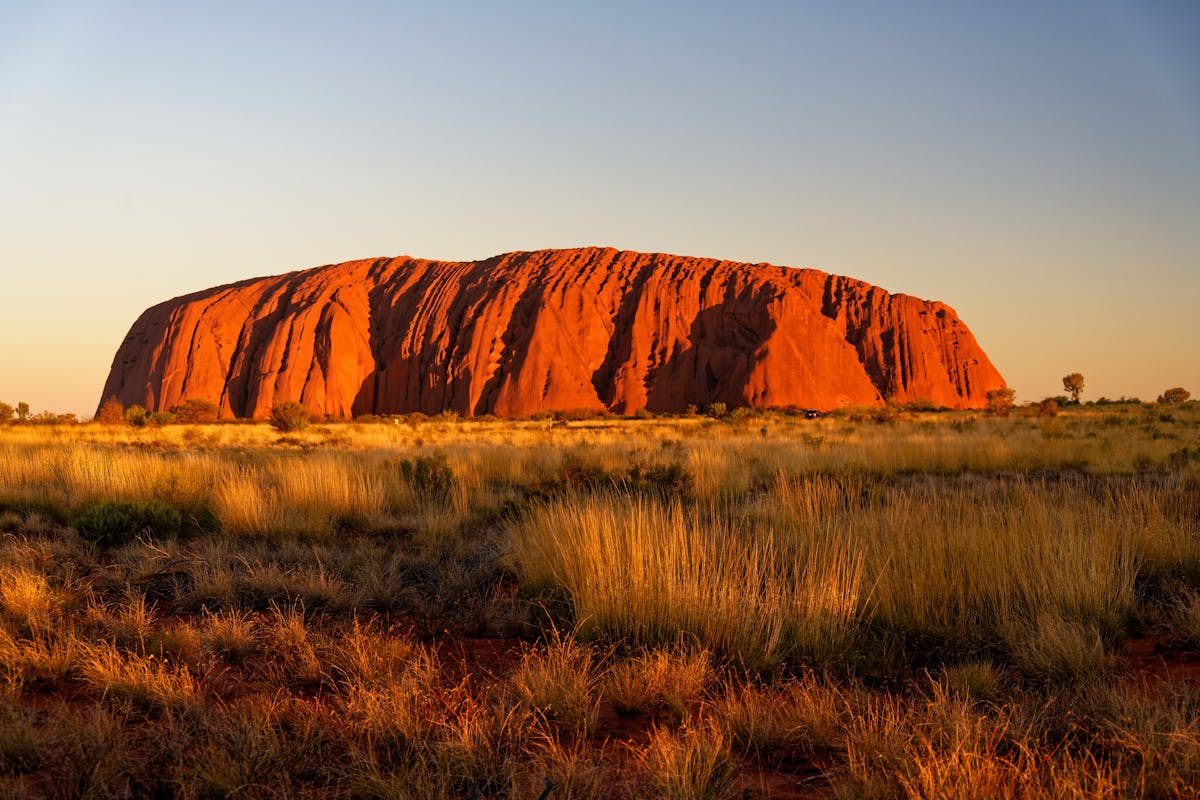
The flight from Cairns to Uluru crosses the interior of Australia, and for two hours you look down at nothing. Not nothing as in sparse — nothing as in the earth below is so uniformly red and flat and empty that it reads as an abstraction, a colour field painting at continental scale. Then Uluru appears on the horizon, and even from thirty thousand feet, even through an aeroplane window, it commands attention. It is not the size — though it is enormous — it is the singularity. One rock, alone, in a landscape that offers no competition for your gaze.
I arrived at the viewing area before dawn the next morning. The sky was still black, the stars more numerous than I have ever seen — the outback has a darkness that European skies have forgotten — and Uluru was a silhouette, a shape defined by absence. Then the sun rose. The rock changed colour in real time: black to deep purple to maroon to red to orange to the unmistakable burnt ochre that every photograph tries and fails to capture. The whole transformation took perhaps twenty minutes, and during those twenty minutes nobody spoke. There were a hundred people at the viewing point, and not one of them made a sound. This is what sacred means — not the label, but the involuntary silence it produces.
Kata Tjuta, the collection of thirty-six domed rock formations twenty-five kilometres from Uluru, is the place the crowds skip, and it is extraordinary. The Valley of the Winds walk threads between the domes through a landscape that feels Martian. The wind channels between the rock walls with a sound that is not quite musical but not quite random — it is the sound of geology and atmosphere in conversation.
The Anangu people, the traditional owners of this land, have lived here for tens of thousands of years. Their connection to this landscape is not metaphorical or sentimental — it is cosmological. The stories embedded in the rock, the songlines that cross the desert, the cultural knowledge held in these formations — this is a depth of relationship to place that European culture has no equivalent for. I walked the base of Uluru on a guided cultural tour and understood, for the first time, that I was not visiting a natural wonder. I was visiting someone’s cathedral, someone’s library, someone’s home.
The Island
Tasmania is Australia’s secret, and the Tasmanians would like to keep it that way. The island sits two hundred kilometres south of the mainland, separated by Bass Strait, and it operates on a different frequency — slower, wilder, more intimate. Where mainland Australia overwhelms with scale, Tasmania overwhelms with density. Everything is compressed: rainforest, mountains, coastline, farmland, all within a few hours’ drive, and all of it producing food and wine that has quietly become world-class.
MONA — the Museum of Old and New Art — is the reason many people first come to Hobart, and it is unlike any museum I have visited. Built into a sandstone cliff on the banks of the Derwent River, it is a subterranean labyrinth of confrontational, beautiful, occasionally disturbing art collected by a professional gambler with impeccable taste and no interest in making you comfortable. I spent four hours inside and emerged blinking into the Tasmanian light feeling like I had been in a philosophical argument with a building.
Cradle Mountain, in the island’s northwest, is wilderness of a different order. The Overland Track — a six-day walk through alpine plateaus, ancient rainforest, and glacial valleys — is one of Australia’s great hikes. I walked the first day, to Crater Lake and back, and the landscape was so pristine, so untouched, that I felt like I was trespassing. Button grass plains stretched to mountain ridges. The air tasted of clean water and eucalyptus. A wombat crossed the path ahead of me with the unhurried confidence of something that has never had a reason to rush.
The food in Tasmania deserves its own essay. Oysters shucked at the farm gate on the east coast. Cheese from Bruny Island that rivals anything in the Pyrenees — and I do not make that comparison lightly. Pinot Noir from the Tamar Valley that is starting to worry Burgundy producers, though they would never admit it. This is an island where the cold Southern Ocean meets fertile soil and a community of producers who chose isolation over compromise, and the results are on every plate.
What Australia Teaches You
I came to Australia thinking I understood distance. I am French — I have driven from Paris to the Mediterranean, from the Atlantic to the Alps. I thought I knew what it meant to cross a large country. Australia disassembled that assumption in the first week and never bothered to put it back together. This is a place where the scale is not scenic but existential. The outback does not just stretch to the horizon — it stretches beyond it, and beyond the one after that, and the emptiness is not absence but presence, a landscape so vast it becomes a character in your trip rather than a backdrop to it.
What surprised me most was the contradictions. A country of brutal wilderness that produces some of the most refined coffee culture on earth. A landscape of ancient silence that holds cities as cosmopolitan as any in Europe. A reef of staggering beauty that is simultaneously one of the planet’s most urgent conservation crises. An Indigenous culture of incomprehensible depth alongside a colonial history of incomprehensible cruelty. Australia does not resolve these contradictions — it holds them, openly, and asks you to sit with the discomfort.
Four weeks is not enough. I knew this before I went, and the knowledge did not help. You cannot comprehend a continent in a month any more than you can comprehend the reef in a single dive. What you can do is start. You can let Sydney’s light and Melbourne’s laneways and the reef’s impossible colour and Uluru’s silence and Tasmania’s wildness accumulate in you until they form something that is not understanding, exactly, but the beginning of respect — for a country that is not one thing, that refuses to be summarised, and that rewards the traveller willing to give it the time it demands.
Australia does not come to you. You must go to it, slowly, over weeks, with patience and an open itinerary and the willingness to be small. It is, I think, the greatest travel lesson a continent can teach.
Voyagez avec intention
Guides sélectionnés, destinations paisibles et récits qui valent la peine d'être lus — envoyés quand nous avons quelque chose qui mérite d'être partagé.
Pas de spam. Désabonnement à tout moment.