Lost in the Medina — Morocco's Labyrinth of Senses
The Labyrinth
I have been told, by people whose travel advice I trust, that the medina of Fes is not a place you navigate. It is a place that navigates you. I believe them. I have studied maps of the Fes el-Bali — the old city, the largest car-free urban zone on earth, nine thousand lanes folding into themselves like a puzzle designed by someone who considered straight lines a moral failure — and I have accepted that no map will help. This is a city that was built over a thousand years for donkeys and people and the particular kind of commerce that requires proximity, not efficiency. The streets were never meant to make sense to an outsider. They were meant to make sense to the people who live there, and those people learned the routes the way the rest of us learn language: by immersion, by repetition, by getting it wrong until getting it right becomes instinct.
I want to enter through the Bab Bou Jeloud, the Blue Gate, in the early morning, when the light is still soft and the lanes are not yet thick with heat and tourists. I want to follow the main artery downhill toward the Kairaouine Mosque — one of the oldest universities in the world, founded in 859 by a woman named Fatima al-Fihri, a fact that deserves more attention than it gets — and then I want to leave the main artery and turn into the side streets, where the medina reveals what it actually is. Not a market. Not a monument. A living city where people are born, work, eat, argue, pray, and die inside walls that have not fundamentally changed since the Middle Ages.
I will get lost. This is not a risk. It is the plan. Every traveler I have spoken to who has been to Fes says the same thing: the getting lost is the point. You turn a corner and find a courtyard with a fountain and three cats sleeping in the shade. You follow a sound and discover a man hammering copper into trays with a rhythm that has not changed in five hundred years. You smell bread baking and track it to a communal oven where women bring their dough each morning and collect it, marked and risen, each afternoon. The medina is not a labyrinth you solve. It is a labyrinth you surrender to.
And when you are truly lost — when the GPS has given up and the landmarks have disappeared and the alley has narrowed to the width of your shoulders — you will find a child who offers to guide you out for a few dirhams. This is not a scam. It is a service, and one that the medina has been providing to disoriented visitors for centuries. Pay the child. Follow the child. Arrive somewhere you did not expect. This is how Fes works.
The Souks
Marrakech is a different kind of overwhelming. Where Fes disorients quietly — its medina dense and inward-looking, its surprises tucked behind unmarked doors — Marrakech assaults the senses with a confidence that borders on aggression. The souks radiate outward from the Jemaa el-Fna, the great square at the city’s heart, and they are organized by trade in a system that dates back centuries: a street for spices, a street for leather, a street for metalwork, a street for textiles, a street for slippers so elaborately embroidered they look like they were made for a sultan and cost less than dinner.
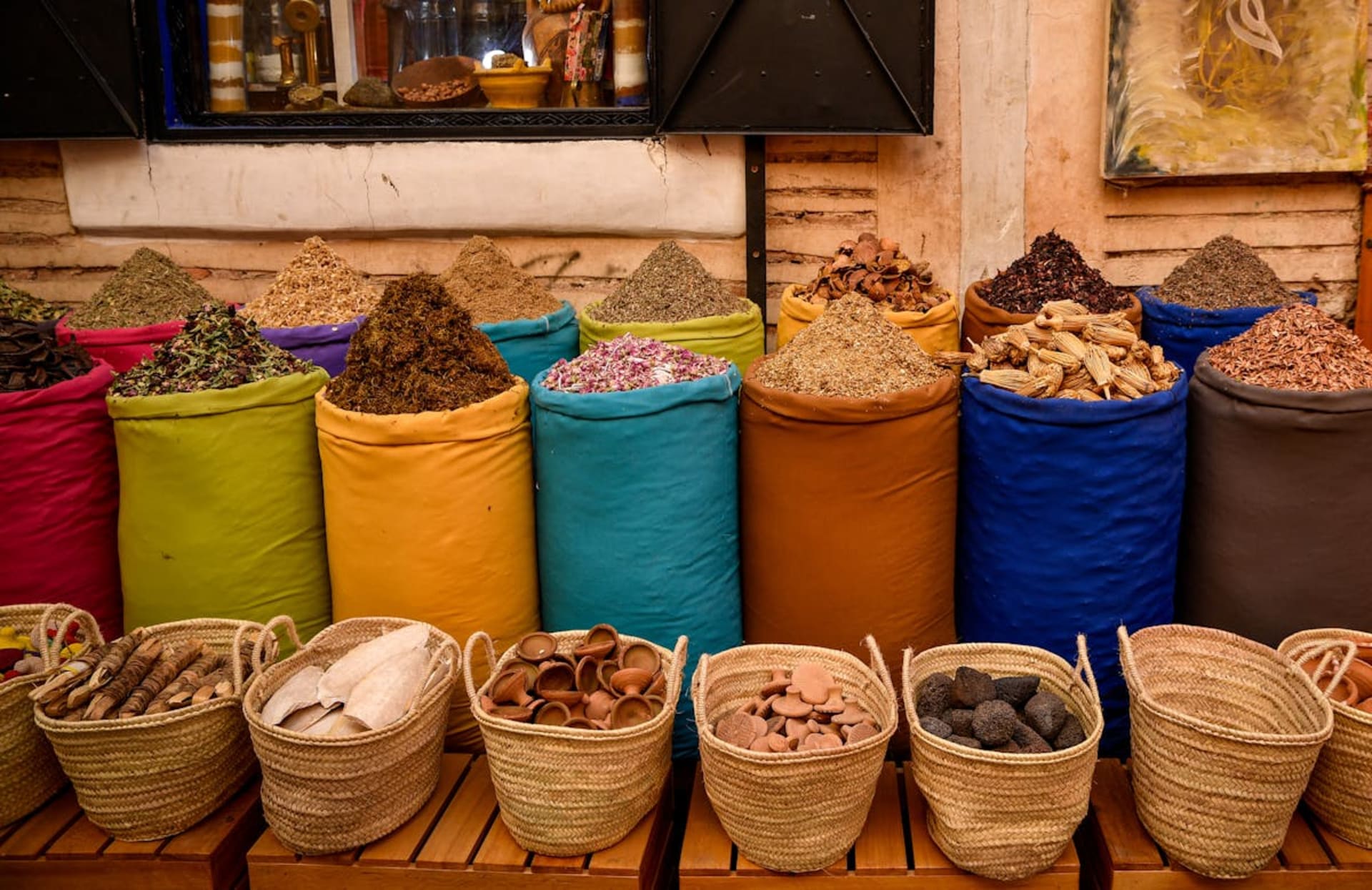
I want to walk the spice souk first, where pyramids of cumin, turmeric, saffron, and ras el hanout — the blend of thirty-some spices whose name means “head of the shop,” meaning the best the merchant has — are arranged with a geometric precision that turns commerce into art. The colours alone are worth the visit: deep gold, burnt orange, the almost violent red of ground paprika, the muted green of dried herbs. The sellers are persuasive in the way that a river is persuasive — not because they push, but because the current moves in one direction and resistance is more effort than it is worth. I will buy more saffron than I need. I have already accepted this.
The leather souk is where the smell changes. Tanned hides in every colour hang from wooden frames, and the craftsmen sit cross-legged on the ground, stitching bags and belts and book covers with needles that look like they predate the industrial revolution. The metalwork souk rings with the sound of hammers — lanterns, teapots, trays, ornamental boxes — and the light in these narrow lanes is filtered through latticed ceilings into patterns that shift on the ground like something alive.
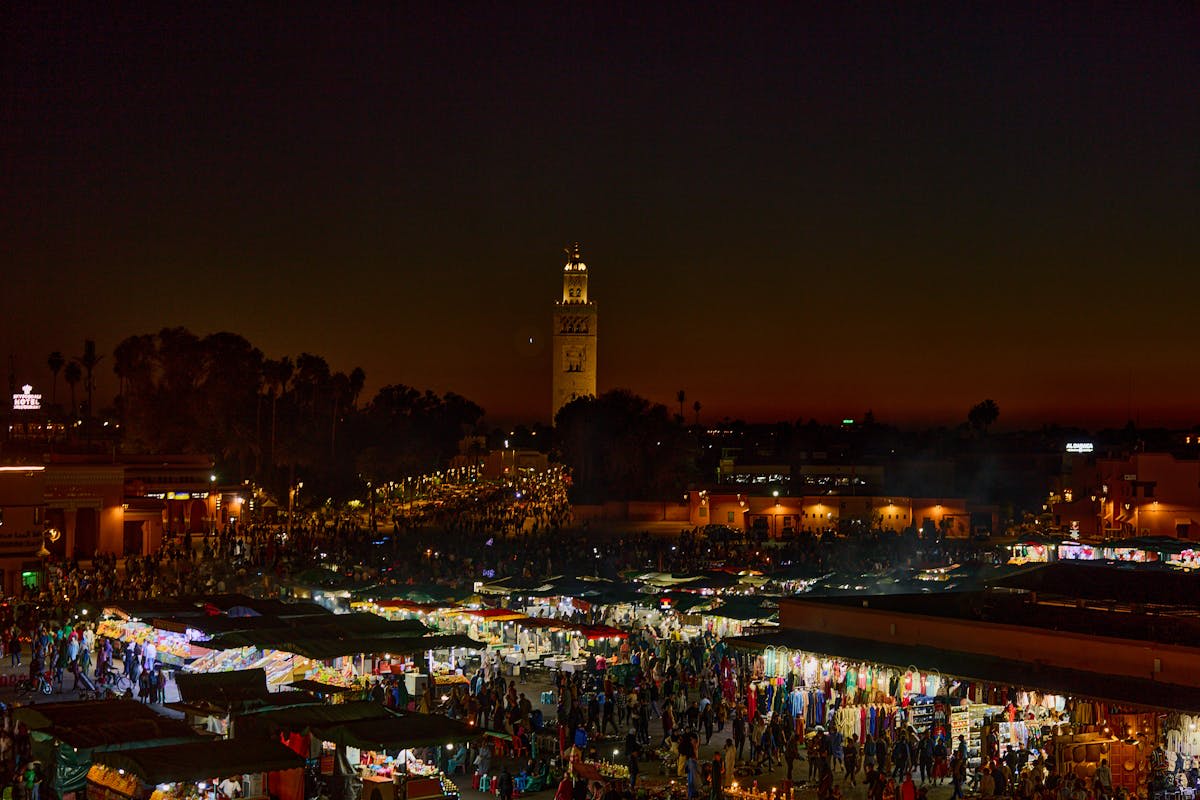
The Jemaa el-Fna at dusk is its own event. The square transforms as the light fades — snake charmers give way to food stalls, storytellers draw circles of listeners, musicians set up in corners, and the smoke from a hundred grills rises into the evening air and mixes with the call to prayer until the whole square feels like a ceremony that has been performed every night for a thousand years and will be performed for a thousand more.
The Food
Moroccan food is patience made edible. A proper tagine — the stew named after the conical clay pot it is cooked in — takes hours. The lamb falls apart at the suggestion of a fork. The prunes have caramelized into something that is no longer fruit but a kind of savoury candy. The almonds are toasted and whole and scattered on top like punctuation. Every riad in the country serves tagine, and I suspect that after twelve days I will have eaten it a dozen times and still not be tired of it, because each version is different — chicken with preserved lemon and olives, beef with dates, vegetable with saffron — and because there is something deeply satisfying about a dish that refuses to be rushed.
Couscous is Friday food, served after the midday prayer, and eating it on any other day feels vaguely transgressive in a way I find appealing. The grains are steamed — not boiled, never boiled — in a couscoussier, a double-tiered pot that allows the steam from the stew below to rise through the semolina above, and the result is lighter and more delicate than anything I have made at home, which tells me I have been making it wrong. Pastilla — the sweet-and-savoury pie of shredded pigeon or chicken, almonds, cinnamon, and flaky pastry dusted with powdered sugar — is the dish I am most eager to try, because it is the dish that most clearly represents Morocco’s willingness to put flavours together that have no business working and make them work spectacularly.
And then there is mint tea. The ritual of Moroccan mint tea is not about the tea. It is about the pouring — from a silver teapot held high above the glass, the stream thin and precise, the foam rising in the glass as the liquid falls. It is about the sugar, which is not optional and not negotiable and not a small amount. It is about the three glasses — the first as gentle as life, the second as strong as love, the third as bitter as death, according to the proverb — though in practice all three taste primarily of sugar and mint and the particular hospitality of a country that considers offering tea to a stranger a moral obligation rather than a social nicety. I plan to drink a great deal of it.
The Desert
South of the Atlas Mountains, the landscape empties. The Dadès Valley gives way to hammada — stony desert, flat and featureless — and then the hammada gives way to sand, and then the sand rises into the dunes of Erg Chebbi, and the world becomes very simple: gold below, blue above, silence everywhere.
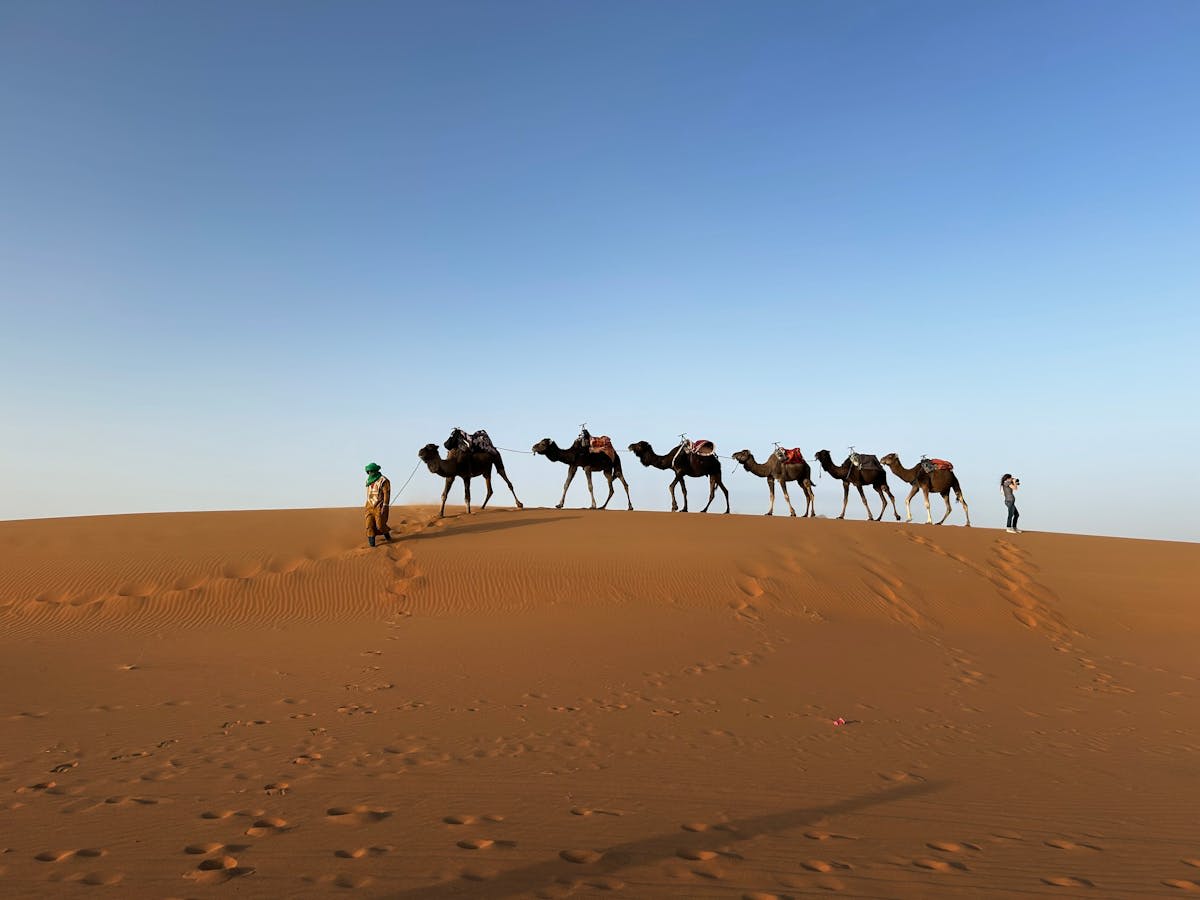
I want to ride a camel into the dunes at sunset. I know this sounds like a cliche. I know every Morocco itinerary includes this photograph — the silhouette against the orange sky, the caravan line stretching to the horizon, the whole scene arranged to look spontaneous and ancient when it is in fact a well-organized tourist excursion with a departure time and a WhatsApp confirmation. I do not care. Some cliches earn their status, and a sunset camel trek into the Sahara is, by every account I have read, one of them.
The camp will be somewhere in the dunes — a cluster of Berber tents, a fire, a dinner of tagine and bread cooked in the sand, and then the sky. The Sahara sky is the part that every traveler mentions first and struggles most to describe. No light pollution. No clouds. No atmosphere thick enough to dim anything. Just stars — more stars than the word “stars” can hold, the Milky Way not a faint smudge but a bright, textured river across the entire dome of the sky, so dense and so close that the distance between you and the universe feels like a technicality. I have seen dark skies before. I have never seen Sahara-dark skies, and I am told the difference is not a matter of degree but of kind.
In the morning, the dunes at sunrise. The light moving across the sand in waves, the shadows deepening between the ridges, the silence so complete that you can hear the sand shift in the wind. I want to climb to the top of a dune and sit there and watch the desert wake up and feel, for a few minutes, the particular smallness that comes from standing in a landscape that has no interest in you whatsoever.
What Morocco Does to You
I have not been yet. I am writing this from a desk in a city with right angles and traffic lights and restaurants that take reservations, and I am trying to describe a country I know only from the accounts of others, from photographs, from the kind of longing that builds when you read enough and listen enough and imagine enough that a place begins to feel real before you arrive.
But I think I understand what Morocco will do. It will recalibrate my sense of time. It will teach me that getting lost is not a failure of navigation but a form of discovery. It will show me that a meal can take three hours and be better for it, that a conversation with a stranger can begin with tea and end with an invitation, that a city can be a thousand years old and still feel like it is happening right now, in real time, for the first time.
Morocco, by every account, is the country that teaches you to stop moving in straight lines. To follow the smell instead of the map. To sit down when someone offers you a glass of tea, even if you are already late, because the tea is the point, and the lateness is a Western invention that has no jurisdiction here.
I am not in a hurry. Morocco, I am told, will make sure of that.
Viaja con intención
Guías curadas, destinos tranquilos e historias que vale la pena leer — enviadas cuando tenemos algo que merece ser compartido.
Sin spam. Cancela cuando quieras.