Angkor at Dawn — The Temples That Rewired My Sense of Time
Before the Light
I have a theory about places that exist in too many photographs. The theory is that familiarity breeds a kind of blindness — you see the image so many times that the thing itself, when you finally stand before it, arrives pre-processed, its edges softened by repetition, its power diluted by the thousand versions of it you have already consumed on screens. I believed this theory. Angkor Wat disproved it in about four seconds.
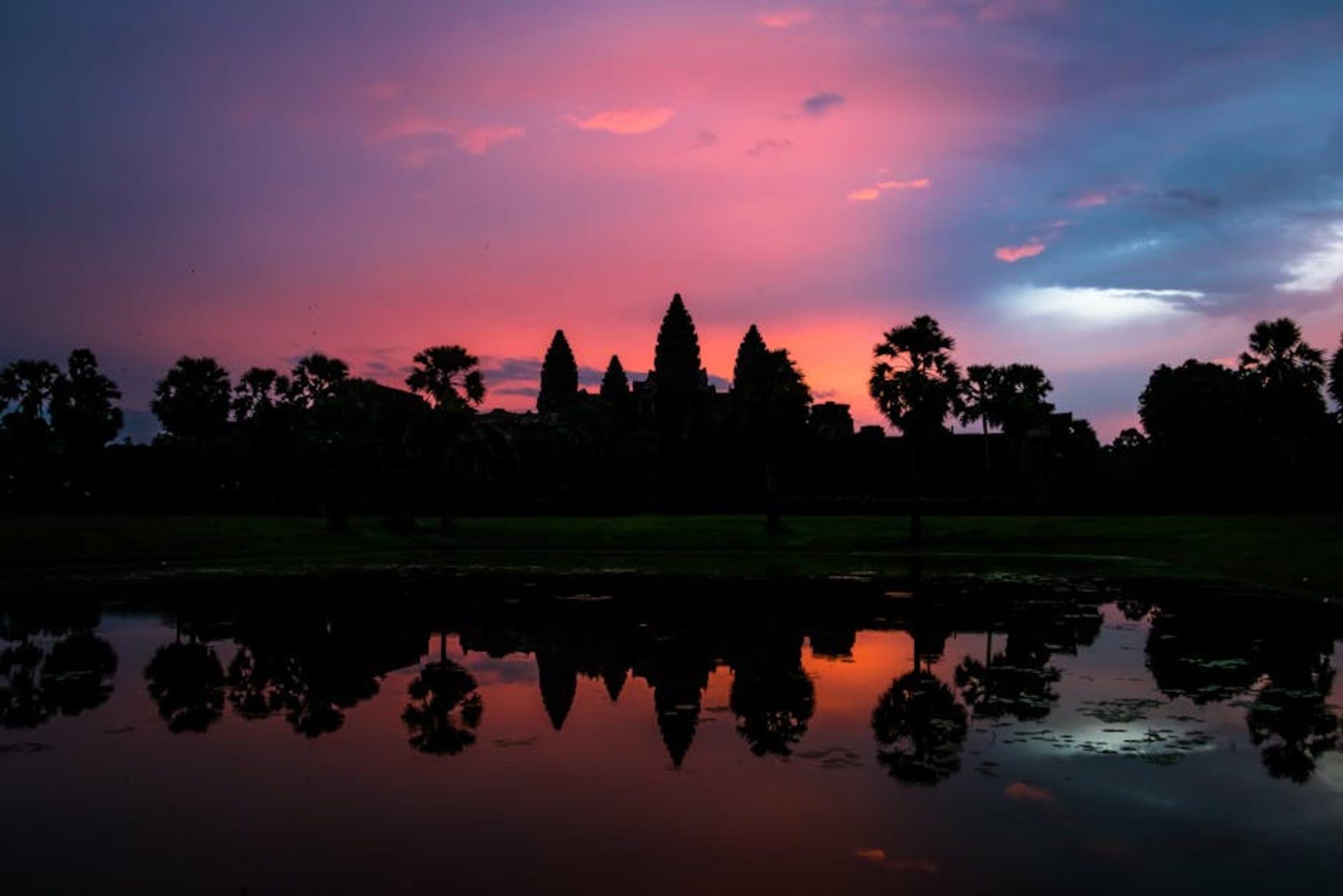
We arrived at the moat at 5:15, crossing the causeway in near-darkness with a handful of other travellers whose footsteps echoed on the sandstone. The air was warm and heavy with the particular humidity of Cambodian mornings — the kind that settles on your skin like a second layer and does not lift until the sun has been up for hours. The temple was a silhouette, nothing more, a dark mass against a sky that was not yet committed to being light. I found a spot near the reflecting pool, sat down on the stone edge, and waited.
What happened next is difficult to describe because it happened slowly and then all at once. The sky began to lighten in the east — not with colour but with a gradual reduction of darkness, as though someone were turning a dimmer switch on the world. The five towers of Angkor Wat emerged first as outlines, then as shapes, then as architecture of such scale and precision that my mind did a kind of recalibration, the way your eyes adjust when you walk from a dark room into sunlight. The reflection appeared in the water below — inverted, perfect, doubled — and for a moment I was looking at two temples, one built by the Khmer Empire and one built by the laws of physics, and I could not tell which was more beautiful.
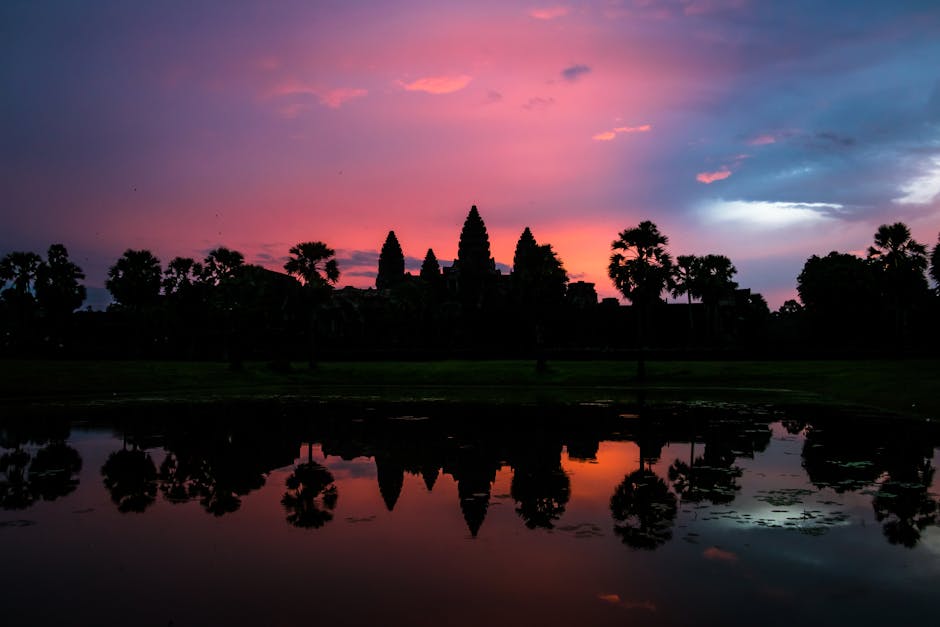
The colours came last. Orange, then gold, then the particular amber that sandstone produces when the light hits it at the right angle — a warmth that seems to come from inside the stone rather than from the sun. The crowd around me — perhaps fifty people, far fewer than the hundreds who would arrive by seven — fell silent with a unanimity that felt involuntary, as though the temple had issued a command that our bodies obeyed before our minds could decide. I sat there for forty minutes. I took three photographs. None of them capture what I saw. None of them could.
The Galleries
The bas-reliefs inside Angkor Wat stretch for nearly a kilometre around the outer gallery, and they are, without exaggeration, one of the great artistic achievements of human civilization. I say this as a Frenchman who grew up visiting the Louvre and who has stood before Michelangelo’s ceiling in the Sistine Chapel. The scale is comparable. The detail is, in some ways, superior.
The Churning of the Ocean of Milk occupies forty-nine metres of the southern gallery. The scene depicts gods and demons pulling a giant serpent wrapped around a mountain to churn the cosmic sea and produce the elixir of immortality. Ninety-two demons on one side, eighty-eight gods on the other, each figure individually carved, each with its own posture and expression, each wearing distinct armour or jewellery. The carving is shallow — only a few centimetres deep in most places — but the sculptors achieved a three-dimensionality through layering that makes the figures appear to move. I stood before this panel for nearly an hour, tracing the details with my eyes, finding new figures each time I looked: a fish leaping from the churned ocean, an apsara dancer emerging from the foam, a demon whose face is twisted with the effort of the pull.
A guide approached and offered his services. I declined politely — I had done the reading, I had the context — and then he pointed to a small detail I had missed: a tortoise at the base of the mountain, supporting the entire cosmic apparatus on its back. Vishnu, he explained, had taken the form of a tortoise to prevent the mountain from sinking into the ocean floor. I hired him immediately. He spent the next three hours showing me things I would never have found alone — a section where the carving style changes mid-panel, suggesting a different team of sculptors; a corner where a carver had made a mistake and corrected it, the correction still visible eight centuries later; a hidden figure in the Battle of Lanka panel that he said most guides do not know about. His name was Sophea, and he had been guiding at Angkor for twenty-two years. He knew every stone.
The Faces
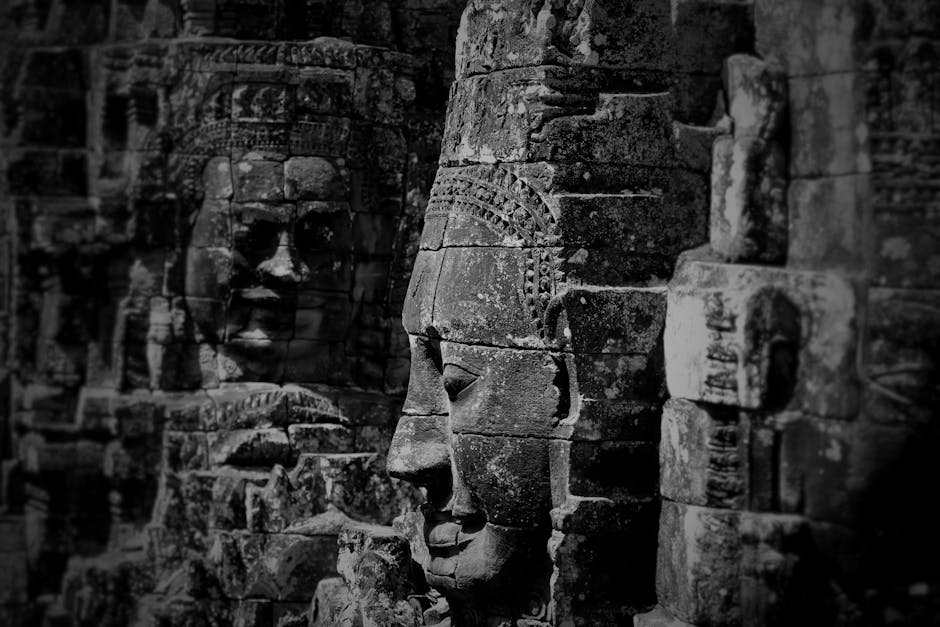
Bayon is a different experience from Angkor Wat — more intimate, more disorienting, more strange. Where Angkor Wat overwhelms with scale and symmetry, Bayon overwhelms with presence. The temple sits at the exact centre of Angkor Thom, the last great capital of the Khmer Empire, and its fifty-four towers are carved with 216 faces of Avalokiteshvara — the bodhisattva of compassion — each one slightly different, each one smiling.
I climbed to the upper terrace in the late afternoon, when the tour groups had thinned and the light was coming from the west, and found myself surrounded by faces. They looked at me from every direction — serene, knowing, amused by something I could not identify. The smiles are not identical. Some are broader, some more contained, some carry what I can only describe as a gentleness so specific it feels personal, as though the sculptor had someone particular in mind. I walked among them for an hour, turning corners and finding more faces, each one watching me with the same patience that I imagine they have watched every visitor for the last eight hundred years.
The effect is cumulative. One face is a carving. Ten faces are an artistic statement. Two hundred and sixteen faces are a psychological experience. You begin to feel observed not by stone but by something that the stone is expressing — a quality of attention, a kind of cosmic awareness, that the builders clearly intended and that, eight centuries later, still works. I sat on a ledge at the top of Bayon and watched the sun move across the faces, the shadows shifting the expressions from amusement to contemplation to something approaching tenderness, and I understood why Jayavarman VII built this temple not to a Hindu god but to a Buddhist ideal. This is not a monument to power. It is a monument to compassion, and the faces are its argument.
The Jungle Takes Back
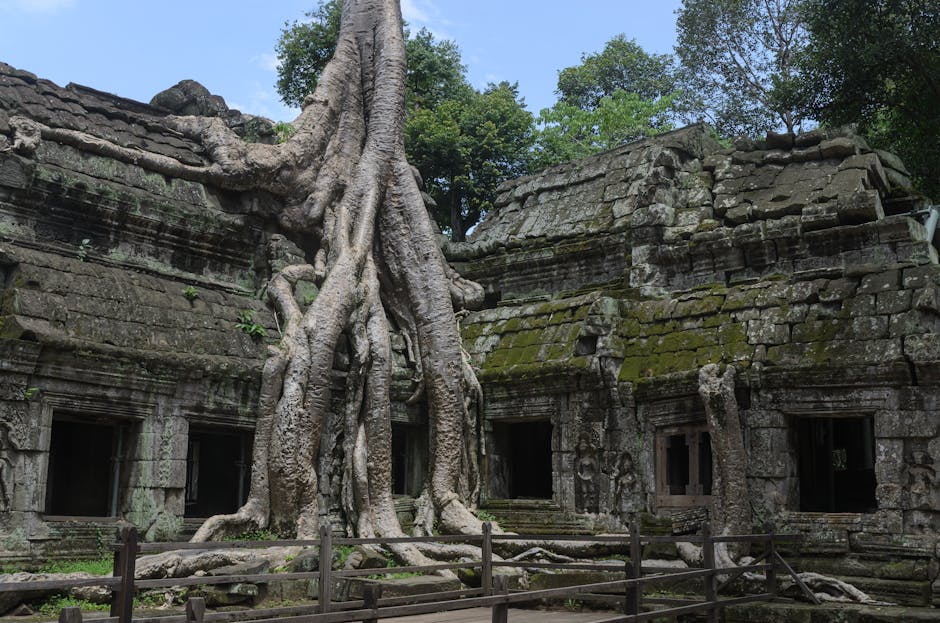
Ta Prohm is the temple that nature is winning. Silk-cotton trees and strangler figs have grown over, through, and into the stone, their roots flowing over doorways and walls like frozen rivers, their trunks splitting blocks that were placed here nine centuries ago. The Khmer Rouge-era decision to leave Ta Prohm largely unrestored — unlike Angkor Wat and Bayon, which have been extensively maintained — means that you see this temple in something closer to the state that the French explorers found it in the nineteenth century: architecture and jungle in an embrace that neither is willing to break.
I went early, before eight, and had corridors to myself. The light inside Ta Prohm is filtered through the canopy, green and shifting, and the sounds are jungle sounds — birds, insects, the creak of wood against stone, the occasional crack of a branch that makes you flinch because the trees here are enormous and their intentions, architecturally speaking, are clear. A root as thick as my torso flowed over a lintel carved with dancing apsaras, and the juxtaposition — the human art and the vegetable force — produced in me a feeling I have not had at many other ruins: the feeling that impermanence is not sad but beautiful, that the slow dissolution of human ambition by natural process is itself a kind of art.
The most photographed spot in Ta Prohm is the doorway where a tree has grown over the entrance, its roots framing the opening like a natural arch. Every visitor takes this photograph. I took it too. But the image I carry in my memory is from a quieter corner — a small chamber deep inside the complex where a shaft of light came through a gap in the canopy and illuminated a carved face on the wall, half-covered by moss, still smiling. The jungle had not yet reached this face, but it would. It was a matter of years, maybe decades. And the face did not seem to mind.
What Stays
On the third day, I rented a bicycle and rode out to the temples that most visitors never reach. Preah Khan, a vast complex that was once a university, a temple, and a city, and whose corridors echo with a loneliness that the more famous sites have lost. Neak Pean, a small temple on an artificial island, reached by a wooden boardwalk over a lake that was once part of the Khmer Empire’s water management system — an engineering achievement that sustained a million people in a tropical forest before Europe had plumbing. Ta Som, where a tree has consumed the eastern gopura so completely that temple and tree are now a single entity, and separating them would destroy both.
I rode through the forest between temples, the road shaded by enormous trees, the heat manageable in the morning, the only company being the occasional motorbike and the birds that followed the tree line. The Angkor complex covers more than four hundred square kilometres, and the temples I visited over three days represent perhaps a tenth of what exists. There are temples in the jungle that have not been fully mapped. There are carvings that no tourist has ever photographed. The Khmer Empire, at its peak, was one of the largest and most sophisticated civilizations on earth, and Angkor is its library, written in stone, shelved in the forest, waiting for readers.
I returned my bicycle at the hotel as the sun was setting and sat by the pool with a beer that tasted better than any beer has a right to taste. I was sunburned, mosquito-bitten, and profoundly changed. Not in the dramatic way that travel writers like to claim — I did not find myself or lose myself or any of the other spatial metaphors that we apply to experiences we cannot quite articulate. What changed was subtler. My sense of time recalibrated. The urgency I carry around — the French Protestant urgency of productivity, of not wasting a moment, of measuring life by what is accomplished — loosened, just slightly, in the face of structures built by people who thought in centuries rather than quarters.
The Khmer builders of Angkor did not know that their empire would fall. They did not know that the jungle would swallow their cities. They did not know that, eight hundred years later, a Frenchman living in Mexico would sit among their ruins and feel his ideas about permanence quietly disassemble. They built anyway. They carved the faces anyway. They aligned the temples to the solstices and the equinoxes anyway, with a confidence in the future that I find, sitting here writing this, both humbling and necessary. We build, knowing it will not last. That is not futility. That is faith.
Viaja con intención
Guías curadas, destinos tranquilos e historias que vale la pena leer — enviadas cuando tenemos algo que merece ser compartido.
Sin spam. Cancela cuando quieras.