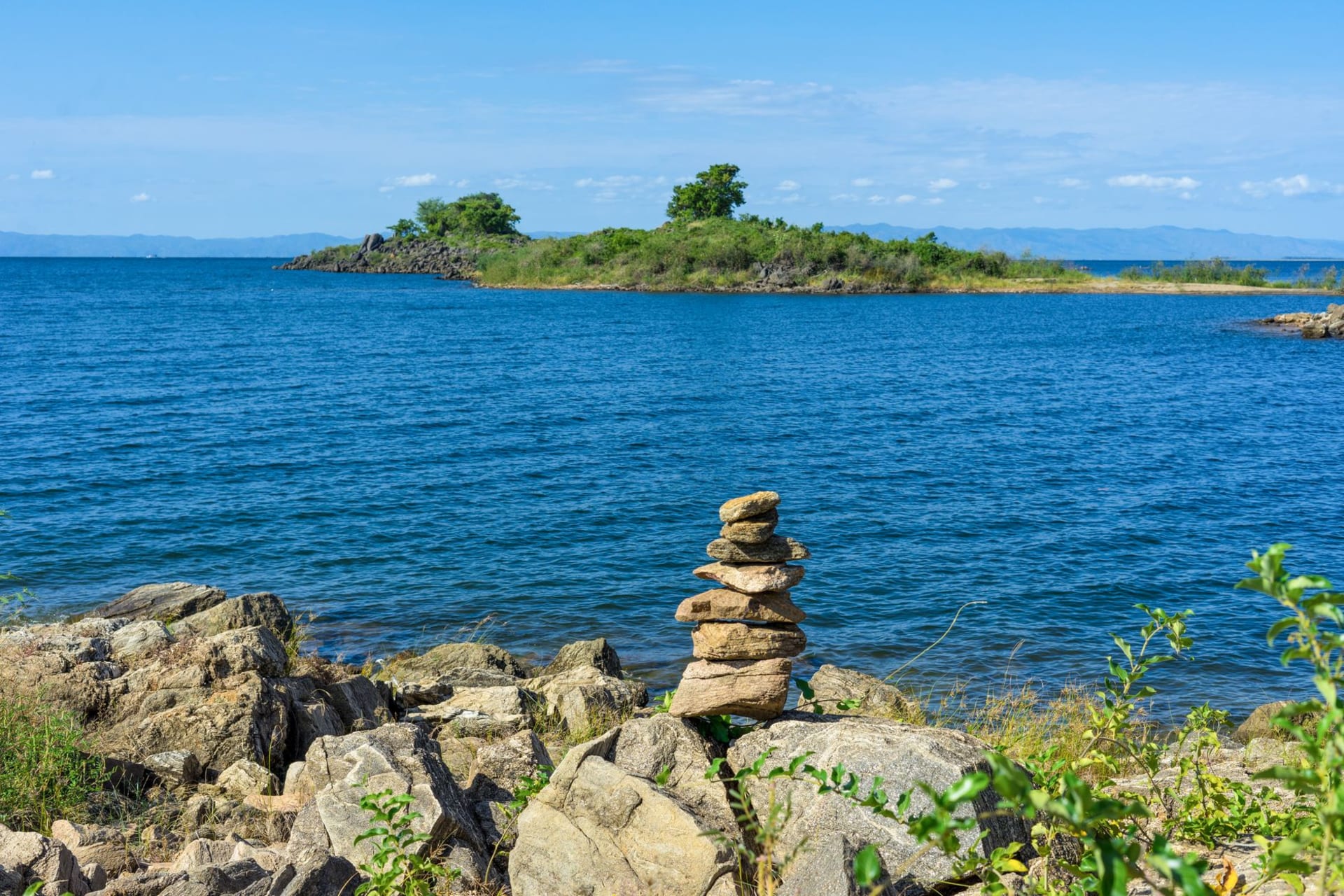
Lake Kariba
"The lake has its own weather, its own moods — some days silk-flat, some days white-capped and furious with no warning between."
Lake Kariba was created in 1958 when the Karambezi Gorge was dammed and the Zambezi Valley slowly filled. The flooding displaced 57,000 Tonga people, drowned their ancestors’ graves, and produced a reservoir 280 kilometers long — the world’s largest artificial lake by volume. The drowned trees never fully decomposed. Sixty years on, skeletal acacias still stand in the shallows, grey and stripped and somehow beautiful, cormorants nesting in the dead branches above the waterline.
This is not comfortable history. But the lake exists, and it has become something strange and its own — a vast inland sea at the edge of two countries, with wildlife on the shores and tigerfish in the depths.
Life on the Water
The Zambian side of Kariba is considerably wilder and less visited than the Zimbabwean side, which has a proper town and more infrastructure. Siavonga is the main Zambian settlement — small, functional, not set up to charm you. The appeal here is the water itself, and the standard way to experience it is a houseboat.
A houseboat on Kariba is its own category of travel. You anchor in a bay at dusk, watch elephants come down to drink from the upper deck, eat whatever the cook has put together from the cool box, sleep to the sound of the lake against the hull. In the morning the water is often glassy enough to reflect the treeline exactly, and the fishermen in wooden dugouts are already out, silhouettes in the mist. It’s slow in a way I hadn’t expected to need.
The Dead Trees at Sunrise
There is a specific light on Kariba at around six in the morning — the sun not yet above the hills, the sky going from grey to pink to a particular luminous blue — that makes the dead trees in the shallows look like something from a painting that would be criticized for being too theatrical. I sat with coffee on the top deck of the houseboat and watched it happen three mornings in a row and it was different each time.
The wildlife along the Zambian shore includes large elephant herds that come down to bathe and drink, buffalo in the riverine thickets, and an astonishing number of hippos in the shallower bays. The bird life is exceptional — African fish eagles call from the dead trees, and the lake’s islands attract waterbirds in numbers that make a pair of binoculars mandatory.
Fishing the Lake
Tigerfish are the main draw for sport fishers. The lake’s open water trolling produces large specimens and the Zambian side is less pressured than the Zimbabwean. I’m not a fisher in any serious sense, but I spent a morning with a rod and understood the appeal: the lake is enormous and you feel very small on it, and the tigerfish, when it strikes, is genuinely shocking in its speed.
The kapenta fishing boats go out at night with lights to attract the small sardine-like fish that feed Zambia’s protein economy. Watching them from the houseboat, scattered across the dark water — dozens of lights, each one marking a boat, the whole scene looking from a distance like a city that only appears after dark.
When to go: May to October for dry season, calmer weather, and best wildlife viewing on shore. July and August are most comfortable. The rainy season brings rough water and reduced visibility but the lake is navigable year-round for experienced operators.