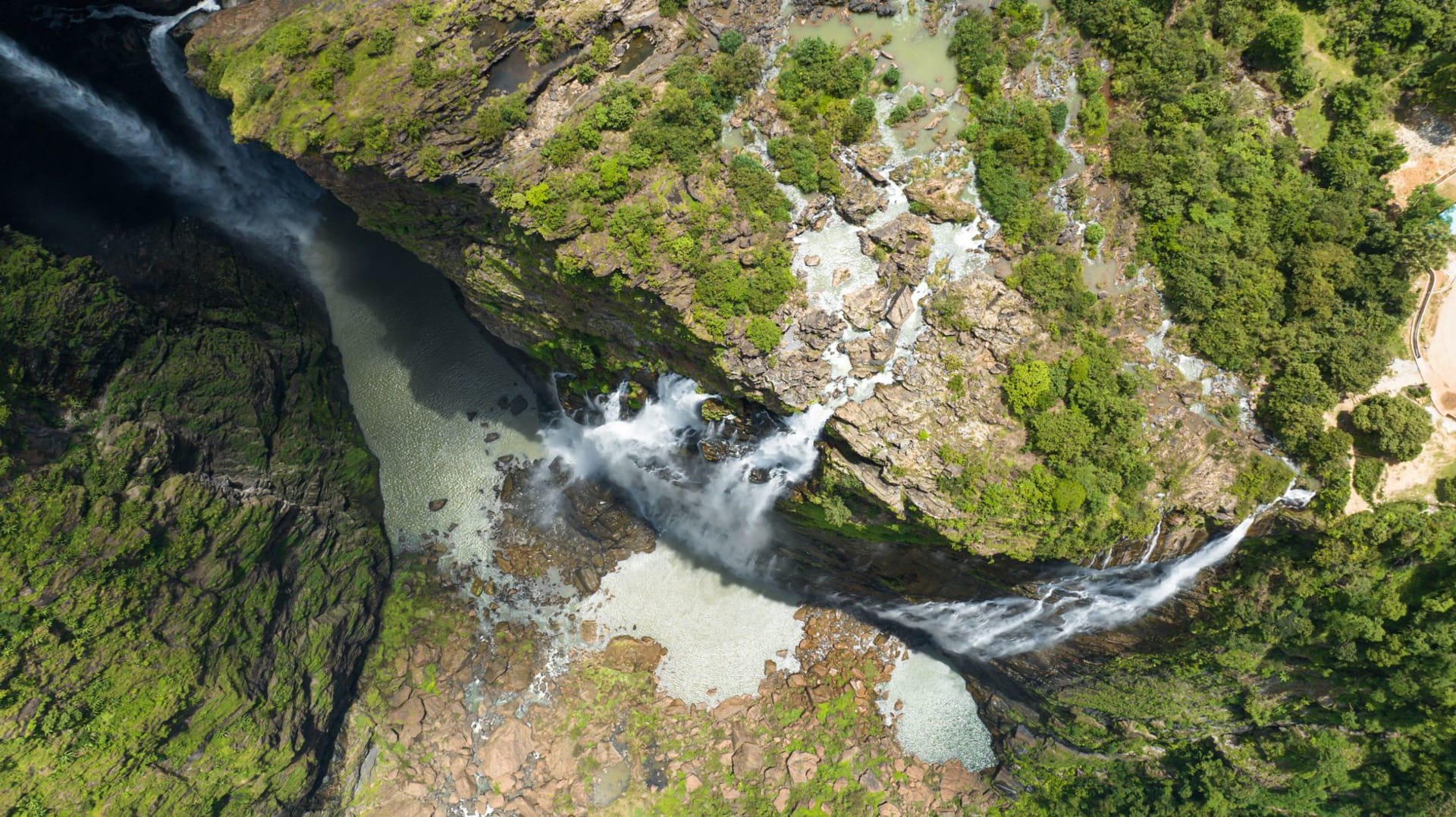
Kalambo Falls
"It falls nearly twice the height of Victoria Falls and almost nobody comes, which tells you everything about how Zambia hides its best things."
The Long Way North
Kalambo Falls is in Zambia’s far northeast, near the southern tip of Lake Tanganyika, which is to say it is a long way from anything most people fly in for. We came up from the south over days, and the roads degraded in the gradual, dignified way Zambian roads do — tarmac to gravel to a red-dust track that the rains had carved into something between a road and a riverbed. By the time we reached Mbala, the last town of any size, I had developed strong opinions about suspension that I had never previously held.
The falls themselves sit on the Kalambo River right on the border with Tanzania, and the drop is the headline: a single uninterrupted plunge of around 235 metres, more than double Victoria Falls. But Kalambo is not Victoria. There is no spray you can see from miles off, no town of curio shops, no helicopter circuit. The river is modest most of the year, so what you get is a thin silver ribbon falling off the edge of the world into a gorge so deep the bottom holds its own weather.
You walk to the lip across rough ground, and there are no railings to speak of, which in this part of the world is treated as your own problem to solve. I lay on my stomach to look over the edge. Lia, sensibly, did not, and told me from a safe distance exactly what she thought of my decision-making.

Where the Gorge Tells Time
What makes Kalambo extraordinary is not just the height but what archaeologists found at its lip. Excavations beside the falls uncovered a sequence of human occupation stretching back hundreds of thousands of years — and, crucially, waterlogged ground that preserved worked wood. In 2023 researchers reported a notched, joined wooden structure here dated to roughly half a million years ago, older than our own species, which upended the assumption that early humans only ever made temporary camps.
Standing on ground where someone shaped timber to fit half a million years before me did something to my sense of scale that the waterfall, for all its drama, did not. The falls are about the present moment — water leaving the cliff right now. The site is about almost unimaginable depth of time. Having both in one place, with nobody else around, is the kind of thing I travel for and rarely find.
The Lake at the End of It
Most people who make this journey are really heading for Lake Tanganyika, and you should too while you’re up here. Mpulungu, Zambia’s only international port, sits on the lakeshore — a hot, busy, fish-scented town where the ferry to Tanzania and Burundi still runs. The lake is the second-deepest in the world and so clear that the cichlid fish, found nowhere else, hang in the water like a tropical aquarium that happens to be vast.
We spent two nights at a small lodge on a rocky point, swimming in water that was bath-warm at the surface, eating grilled lake fish at a table where the only light came from the lodge and the stars. After the rattling roads and the vertiginous gorge, the lake felt like the reward at the end of an argument. Lia forgave me for the cliff edge. Mostly.
When to go: May to August, the dry season, for passable roads and comfortable heat. The falls run thinner in the dry but the gorge is still staggering; visit just after the rains, around April, if you want maximum water and are willing to fight the mud for it.