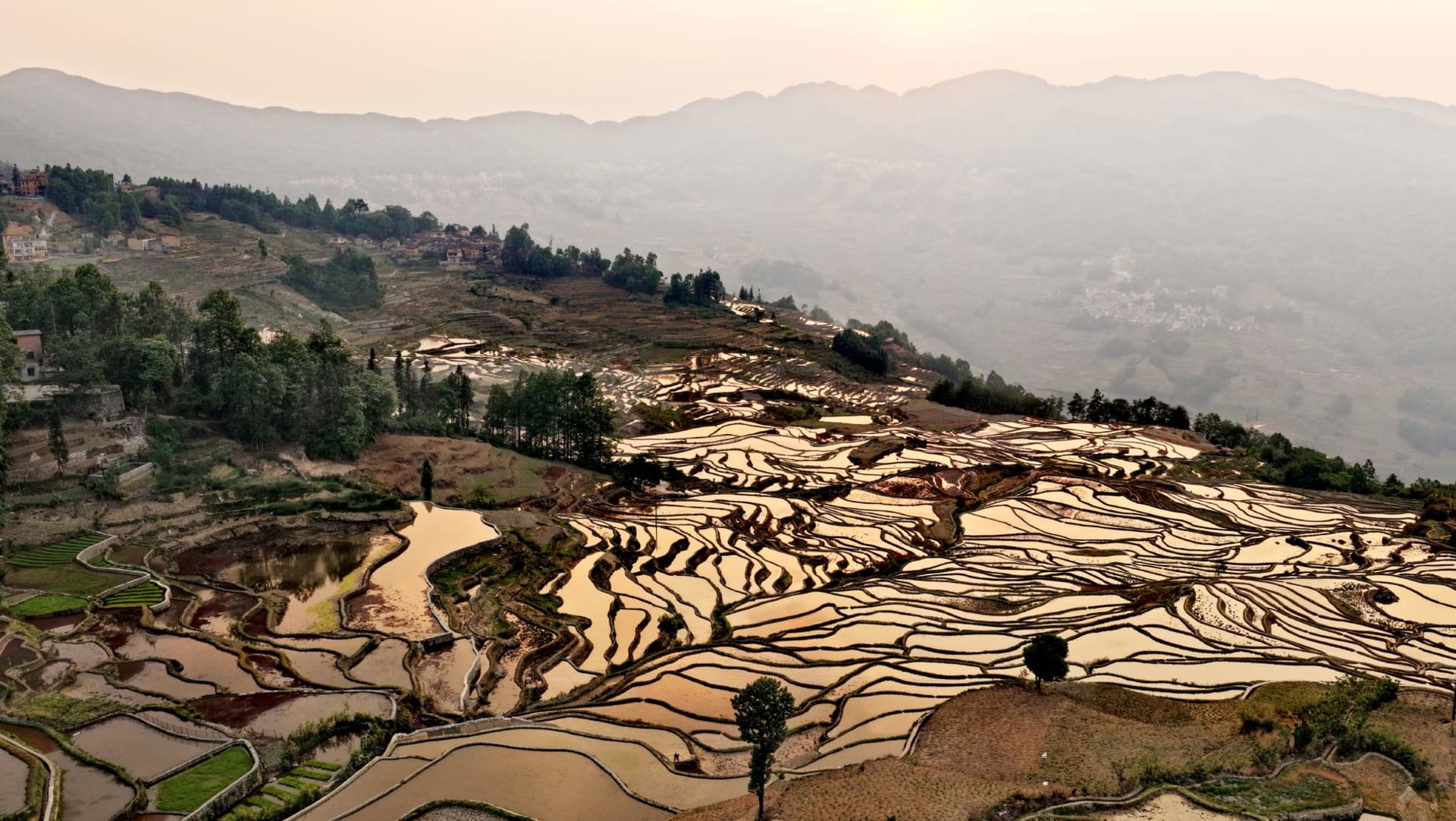
Yuanyang Rice Terraces
"I'd seen the photographs so many times they'd stopped meaning anything. Then I stood at the Duoyishu viewpoint at six in the morning and the mist was still in the valleys and the terraces were full of sky, and the photographs suddenly seemed very inadequate."
The scale of what the Hani built
The Hani people began terracing these slopes around 1,300 years ago, and the system now covers roughly 16,000 hectares across steep hills that drop from 2,000 meters to the Red River below. UNESCO listed it in 2013, though the Hani had been farming it successfully for centuries without international validation.
What strikes me first is not the beauty — which arrives a few seconds later — but the engineering logic. The terraces follow the contours of the mountains with a precision that looks almost algorithmic, each paddy holding water from the forest springs above, each one feeding the next via a gravity-fed channel system that the villagers maintain collectively every year. The water doesn’t pump or filter. It follows gravity from forest to field to river, and the rice follows the water.
The winter and early spring flooding season — January to April — is when the terraces fill and catch the sky. This is the famous photography period. The paddies become mirrors: flat pools that hold the sunrise colors for an hour before the light shifts and they return to being fields.
The viewpoints and the before-dawn calculation
There are three main viewpoints — Duoyishu, Bada, and Laohuzui — and each catches a different angle of the terraces. Duoyishu faces east and is the one for sunrise; Laohuzui catches late afternoon. I went to Duoyishu at 5:30 AM, in the dark, and found a crowd already assembled with tripods and thermoses. This is unavoidable and worth accepting.
The sunrise itself justified the assembly. The terraces filled with pink, then orange, then a brief electric gold as the sun cleared the ridge. The mist that had been sitting in the valleys thinned and moved and the whole landscape shifted its depth every few minutes. I took approximately one hundred photographs. I will use maybe three.
The Hani villages
The terraces are inhabited and maintained, which means there are villages throughout the zone, and the villages are more interesting than the viewpoints. Quanfuzhuang and Shengcun are accessible on foot from Duoyishu and have the characteristic Hani architecture: mushroom-shaped thatched rooftops on two-story houses, the roof curved outward to deflect rainfall.
Inside the villages, the work rhythms are agricultural and specific. In February I watched women spreading harvested rapeseed on mats to dry — the terraces rotate crops in the off-season — while older men repaired the stone walls that separate the paddies. A village elder explained, through patient translation by a younger cousin, that maintaining the terraces is a communal obligation: every household is responsible for a section of the shared water channels, and neglect cascades downstream.
Food in the valley
The Hani eat rice in every configuration and at every meal, which I found not monotonous but clarifying. The village guesthouses — small family operations, not hotels — serve meals that are cooked in the morning and left warming: braised pork with dried chili and mountain vegetables, river fish fried hard and crispy, fermented black beans that smell aggressive and taste essential. I ate everything.
The local rice wine comes in an unlabeled bottle and has no apparent percentage printed on it. This is information.
When to go: Mid-January through early April for flooded terraces and sunrise reflections — this is the peak photography season and the most visually dramatic period. June through September sees the terraces green with growing rice, equally beautiful and less crowded. Avoid Chinese national holidays regardless of season.