Most visitors to the Yucatan make it to Chichén Itzá and not to Uxmal. The reasons are logistical — Chichén Itzá sits on the main highway between Mérida and Cancún, while Uxmal requires a deliberate 80-kilometer drive south of Mérida into the Puuc hills — and the reasons are a mistake. Uxmal is, by almost any architectural measure, the more refined site: its stonework is among the most sophisticated in all of pre-Columbian architecture, its layout is dramatically legible, and on a weekday morning you can have entire plazas nearly to yourself.
The Pyramid of the Magician
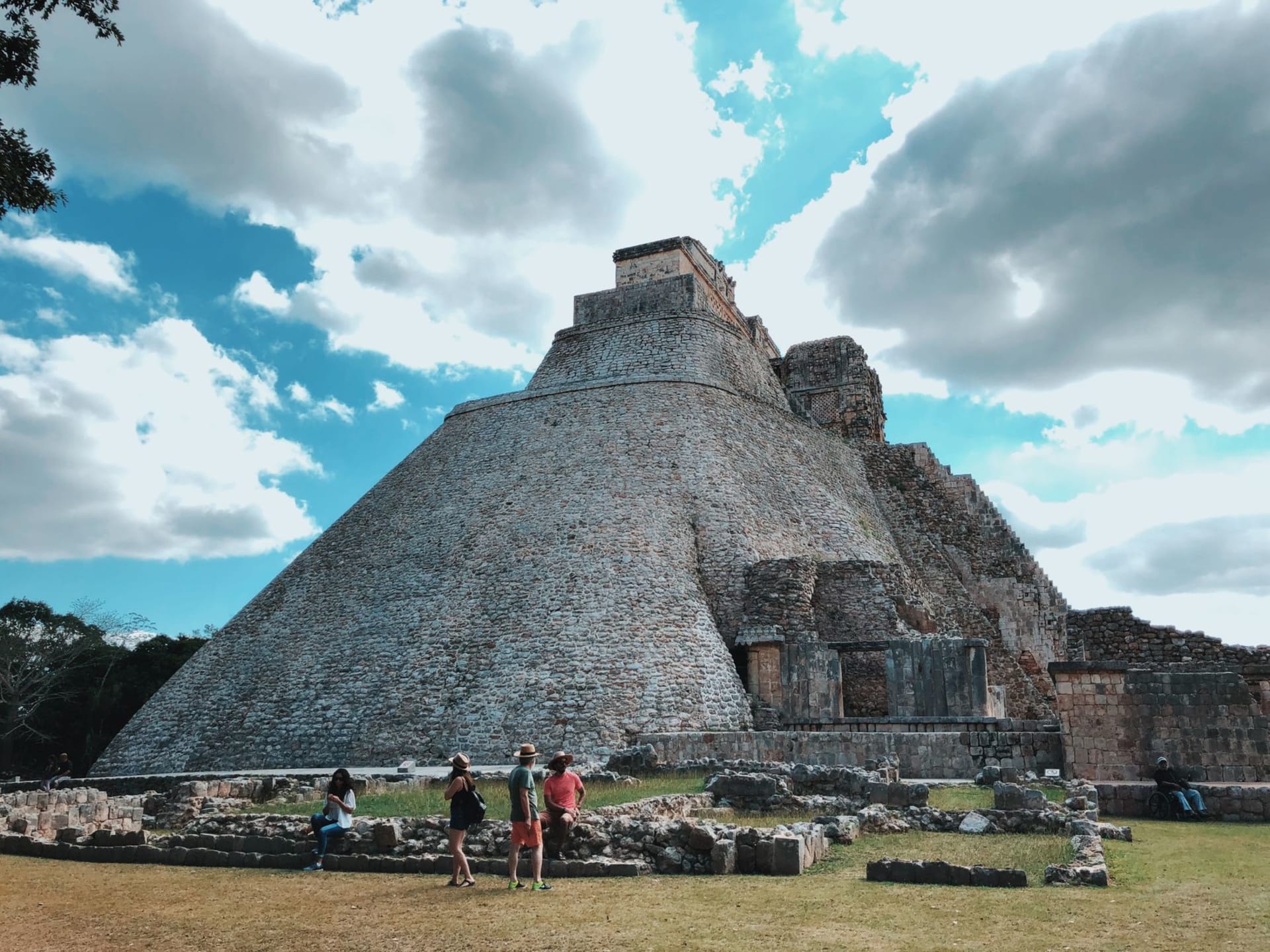
The first thing you see entering the site is the Pyramid of the Magician, and it is immediately strange. Unlike the squared, stepped pyramids at most Maya sites, this one has an elliptical base — rounded ends and sides that curve — which gives it an organic, almost muscular silhouette against the sky. It rises 35 meters in five construction phases built over four centuries, each new pyramid encasing the previous one.
I walked around the base of it for twenty minutes before I went anywhere else, trying to understand the geometry from different angles. The stone facing is still sharp enough that you can see the individual blocks and how they were fitted. No mortar — pure precision of cut and placement.
The Nun’s Quadrangle
Behind the Pyramid of the Magician, a corbeled archway leads to the Nun’s Quadrangle: four elongated buildings arranged around a perfect rectangular courtyard. The facades of the upper registers are covered in stone mosaic panels — geometric latticework, serpent motifs, stacked masks of Chaac the rain god — that run continuously for hundreds of meters. Uxmal had no cenotes and depended entirely on captured rainwater, which makes the obsessive presence of Chaac on every available surface make sudden sense. These buildings are prayers in stone, addressed to the source of survival.
The detail in the mosaic work is the kind of thing that makes you slow down involuntarily. I kept stopping to look at sections — a serpent’s body that travels the length of a building, a doorway flanked by stacked deity masks each slightly different from the others — and losing track of time.
The Governor’s Palace
The Governor’s Palace is what many archaeologists consider the finest single building in pre-Columbian Mesoamerica, and spending an hour in front of it gives you a sense of why that claim is taken seriously. It’s a long, low structure on a raised platform, with a 100-meter facade covered in intricate mosaic work — approximately 20,000 individually carved stones — and a perfectly centered doorway aligned to the rise of Venus on the horizon.
The Venus alignment was not accidental. The Maya tracked the planet’s cycle with precision that humbles most subsequent astronomers. The Governor’s Palace is positioned so that on the specific day when Venus rises at its southernmost point, you can see it from the central doorway directly over a stela in the plaza below. I looked it up before visiting and then stood at the door and tried to inhabit the scale of thinking required to plan that.
Sound and Light
The site offers a sound and light show on most evenings, and while it is absolutely a tourist production with dramatic narration and colored lights illuminating the Pyramid of the Magician, it is also genuinely affecting. The Pyramid at night, lit in amber and blue, with the jungle dark on all sides and bats cutting the air above the plaza, is its own experience.
When to go: November through February for the most bearable temperatures and low humidity. The site opens at 8 a.m. and is at its quietest on weekday mornings before tour groups from Mérida arrive around 10. The sound and light show runs year-round; check current schedules at the site entrance.