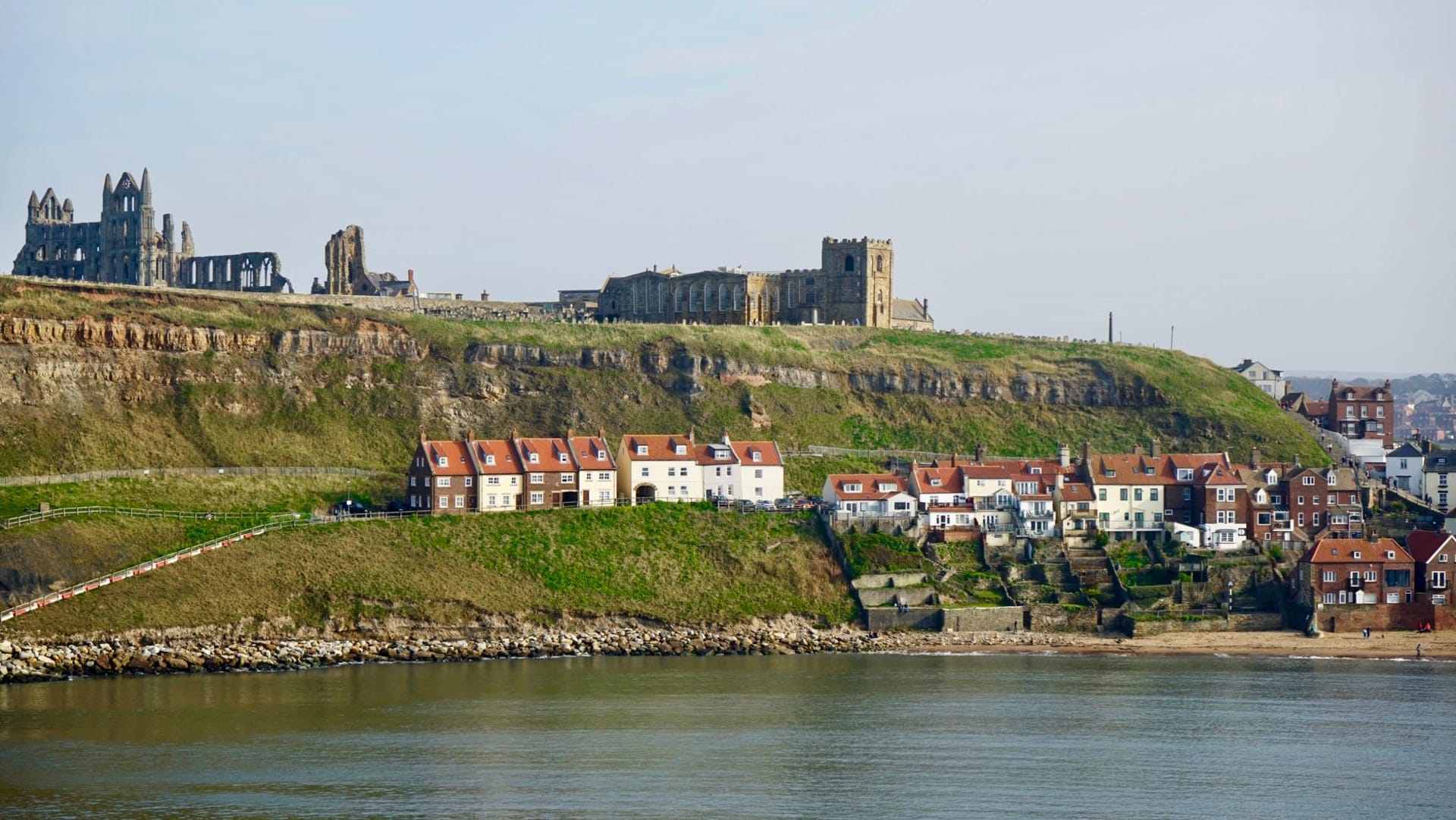
Robin Hood's Bay
"The village is so steep that standing at the top, you're looking at the rooftops of the houses at the bottom."
Robin Hood’s Bay has no known connection to Robin Hood. The name appears in records from the sixteenth century and nobody has adequately explained it. What the village does have is a connection to smuggling that is considerably better documented — the labyrinth of passages, hidden cellars, and interconnected houses that allowed contraband to travel from the beach to the top of the cliff without ever appearing on the street. Some of the original passages are still there, incorporated into private homes. The pub at the bottom of the hill will tell you about them.
I came down the hill on foot from the clifftop car park, which is the right approach because the wrong approach involves attempting to drive down a lane that narrows to approximately car-width and then wondering how to get back up. From above, the first view of the village from the path is the one that stops you: a cascade of red pantile roofs and whitewashed walls tumbling down the cliff, the North Sea directly below, the whole thing looking engineered by someone working from a picture rather than a practical brief.
The Village Architecture
Robin Hood’s Bay is technically a village but functions more like a vertical maze. The main road — Bank Top to Bay — drops approximately 120 meters over perhaps 400 horizontal meters, and the lanes that branch off it are narrower still, some of them essentially slots between houses. The buildings lean on each other, share walls, build over each other at the upper floors. Several have been lost to the sea entirely, which is not a metaphor — the cliff below the village has eroded significantly over the centuries and houses have simply fallen in.
What remains has been preserved by the difficulty of getting construction vehicles into it. The result is a village that looks more or less as it did in the nineteenth century, minus the fish curing and plus the ice cream.
The Beach and Rock Pools
At low tide the beach at the base of the village extends a considerable distance across exposed rock platforms — the same limestone that makes up the Jurassic Coast here — and the rock pools are extraordinary. I spent an afternoon at a pool that contained sea anemones, hermit crabs, a small shore crab that moved with considerable attitude, and what I believe was a blenny wedged under a rock regarding me with justified suspicion.
The fossils here are Jurassic — ammonites, belemnites, bivalves — and the shale exposures on the beach produce them in enough quantity that dedicated collectors arrive with hammers and buckets. The casual visitor can find usable specimens just by walking along the water’s edge with eyes open. Lia found an ammonite about the size of her palm in the first twenty minutes, which established an unfair baseline expectation for the rest of the afternoon.
Walking the Coast
Robin Hood’s Bay sits on the Cleveland Way long-distance path and is the official eastern terminus of Alfred Wainwright’s Coast to Coast walk, which crosses England from St. Bees in Cumbria over 192 miles of increasingly dramatic landscape. Walkers completing the route arrive at the slipway and throw pebbles into the North Sea. I’ve watched several groups arrive this way — they tend to look dazed and satisfied in equal measure and are usually in need of beer.
The coastal walk north to Whitby takes about two hours on the clifftop path. It’s one of the best cliff walks in Yorkshire, with views north and south along the coast, old alum workings cut into the cliff face at intervals, and the ruins of Whitby Abbey visible in the distance for most of the second half.
When to go: Low tide at any time of year for the rock pools — check local tide tables before going, because the beach disappears at high water. May through September for the coastal walk in reasonable weather. The village itself is busiest on summer weekends when the car park fills and day-trippers pour down the hill; weekday visits between October and April are considerably more atmospheric.