
Knaresborough
"I've never seen a town so theatrically pleased with its own geography, and I mean that as a compliment."
A Town Built for the View
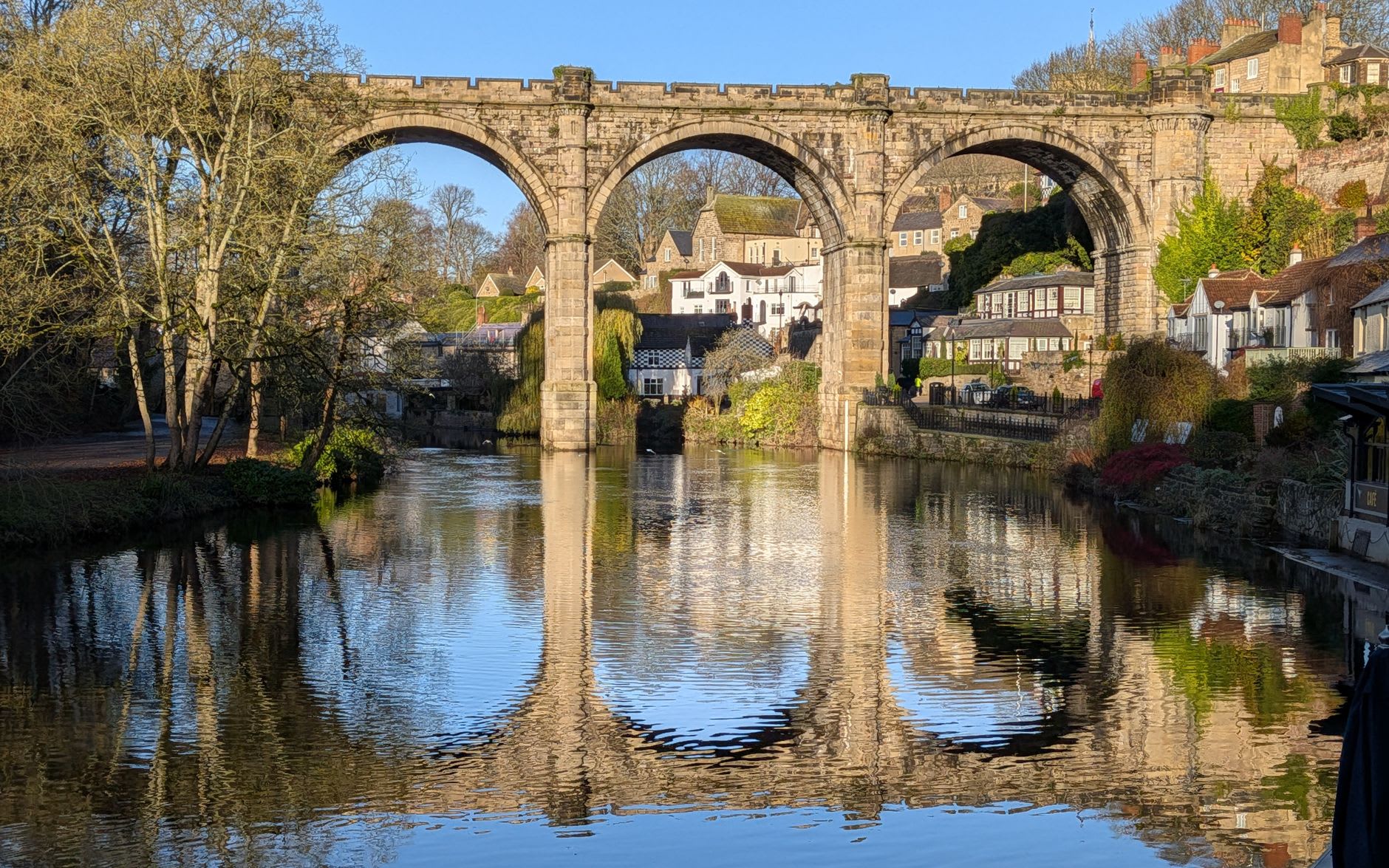
Knaresborough does not ease you in. You come over the hill or out of the station and suddenly the ground falls away into a wooded gorge, the River Nidd curving green below, the railway viaduct striding across it on tall arches, and the whole town stacked up the far cliff in tiers of stone and slate. It is one of the most photographed views in Yorkshire and for once the photographs undersell it, because no photograph carries the sound of the river or the way the light comes up off the water onto the undersides of the trees.
The viaduct is the thing that shouldn’t work and does. Built in 1851 — after the first attempt collapsed into the river, which is the sort of detail Knaresborough tells you proudly — it carries the railway across the gorge on four arches, and Victorian sensibilities being what they were, they built it in a mock-medieval Gothic style so it would harmonise with the castle ruins. It’s a piece of engineering pretending to be a piece of scenery, and against all my instincts about pastiche, it’s wonderful.
We hired a rowing boat below it, because that is the correct thing to do, and I rowed us upstream with the competence of a man who has rowed maybe twice in his life. Lia took the rudder and the role of critic. A swan came to inspect us and found us wanting. The whole thing was absurd and I’d do it again tomorrow.
The Castle and the Long Memory
On the clifftop sit the ruins of Knaresborough Castle, a royal stronghold that did real medieval work — it sheltered the knights who murdered Thomas Becket, it was a favourite of King John, and it was systematically wrecked after the Civil War on Parliament’s orders, which is why what survives is a single dramatic tower and a great deal of grassy rampart with one of the best views in the county.
What I liked was how little fuss the place makes of itself. You can walk the grounds for free, sit on the grass where local families are eating sandwiches, and look down on the viaduct and the river while a guide leads small groups into the underground sallyport — a sloping tunnel cut through the rock that let defenders slip out unseen. It’s the kind of history that hasn’t been polished into a theme park. It’s just there, in a town that uses its castle lawn as a park.
The Cave That Turns Things to Stone
The strangest attraction is Mother Shipton’s Cave, across the river — England’s oldest visitor attraction, charging admission since 1630. The draw is the Petrifying Well, where water rich in minerals pours over a rock face and coats anything left beneath it in stone. People hang teddy bears, hats, and gloves under the dripping water and come back months later to collect their petrified souvenirs.
It’s gloriously eccentric, and the mineral-stiffened objects hanging there — a kettle, a boot, a forest of small toys slowly turning grey — are genuinely unsettling. Mother Shipton herself was a sixteenth-century prophetess, half-real and half-legend, said to have been born in the cave. Lia bought a postcard of her and propped it on the boat’s seat for the row back, which felt like the right way to leave.
When to go: Late spring and summer for boating on the Nidd and the riverside open. The August bed race — a chaotic charity event involving teams pushing decorated beds through the river — is pure Yorkshire, and worth timing a visit around if you like your traditions deranged.