Esperance
"The kangaroo on the beach wasn't posing. It simply lives there and has clearly decided this is the correct decision."
There’s a photograph that circulates every so often online — kangaroo on a beach, turquoise water, white sand — and people assume it’s been edited or at least selected for unusualness. I thought this until I arrived at Lucky Bay in Cape Le Grand National Park and found three kangaroos on the sand before nine in the morning, and the water behind them was that color, and I stood there recalibrating my understanding of what exists.
Esperance is two hours east of Kalgoorlie and seven hours from Perth on the South Coast Highway, which follows the edge of agricultural country through stands of mallee scrub and past wheat towns whose names don’t appear on most maps. It’s a significant drive. The moment you reach the coast and see the Recherche Archipelago — more than a hundred granite islands scattered across an impossibly blue sea — you understand why people make it.
Lucky Bay and the Cape Le Grand Coast
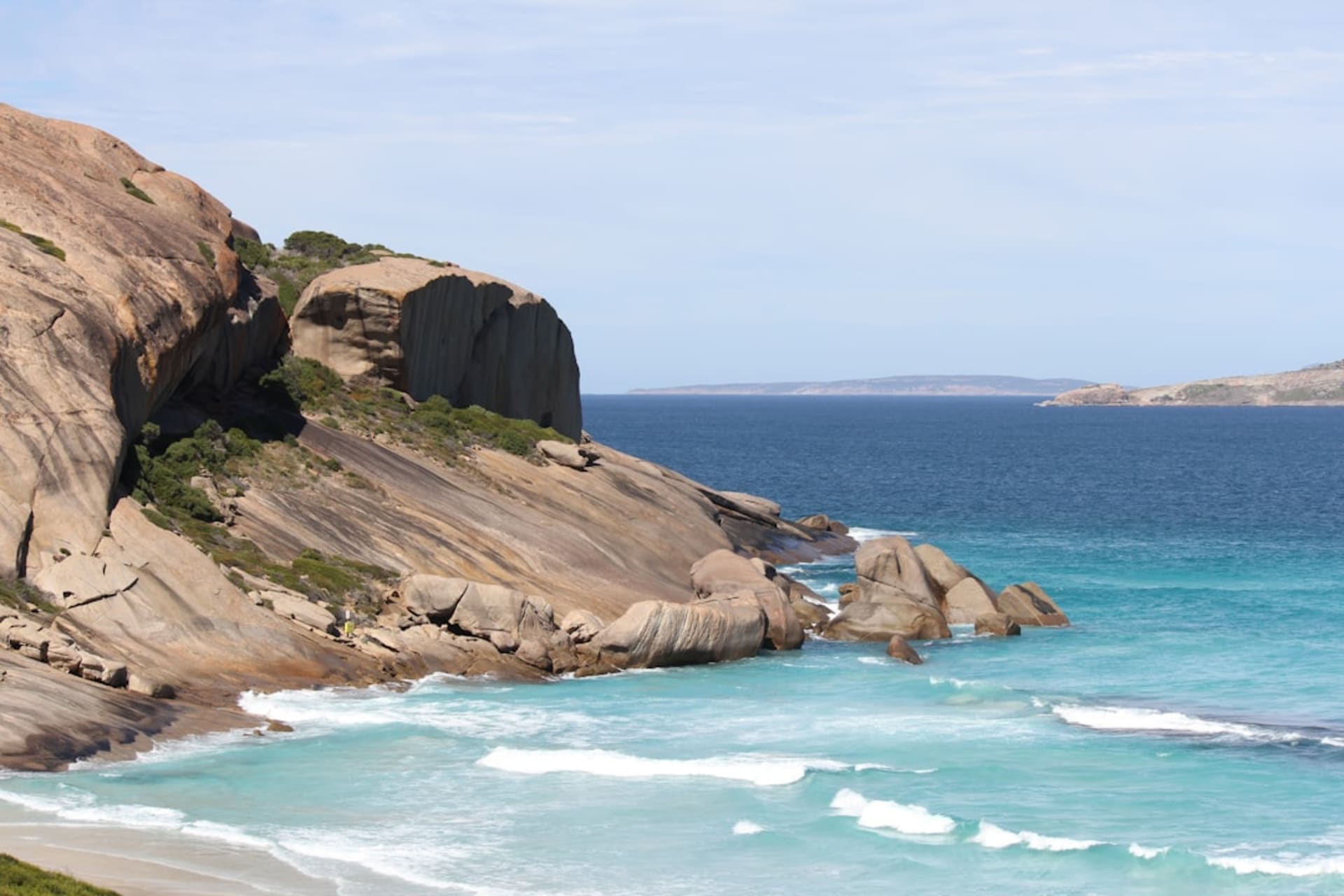
Cape Le Grand National Park runs east from Esperance along a coastline that collects best-beach nominations the way other places collect postcards. Lucky Bay is the famous one: pure quartz sand so white it squeaks underfoot, water shifting from pale green nearshore to deep blue in the channel, granite boulders rounding out of the sand at the eastern end like the backs of sleeping animals. The kangaroos are eastern greys, not particularly unusual for Western Australia, but they’ve established a residency at Lucky Bay that is now so settled the park rangers simply include them in the beach briefing.
Hellfire Bay, a kilometer to the west, is smaller and receives fewer visitors. The snorkeling off the granite ledges is better than Lucky Bay’s. Rossiter Bay further east requires a slightly longer walk and offers significant solitude even in the middle of summer.
I paddled a kayak out from Lucky Bay into the Recherche Archipelago for three hours, moving between islands where sea lions hauled out on granite shelves and New Zealand fur seals moved like oil through the water beside the hull. The granite of the islands is a warm orange-pink up close, completely different from the bleached white it looks from shore. Nothing about Esperance is what you expect until you’re in the middle of it.
The Town and Its Waterfront
Esperance town is small and unpretentious and functions as a service center for agricultural operations across the Goldfields-Esperance region. The waterfront has been developed enough to have coffee and fish and chips, not so developed that it’s lost the fishing-town quality that makes it feel honest. Pink Lake — once a brilliant magenta from the halophilic algae that lived there — has been less reliably pink since the water management changed in the 2000s, a minor ecological disappointment that the town acknowledges with some rueful humor.
The museum on Dempster Street has an entire room devoted to fragments of the American space station Skylab, which fell over Esperance in 1979 and scattered debris across the region. The local council issued NASA a littering fine of $400. NASA did not pay it. In 2009, a radio presenter in San Francisco raised the money from listeners and the fine was finally settled. This is the best administrative story in Australian history.
Wildflowers and Interior
The coastal heath behind Esperance produces spectacular wildflower displays between August and October — native orchids, banksias, hakeas, and a density of species per hectare that reflects the Kwongan heath system’s extraordinary plant diversity. The Fitzgerald River National Park, two hours west, protects some of the most biodiverse coastal heath in the world. I walked a trail through the heath in September with the morning light coming low through the shrubs and the smell of flowering hakea in the air, and it was the kind of landscape that takes a few minutes to reveal its scale of beauty because it’s quiet and low and doesn’t ask for attention.
When to go: November through April for beach weather and swimming (water temperature peaks at around 23°C in February). August through October for wildflowers. Avoid July if you’re heat-sensitive; Esperance winters are mild by Australian standards (18–20°C days) but the Southern Ocean makes it feel cooler. Lucky Bay can be crowded on summer weekends — weekday visits or early mornings are dramatically better.