Albany
"The ocean here has been coming from Antarctica for approximately forever. You can feel it in the sound."
Albany sits at the point where Princess Royal Harbour meets King George Sound, a deep-water harbour that Captain Vancouver charted in 1791 and that has been a strategic asset, a whaling port, and a departure point for soldiers ever since. The town feels more English than almost anywhere else in Western Australia — Victorian-era brick buildings on a hillside, a main street with trees and a certain colonial self-regard — and also completely specific to its geography, which is Southern Ocean and granite and wind.
The Coastline at Torndirrup
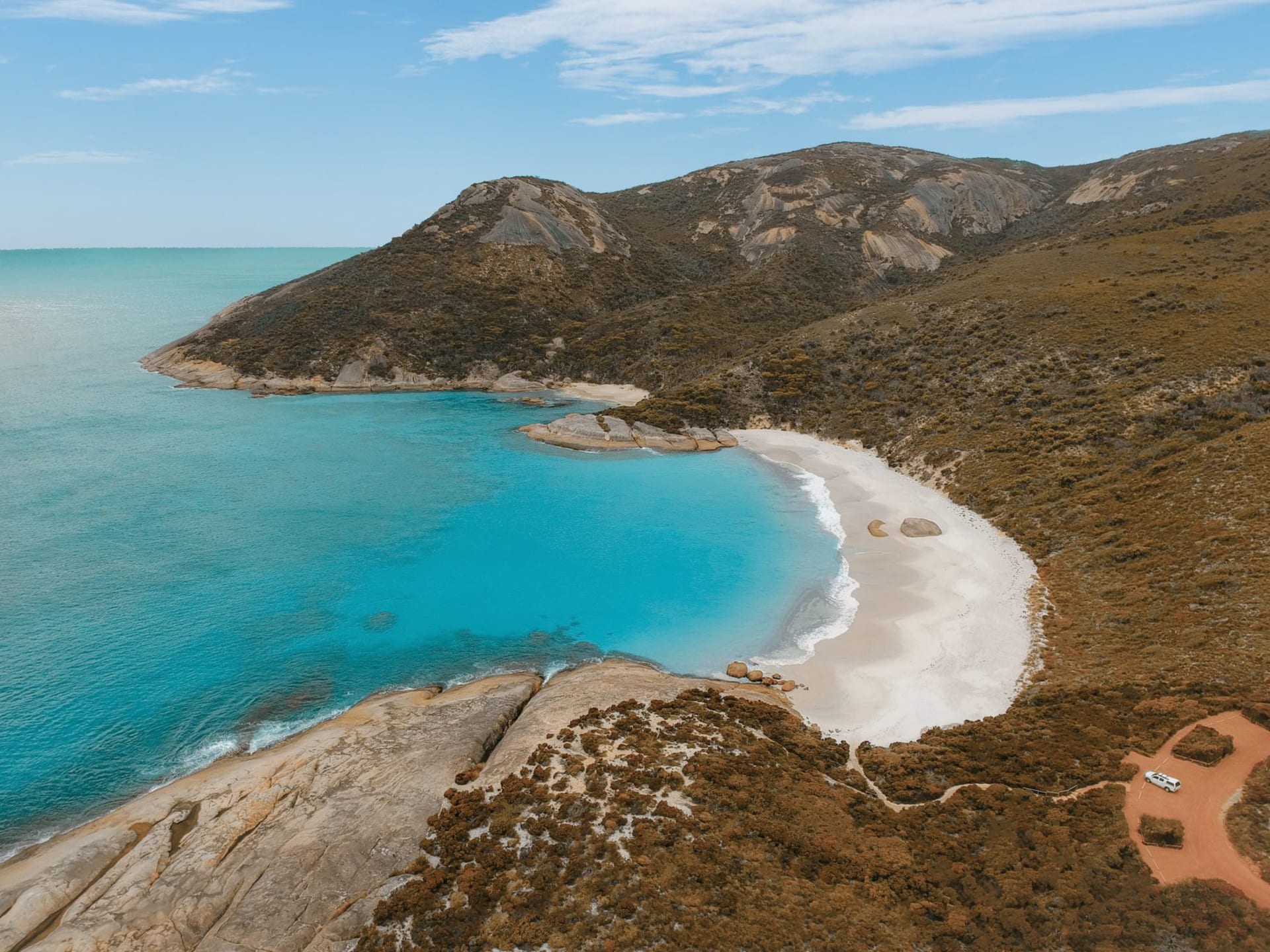
Drive fifteen minutes south of Albany along Frenchman Bay Road and you arrive at Torndirrup National Park, where the Southern Ocean has been at work on the granite coast for long enough to produce things that architects would struggle to invent. The Natural Bridge is a granite arch above churning water, the rock polished by millennia of wave action to a pale grey smoothness that catches the light differently in morning and afternoon. The Blowholes are exactly what they sound like: gaps in the rock shelf where ocean swell compresses and erupts in columns of spray. The Gap is a sheer slot in the cliff face down which the ocean runs and recedes with a grinding sound like something mechanical.
I stood at the Gap railings in a moderate swell and watched waves arrive from the south, knowing intellectually that the next piece of land in that direction was Antarctica. The sound was less like waves than like something geological — a shifting of plates, a breathing of deep structures. I’ve stood on dramatic coastlines in Ireland, in South Africa, in Patagonia. This one has its own register.
A Town That Kept Its History
The Whale World museum at Cheynes Beach, twenty minutes from town, is housed around the last whale chaser built in Australia — the Cheynes IV, dry-docked now on the site of the last operating whaling station in the country, which closed in 1978. The guided tour covers the process in detail that is neither sanitized nor gratuitous: the economics of industrial whaling, the species hunted, the men who worked the platform with flensing knives at first light. The smell of whale oil still lives in the building’s walls, a rancid-sweet smell that the ventilation hasn’t fully cleared in forty years. It’s a harder museum than most, and a more necessary one.
The town itself rewards walking. The historic precinct near York Street has a small number of genuinely old buildings — the old gaol, the post office, the hospital — and the views from Mount Clarence over the harbor are the kind that make estate agents work overtime.
Food from the Great Southern
The Great Southern wine region surrounds Albany and produces cool-climate varietals that have improved dramatically over the past two decades. Riesling and Chardonnay from the Porongurup and Mount Barker subregions show the influence of the ocean — tight acidity, mineral length. Several cellar doors operate within thirty minutes of town.
The fish is the other thing. King George Whiting comes out of the sound and appears on every restaurant menu in a version that ranges from fine to excellent. I ate it grilled with a butter sauce of no pretension whatsoever at a waterfront restaurant overlooking the harbor, a glass of local Riesling alongside, and thought: this is what regional food is supposed to be.
The Anzac Connection
Every year on the 31st of October, Albany marks the anniversary of the departure of the first Anzac convoy — 41 ships carrying 30,000 soldiers — that set out from King George Sound in 1914. The National Anzac Centre on Mount Clarence is among the finest war memorial museums in Australia, its design threading visitors through individual soldier narratives rather than statistics. It’s the kind of place you arrive at expecting to stay an hour and leave two hours later.
When to go: October through April offers the most reliable weather, though Albany’s southerly position means it can turn cold and wild at any month. November through February is warmest and best for swimming at Middleton Beach. The whale chaser tour runs year-round. Winter (June–August) is dramatic on the coast — powerful swells, green seas, the blowholes at their most violent — and worth it for those who don’t mind a jacket.