Mu Cang Chai
"At harvest, Mu Cang Chai turns the entire hillside into a mosaic of gold that no photograph can contain."
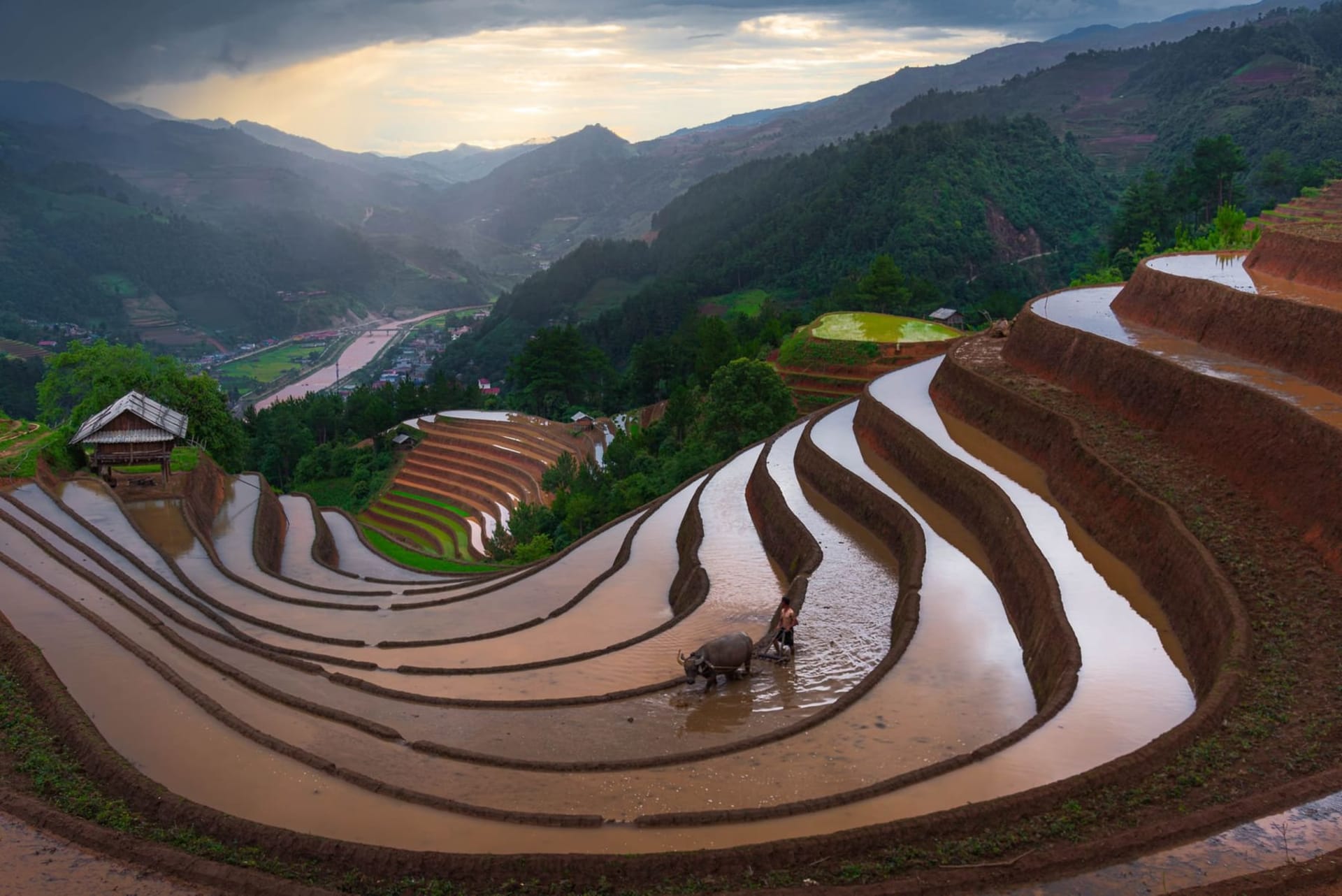
Stacked golden rice terraces carved into steep mountainsides by Hmong farmers over centuries.
I had seen the photographs, of course. Everyone has. That particular shade of amber stacked against green ridgelines, the terraces repeating like sound waves on a hillside. I thought I understood what Mu Cang Chai would look like. I was wrong in the best possible way.
The Road Up from Nghia Lo
We arrived via the pass from Nghia Lo on a morning when the clouds sat low in the valleys and the peaks above them were bare and brilliant. The road through the Yen Bai province climbs in hairpin loops past villages where women in indigo-dyed skirts walk the roadside with no particular urgency. Lia pressed her face against the window and didn’t speak for almost an hour, which is how I knew she was as stunned as I was.
The town of Mu Cang Chai itself is modest — a main road, a market, guesthouses stacked behind one another — but that is precisely the point. Nobody comes here for the town. The town is the staging ground for what surrounds it.
Mam Xoi and La Pan Tan
The viewpoint at Mam Xoi — the one everyone photographs, the one you will recognize immediately — sits about three kilometers from the town center off the road toward La Pan Tan. What no photograph prepares you for is the smell: warm rice straw drying in the sun, the faint green-mud scent of the paddies, wood smoke drifting from the Hmong settlements tucked into the folds of the hill. I stood there long enough that a farmer passed me twice on the same dike path, each time glancing at me with a mild, patient amusement.
The unexpected moment came at La Pan Tan, the second major terrace cluster, where I followed a narrow path down into the paddies themselves rather than staying at the ridge. Halfway down, the terraces closed around me on both sides and I could no longer see the horizon — only gold above and below, the sky reduced to a strip, and the sound of water moving slowly from one level to the next through bamboo pipes. It felt less like a landscape and more like a room someone had built out of patience and centuries.
What to Eat in the Evening
Back in town after dark, the market stalls along the main road sell thang co, a Hmong stew made from horse meat and offal and spices I cannot name, simmered in a clay pot until the broth turns deep brown. It is not delicate. It is exactly right after a day of walking dikes in the mountain cold. We sat on plastic stools under a tarp and ate until we were warm again, listening to the vendors speak Hmong to one another over our heads.
When to go: The harvest season runs from late September through early October, when the terraces peak at full gold. A secondary flush of interest comes in May and June when the paddies are flooded and the water reflects the sky in silver panels between the green shoots.